
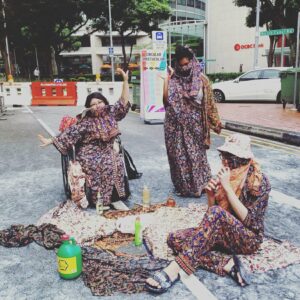
 As an artist, Nur Fariza observes, in great depth, that art imitates life. By day, she works in a hotel as a communications and reservations agent. By night, the 30-year-old relates her personal research on mythological women to her life and expresses it in her evocative performative pieces.
“Most of my art pieces are about the burdened body. Most of my research is about archaic laws: what it does to a person with disability, the kinds of treatments they got, and how barbaric it often was,” she says. As research on this is abundant in the contexts of Europe and North America, Fariza focuses on stories of women with ‘burdened bodies’ in Southeast Asian mythology.
One of her pieces, Che Siti 99, refers to the legend of an ugly, hunchbacked Malay woman who became beautiful after making an unholy pact with a penunggu, a magical creature in Malay folklore. In order to maintain this beauty, she then marries and kills 99 men. The Malaysian film Sanggul Beracun (2011) directed by Sabri Yunus, was based on this story.
“These kinds of stories motivate me to know more about why women are subjected to such perceptions, regardless of culture. If a woman is not beautiful she will not be desired. It relates back to my life. People question me, are you able to reproduce, have babies? Are you able to have a boyfriend?”
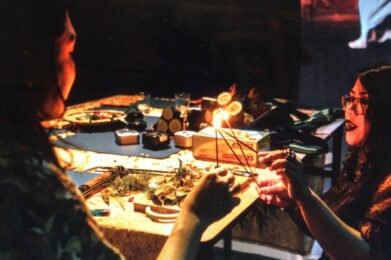
Plaintively, she recalls an interview at the current workplace, when the first thing the human resource staff asked her was if she was married. “I said, ‘No, I’m not’. Then he asked, ‘Are you allowed to?’ ‘What do you mean?’ ‘Are you able to get married?’ I was like, ‘Sorry? How is this relevant to the job that I applied for?’” When she asked him why he was interrogating her, he said that he did not know how to speak to a person with a disability. “Would you ask someone else if they were able to get married and if they were allowed to? So, why is it applicable to me?”
Part of her interest in mythology is due to the salience of traditional healing in Malay culture, especially in the realm of physical and mental disabilities. When scientific explanations for conditions are insufficient, some people choose to engage traditional or religious healers known as bomoh. The healers she encountered as a child suggested various ‘cures’ for her disability: changing her name to a more an auspicious one, drinking water with jampi [spells] and even use a ruler and cardboard to ‘straighten’ her legs.
Born with osteogenesis imperfecta (also known as OI or brittle bone syndrome), Fariza spends much time in hospitals: either recovering from broken bones or going for intravenous treatments of pamidronate, aimed to strengthen her bones.
“I grew up angry. Growing up, I always heard [others say]: ‘Kan menyusahkan’ [So troublesome], ‘Kasihan dia’ [Poor her], ‘Sudah lah, nanti siapa nak kahwin dengan dia?’ [Who will marry her later?].”
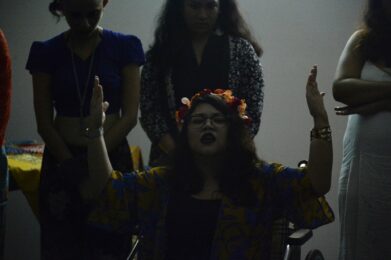
This led to depression, anxiety, addiction and other mental health issues in her teenage years. However, Fariza has always used her personal experience with OI as inspiration for her art. At the age of 11, she participated in a poetry competition for the first time with a piece in Malay about the burdened body, entitled Jeritan [Scream].
“I was talking about my struggles: growing up not having friends, being isolated. When I was young, I knew that something was wrong with my body, but I didn’t know what it was. Writing was my way of escaping.”
When she performed Che Siti 99 in 2016, she describes it as “coming full circle”. In the opening first piece, she channels the rage of several strong feminine figures: Cik Siti, Rangda [Balinese demon queen], and Kali Ma [Hindu goddess]. “I was questioning the burdened body, about myself and how society perceives us.”
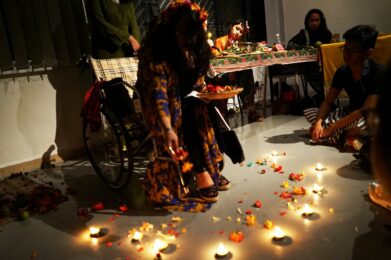 In the final closing piece, she gave thanks to these female spirits. “I used candles and flowers in a ritual thanking them, for giving me the opportunity to come to terms with myself. It’s not a jeritan for me anymore, I was calm.”
“It was a homage to the women who can be for us. To women with burdened bodies, [whom] no medical intervention or no medical breakthrough ever assisted. Just like them, I can be whoever I want.”
Be sure to share this post with others to encourage them to let their creativity and uniqueness come forth.
