- I last covered our movement’s fight for safety and accessibility in the skies a year ago — and the struggle continues.
- The issues I outlined remain the same, but our campaign is on the eve of making a breakthrough.
- The opportunity to revamp the Air Carrier Access Act is finally here, as Congress renews the authorization for the Federal Aviation Administration this autumn.
The Time Has Come for One Last Big Push
As we close in on making tougher protections and raised expectations for our community a reality, I want to address how ableism contributes to air travel remaining a serious source of danger and anxiety for us. This fight is ultimately about fundamental human rights, on and off the plane.
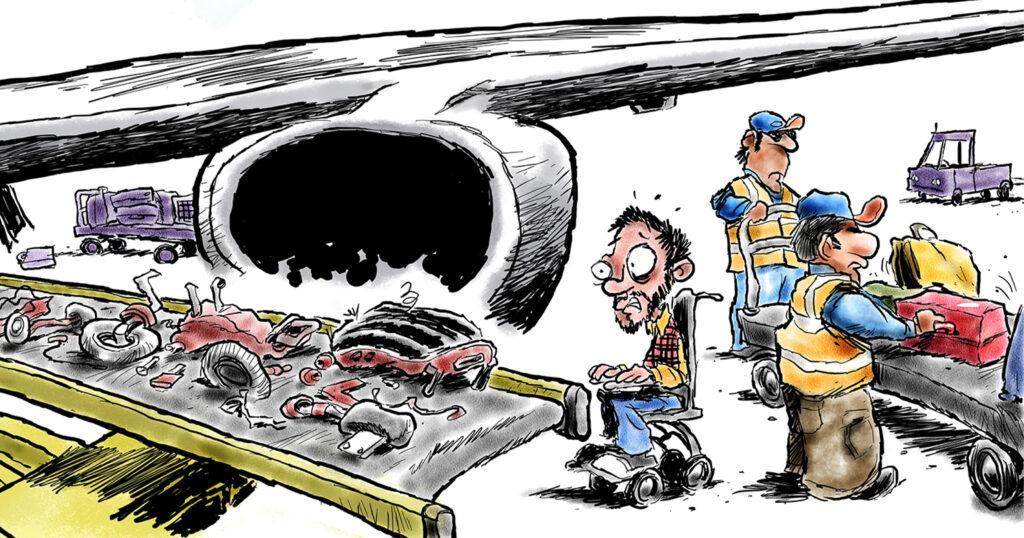
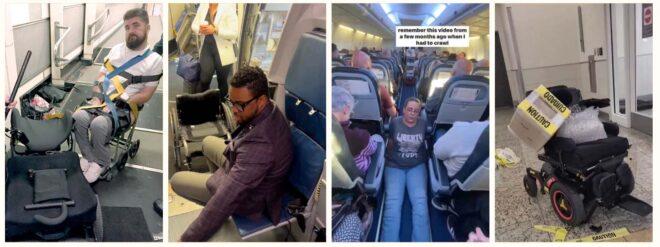
For one, it’s about our bodily integrity and dignity. Dropped on the floor like cargo or denied use of the bathroom for hours on end? That’s dehumanizing. Wheelchairs remorselessly damaged, as if they are not an important extension of our bodies? That’s disempowering.
For decades we have fought for equal-opportunity employment and the economic advancement of our community. This is still the area where we remain the most disproportionately disenfranchised. Yet one bad, humiliating flight could be all it takes to knock the fight out of us and undermine our personal successes and even our sense of self.
Nowadays, travel is a mandated part of the duties and responsibilities of many workers. Botched flights that damage our bodies and our wheelchairs also damage our ability to be on-site at a different office to conduct a training, participate in a retreat, or present at a career-making conference — where we are left with only the mere hope that our employers are compassionate and accommodating.
Imagine the effect of an injury sustained on a plane due to discriminatory negligence on the life of a parathlete flying to a national competition or a wheelchair dancer traveling to a major performance. It is another source of worry that our nondisabled counterparts do not have to contend with, giving a different meaning to “fear of flying” that is often overlooked.
Our lives and livelihoods are not part of “the cost of doing business.”
Flying Safely Should Be an Ordinary Experience
Fear of flying is so commonplace that it has a name (aerophobia), and countless articles tout air travel as the safest mode of transportation to calm nervous travelers. However, that is not true for people with disabilities.
Anyone who claims flying is safe does not even have us in their peripheral vision. It is just one more sweeping assertion based on false universalism. It relies on people with disabilities being seen as an anomaly (or not being seen at all!).
We are not an anomaly.
People with disabilities are 20% of the population, and 5.5 million Americans use wheelchairs. Yet, unabashed ableism can make millions of people with disabilities magically invisible to an entire industry.
We are fighting for air travel to be an ordinary experience. We are fighting for these millions as part of our overall aspiration that, one day, accommodating people with disabilities will be ordinary rather than the exception.
Dropped on the floor like cargo or denied use of the bathroom for hours on end? That’s dehumanizing. Wheelchairs remorselessly damaged, as if they are not an important extension of our bodies? That’s disempowering.
Post-COVID #FlightMares
Many people groused about airline mask mandates, testing requirements and other pandemic precautions making flying an unpleasant experience. I want everyone who felt their rights violated by those temporary measures in the face of a global public health emergency to imagine legitimately feeling mortally endangered every time they deplaned for their entire lives.
Or, to imagine how truly inconvenient—and dangerous—it is to be unable to use the bathroom on many conventional aircraft.
The lifting of pandemic precautions has relieved many weary passengers. But the staffing challenges caused by the pandemic have brought members of our community into harm’s way more so than ever before, with high-profile injuries and fatalities making the news in recent months. However, it’s not enough for us to break into and then fade out of the news cycle.
The time for change is now.
The Air Carrier Access Amendments Act will be a huge asset to our community, making air travel safer and more convenient. However, as we’ve seen many times, having rights is not enough. As new measures take hold, we must remain vigilant and active.
We are working hard to make our voices heard and empower our members to fight for their existing and—I hope—newly acquired rights. I am proud to present our newly launched page on this issue to the public, where we tell our own stories (I have many of my own, as my friends and collaborators know).
We’ve also put a new edition of Navigating the Friendly Skies: A Guide to Air Travel with a Disability in the spotlight. And as always, United Spinal has given you the tools to take action: to alert your elected representatives to the urgency of our fight and to tell the public on social media that what we have endured is #JustPlaneWrong.
Join us in making history.