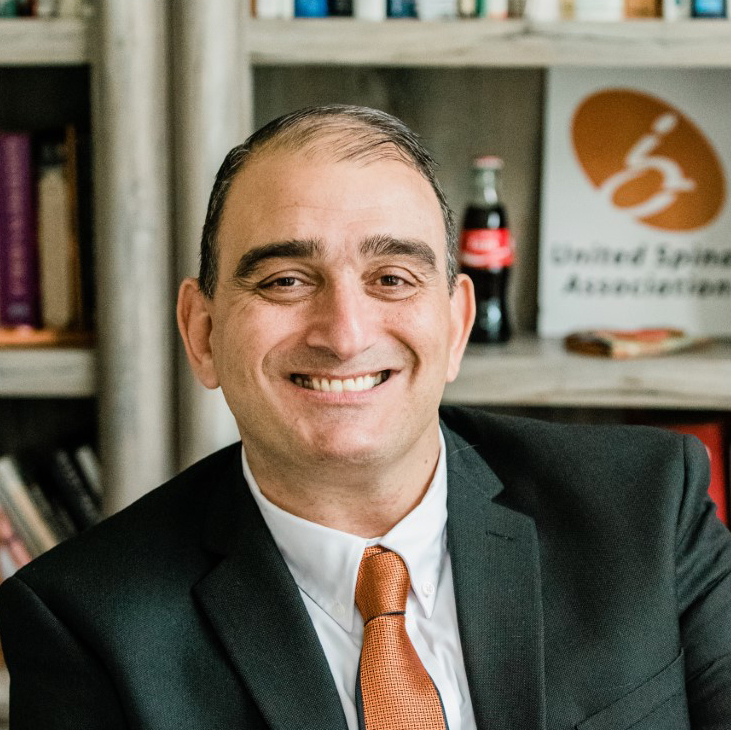
President & CEO
United Spinal Association
As I celebrate my first anniversary as United Spinal Association President/CEO, I want to take a moment to reflect on first principles for Disability Employment Awareness Month, and think about the journey that brought me here. Since my injury in 2010, I have been posing questions to Corporate America around the advancement and inclusion of people with disabilities at work and seeking solutions that the disability community can put into practice together with supportive peers and leaders in the corporate world.
Now is the time for people with disabilities to have our collective Renaissance in the American workforce. We have more recognition and means for accommodation—especially after the remote work revolution—than ever before. Disability organizations must work with employers to unsettle the preconceived notions about workers with disabilities that keep us out of the workforce and dependent on charity, and to promote the reality of the value that people with disabilities bring to the table.
Workers with disabilities come by their strengths as employees honestly through lived experience. While no experience of disability is the same, you can be certain that we are locked into a constant battle with overcoming health issues, discrimination, and lack of accessibility. For some people with disabilities, this battle begins at the moment of birth. For others, they are taken by surprise by the onset of disability much later in life, and confronted with the challenge of having to envision and forge a completely different existence than the one they took for granted.
We live in a world that was literally not made for us—we are resilient. You have to bulldoze your way through life on raw instinct and creativity—we are innovators. Explaining the challenges you face to people who will never face them becomes second-nature—we are communicators and collaborators. These are all fundamental qualities sought by hiring managers that do not necessarily exist in abundance.
My disability journey has given me a vast portfolio of ingenuity to steer me through a world that was not built for me, and never fails to provide a unique perspective when solving a business problem. That wasn’t always the case. How did I get there?
After a period of doubt and uncertainty following my injury, as I began pushing the limits that were imposed on me, conquering challenge after challenge, I became more and more energized and felt like the world was limitless. When you have a disability, you are in problem solving mode 24/7. For those of us with mobility disabilities such as paralysis, we literally break down barriers on the path to success.
I was also extremely fortunate to be part of a company that had a genuine and resolute commitment to inclusion. My story is ultimately that of a group effort—one which was highly illustrative of the kind of intentional work that all companies need to do together and on behalf of with their employees with disabilities. Moreover, my success was Coca Cola’s success, and vice versa. It’s the kind of mutual victory that can be replicated depending on the individual—it’s both a science and an art—over and over again.
When I returned to Coke after my injury, they assured me the value I brought to the organization was the same—or even, enhanced—by what I had been through. Importantly, we got to work on the first ever Employee Resource Group and internship program for people with disabilities, which increased the willingness of our hiring managers to give serious thought to hiring people with disabilities.
My aspiration as an advocate and a member of the disability community is that every person with a disability can have this kind of experience. The two key components here were management that genuinely believed in disability empowerment, and coworkers who actively wanted to collaborate on both making our collective voices and concerns heard and lifting up a new generation of people with disabilities.
However, genuine inclusion of people with disabilities has repercussions beyond the uplift and health of our community that are taken seriously by any corporation interested in meeting the challenges of the 21st century. Inclusion is a growth engine—and disability hiring is a major part of that.
The new generations—Millennials and Generation Z—are purpose-driven, animated by a commitment to social justice: when people see an organization purposefully including the voices of people with disabilities in their messaging and overall culture, that becomes a strong hiring and retention tool.
Forging loyalty through authentic representation and inclusion of people with disabilities is also a powerful tool for market penetration. People with disabilities make up 20 percent of the population. Collectively, we wield at least $600 billion in disposable income, and combined with our communities and networks we represent a whopping $8 trillion of purchasing power. And cultivating the loyalty of this still all-too untapped market will take our participation and leadership in communications and marketing.
Before marketing, there is inclusive product design. Involving people with disabilities at the R&D/engineering level can generate insights and breakthroughs that can have an impact well beyond our community. Designing for accessibility already necessitates thinking outside the box. Innovations that make your businesses accessible and products inclusive can benefit and entice the general public. Universal design isn’t just universal at a functional level, it spurs innovation on an industry-wide scale. Think smart home technology and voice activation. When you meet our needs—which will take our participation—it can also open doors to innovate for the mainstream, encouraging consumers to pay a premium. Now that’s a win-win.
If we can get modern corporations on board with our message as a community, the most important win-win will happen on the level of American society as a whole. When people with disabilities are equitably represented in the workforce—overcoming the unjust levels of unemployment to which our community has been subject—we will infuse the economy with new consumer spending. Not only will tax revenue rise, but the cost of social programs will diminish, as those of us who can work will be liberated from the state of dependency that is imposed on us by disability benefit restrictions. It will enable a higher level of civic enfranchisement and participation and improve mental health on a wide scale—not to mention that communities and families truly become whole when people with disabilities thrive. We are one fifth of the American population. Our exclusion from traditional employment has been a loss for society. It’s time to make society whole.