Our United Spinal Association Outdoor Access Working Group knows that having fun does not come cheap for the disability community. Adaptive equipment and activities can cost thousands of dollars. Fortunately, there are funding sources to help offset the expense. This article shares our knowledge about writing successful grants for foundations and government sources. We have also compiled a list of organizations that welcome such grants. We hope our resource guide encourages you to get outside and enjoy a wide range of accessible outdoor activities.
Before we begin …
Our most important time-saving tip is to make sure you are eligible for the grant you are pursuing. Some grants are only for individuals, while others may be targeted toward nonprofits, local government entities or other organizations.
There are two primary sources for outdoor recreation grants: the government and foundations. When deciding whether to apply for a foundation or government grant, consider timing, resources, and the scale of the project.
Government grants can offer much larger monetary awards, but the application process and award management are much more labor-intensive. Foundation grants offer smaller awards but are less time-consuming for you and your staff and can be less competitive.
Applying for foundation grants
Foundation grants are a crucial source of funding for nonprofits, but often, their grants are not publicly advertised. The Community Foundation Locator can help you find grant-making foundations in your region. Another option is to search the Web for your state’s grant or foundation directory.
Be sure to follow the application guidelines provided by the specific foundation offering the grant. Look for an application checklist, eligibility requirements, rules, instructions, and required documents.
Here are a few more tips:
- Know your strengths
- Target funders interested in supporting your activities.
- Don’t rush the research. Remember, private and community foundations are the most likely funding sources.
- Submit grant applications to at least three funding sources. Ensure they’re tailored to each funder—do not submit a generic proposal.
- Meet the eligibility requirements.
- Submit a compliant proposal, which means ensuring you meet every application requirement and leaving nothing blank.
- Make sure your proposal is coherent and readable.
- Prove you are responsible with money.
Applying for government grants
Government grants are monetary funds allocated by local, county, state, or federal agencies and departments. These usually have more significant award amounts, but the application process is longer. The guidelines and reporting requirements can be very strenuous.
One possible source for federal grant programs is SAM.gov Assistance Listings. Here, you can find lists of funding programs for all levels of government, nonprofit organizations, for-profit businesses, and other eligible entities. At grants.gov/search-grants, you can search, filter, and apply for specific opportunities to receive funding from one of these programs.
The U.S. Department of Health and Human Services has provided some helpful tips on applying for government grants:
- Don’t wait until the last minute. Register with grants.gov well ahead of time.
- Include a Unique Entity Identifier (UEI) if applying as an organization.
- Keep the audience in mind.
- Start preparing the application early.
- Follow all instructions and application guidance carefully.
- Be brief, concise, and clear.
- Be organized and logical.
- Carefully proofread.
For more information on the role of the Grantors and Applicants in the Federal grant lifecycle, visit Grant Lifecycle Timeline through grants.gov. Here, you can learn about the lifecycle’s three phases and the actions grouped into these phases.
List of foundations that provide grants
Outdoor Access Working Group members Jeff Pagels, Kristina Ericson, Bonnie Lewkowicz, Catherine Denny, Amanda Dessert, and Matt Howard compiled this list of potential funders. Since organizations can change the scope of eligibility and other parameters over time, always read through eligibility requirements carefully.
Active Fund, Kelly Brush Foundation
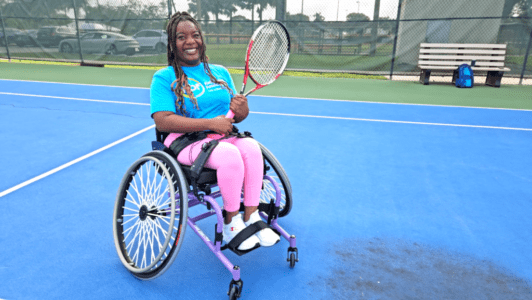
The Kelly Brush Foundation provides grant funding and assistance for people with spinal cord injuries to purchase adaptive sports equipment. If successful, you can order the equipment and the vendor bills KBF directly.
Besides equipment grants, KBF holds numerous outdoor events, such as Alpine and Nordic ski events and handcycle events. Anyone living in the U.S. with paralysis from a traumatic spinal cord injury can qualify. The Spring Active Fund is open until April 17, 2024.
Working Group member Catherine Denny shares, “I applied for and received a grant from the Kelly Brush Foundation. They paid for half of an e-assist road bike.”
Phone: (802) 846-5298; email: info@kellybrushfoundation.org
Action Sports Foundation
Action Sports Foundation provides a further list of possible grants and funding resources to help members of the disability community obtain adaptive sports equipment.
Phone: (813) 389-3683; email: info@asfadaptivesports.org
Athletes Helping Athletes Foundation, Road Runner Sports
Road Runner Sports offers adaptive bicycling grants for children 18 and under with permanent physical disabilities or severe mobility impairments.
Phone: (888) 566-5221; email: aha@roadrunnersports.com
Challenged Athletes Foundation
The CAF Annual Grant Program provides grants for individual athletes who need adaptive gear, travel assistance, and more. Besides funding equipment, CAF also funds supplies that contribute to accessing the outdoors.
“If your sport is trap shooting, grant funds could be used to purchase ammunition or cover shooting fees for entering competition,” says Jeff Pagels, an Outdoor Access Working Group member from Wisconsin.
To apply for a CAF grant, an individual must have a permanent physical disability that impairs mobility, balance or motor control or affects the neuromuscular system. Applicants can request a Sports Expenses Grant or an Equipment Grant.
Phone: (858) 866-0959; email: caf@challengedathletes.org
Challenged Athletes Foundation – Operation Rebound
This CAF grant opportunity is for active-duty military, veterans and first responders. The individual grants fund adaptive sports equipment, training, and competition expenses across all 50 states for over 100 sports. Challenged Athletes who are honorably discharged members of the U.S. Armed Forces, active military personnel, as well as U.S. law enforcement officers, firefighters and paramedics are eligible to apply for the Operation Rebound grant. Applicants can request a Sports Expenses Grant or an Equipment Grant.
Phone: (858) 866-0959; email: caf@challengedathletes.org
GoHawkEye Foundation
The GoHawkEye Enabling Grant Program extends its eligibility to adaptive individuals and organizations across the United States, offering grants for adaptive sports equipment and adaptive sports experiences. The grant cycle is biannual, ending May 1st and November 1st.
Email: hawkeye@gohawkeye.com
High Fives Foundation
High Fives Foundation offers three grant cycles in the calendar year. The Empowerment Fund provides resources for people who have suffered injuries such as spinal cord injuries, traumatic brain injuries, amputations, or other mobility-limiting injuries who reside in the U.S. or Canada. Each grant cycle has different eligibility requirements, so reading through the Empowerment Fund Grant Guidelines is suggested to ensure you meet the criteria.
Phone: (530) 562-4270; email: dani@highfivesfoundation.com
How I Roll Sports
How I Roll Sports provides a map of the United States that allows you to search for funding and grant resources by state.
Phone: (888) 304-7655; email: support@howirollsports.com
Ian Burkhart Foundation
The Ian Burkhart Foundation will help individuals seek out funding sources and provide grants for items not usually covered by insurance that will significantly increase independence and quality of life. Grants will be given after the board determines that they are necessary. You can look through past recipients on the IBF website.
Move United
Move United has over 225 member organizations across the country. It is an organization focused on ensuring everyone has equal access to sports in their communities regardless of ability. Move United offers youth athletes a Ski Spectacular Race Camp Grant and a list of organizations offering possible youth adaptive equipment grants.
Phone: (301) 217-0960; email: info@moveunitedsport.org
Outdoor Ability Foundation
The Outdoor Ability Foundation’s mission is to empower disabled children aged 8 to 19 by providing grants to purchase adaptive equipment. This equipment enables them to explore and enjoy the great outdoors and supports their participation in activities such as hunting and fishing. Grants have been used to purchase adaptive equipment like crossbow cocking devices, portable hunting blinds, fishing equipment and skiing equipment.
Email: sphillips2282@gmail.com or graysonphillips308@gmail.com
Ski for Light
Ski for Light provides stipends to attend various cross-country ski events in several states and an annual international event. It also provides skis and sit skis at SFL events. At any event, SFL pairs each participant with a “guide” for the duration of the event. While most participants are blind or visually impaired, there is always a tight-knit cadre of mobility-impaired skiers.
Phone: (612) 827-3232
Spinal Cord Opportunities for Rehabilitation Endowment (SCORE)
SCORE focuses its grants exclusively on individuals who meet the following criteria: Sustained a paralyzing spinal cord injury while participating in non-motorized sports or athletic recreation activity and have a demonstrated financial need. SCORE assists with some out-of-pocket costs for items or services that will improve the grant recipient’s quality of life. Use of grant funds might include home modifications, adaptive sports equipment, and vehicle adaptations.
Email: questions@scorefund.org
Victoria’s Victory Foundation
VVF is dedicated to assisting with the day-to-day needs of those living with spinal cord injuries, traumatic brain injuries, and other mobility-related disabilities caused by an injury or diagnosis. You can read the guidelines and other important details for the Victory Scholarship Application.
Phone: (617) 918-7979; email: director@victoriasvictory.org
Region-specific grants
California Coastal Conservancy
The California Coastal Conservancy has grant cycles for organizations to purchase beach wheelchairs for use at beaches on the California coast. The funding grant category is called “Explore the Coast.” Bonnie Lewkowicz, a working group member from California, adds, “These grants can be large amounts and also require good grant writing skills.”
Phone: (510) 286-1015
Harry Allen Gregg Foundation Recreation Grants
The Harry Allen Gregg Foundation offers grants to individuals with physical, developmental, or emotional disabilities and their families. The grant recipient must be a New Hampshire resident. Recreation grant applications may be submitted at any time, and they are reviewed on an ongoing basis beginning in February. Due to limited funds, these grants are distributed on a first-come, first-served basis. Applications submitted early in the year are more likely to be funded.
Phone: (603) 792-0137; email: hgf@crotchedmountain.org
IM ABLE Foundation
The IM ABLE foundation awards equipment grants to individuals with disabilities who reside in the Mid-Atlantic region. IM ABLE does not typically offer grants to other entities. However, it occasionally seeks opportunities to collaborate and partner with like-minded organizations that align with its mission. Instead of direct financial assistance, IM ABLE focuses on creating partnerships to provide equipment or support programming initiatives that promote inclusivity and accessibility for individuals with disabilities.
Phone: (877) 595-3505; email: info@imablefoundation.org
Northeast Passage
Northeast Passage is a privately funded program of the University of New Hampshire. Its mission is to “Empower people living with disabling conditions, both visible and invisible, to define, pursue and achieve whole life health, community engagement and fulfillment through the purposeful use of sports and recreation; to develop and promote best practices in the fields of Therapeutic Recreation and Adaptive Sports.” Its website provides a resource page with a list of resources for funding adaptive recreation equipment.
Phone: (603) 862-0070; email: northeast.passage@unh.edu
Grants for organizations only
Christopher and Dana Reeve Foundation Quality of Life Grant
The Christopher and Dana Reeve Foundation offers grants for nonprofits whose programs include people with paralysis. Created by the late Dana Reeve, it strives to empower individuals with disabilities and their families by providing grants to nonprofit organizations that improve quality of life through inclusion, access, independence, opportunities for community engagement, and other life-enhancing endeavors.
Phone: (800) 225-0292; email: information@reeve.org
Craig H. Nielsen Foundation
The Craig H. Neilsen Foundation is the largest private funder of spinal cord injury research, rehabilitation, clinical training, and programmatic support in the United States and Canada. This Foundation creates grants and funding opportunities for organizations in the U.S. and Canada working to advance the quality of life for people with spinal cord injuries or disorders.
Phone: (818) 925-1245
National Environmental Education Foundation
NEEF has grant cycles for organizations to increase outdoor access and has funded equipment. “I used grant money from this organization to work with my park district to add accessibility content for trails,” says Bonnie Lewkowicz.
Phone: (202) 833-2933; email: info@neefusa.org
V.A. Adaptive Sports Grant Program
The VA Adaptive Sports Grant Program is facilitated and managed by the National Veterans Sports Programs and Special Events Office. Its mission is to provide opportunities for Veterans to improve their independence, well-being, and quality of life through adaptive sports programs. These grants are available for qualifying organizations to implement adaptive sports programs for disabled veterans.
Phone: (800) 698-2411; email: grants4vets@va.gov
More resources
United Spinal Association Knowledge Books
United Spinal Association’s Resource Center offers Knowledge Books on many topics, including Adaptive Sports, Recreation, and Fitness. The information provided is organized by state.
Helpful sites
Corporate Grants for Nonprofits
How to Write a Grant: A Comprehensive Step-by-Step Guide
11 Best Grant Research Tools To Help Nonprofits Find Funding
Here are a few more tips
Receiving grants is quite competitive, but do not let that deter you from applying. Remember….
- Do your research on the funder and past recipients
- Give yourself plenty of time to plan and write
- Keep up on what is new and improved in the world of grant writing
- Network with the community giving out the grant
- Always read the fine print
- Follow the grant application directions
- Stay focused on your goals and objectives
- Proofread and edit thoroughly
- Submit early and do not procrastinate
- Handle rejections the right way. Use feedback to keep improving and moving forward!
Outdoor Access Working Group
Consider participating in United Spinal’s Outdoor Access Working Group. You’ll collaborate with advocates across the United States to help remove barriers to outdoor recreation for the disability community and promote adaptive recreation activities of all kinds. The image at the top of the page is of Erik Kondo, an active member of United Spinal Association and a 2022 Strongwheeled Together awardee.