
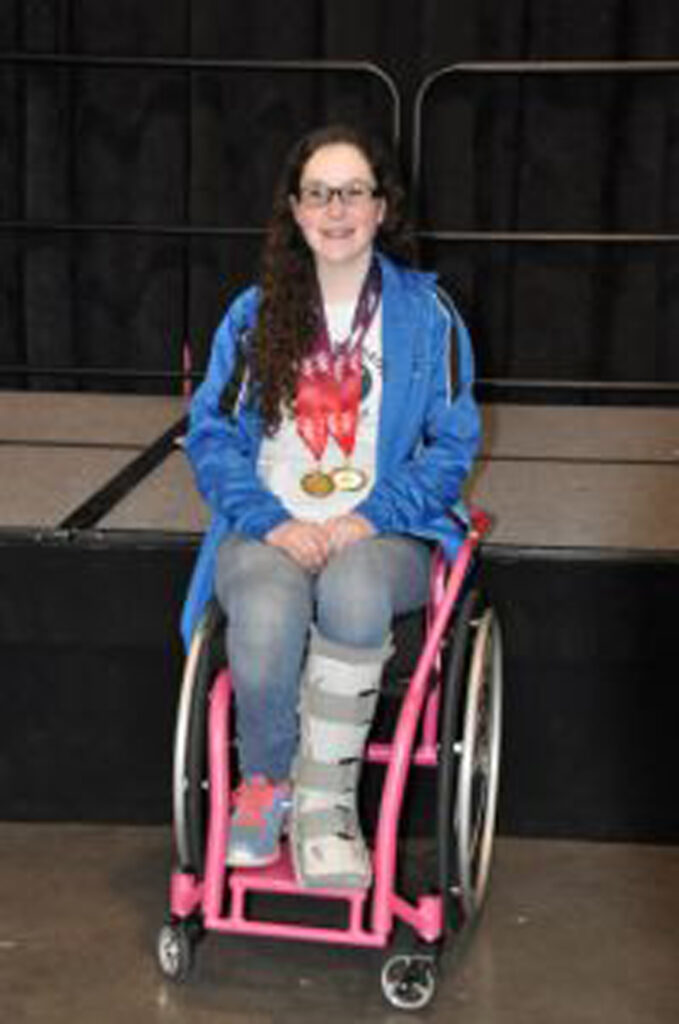
Fencing was always a sport Lauryn DeLuca wanted to excel in. Born with moderate cerebral palsy, Lauryn started her fencing journey as an able-bodied fencer. She joined a fencing club when she was 9 and trained with other able-bodied children. However, her body began to weaken gradually as she grew older, causing Lauryn to struggle as she continued fencing.
“I was competing, and I was getting more tired. I wasn’t really able to perform…at my best ability.”
Then, in 2012, Lauryn’s parents were approached by Les Stawicki, the coach of the USA wheelchair fencing team. He noticed Lauryn’s disability, and told them that he wanted Lauryn on his team. Her parents initially kept this offer to themselves, not knowing how Lauryn would react to this suggestion. “I wasn’t too sure [what] her feelings would be,” Lauryn’s mother, Tracy, explains. “She doesn’t want to be treated as a person with a disability, just a regular human.”
Lauryn’s body continued to weaken, and after her 2012 National Championships, her parents brought up the idea of wheelchair fencing to her. Lauryn agreed to give it a shot.
Shifting to fencing on wheels
Wheelchair fencing was new to Lauryn, and she soon found out that while the rules and strategies are largely the same, wheelchair fencing requires fencers to tap into a unique set of skills and abilities. As the wheelchairs are stationary, fencers have to build up their core strength and reflexes to attack and defend swiftly. With dedication and hard work, Lauryn adapted her skills to the wheelchair and saw her efforts pay off as she competed regularly in tournaments. Despite a back injury, Lauryn continued to push herself by resuming her daily training regimen.
Surprisingly, fencing was not the first sport that Lauryn took seriously. She started off with volleyball, aiming to be as good as her two sisters, but she never found her groove with it. Fencing came into the picture when Lauryn watched it during the Olympics, and knew that was what she wanted to do. And now, at 16 years old, Lauryn is one step closer to being a competitor herself in the Paralympics.
To do so, Lauryn has to win gold at one of the “zonal championships”, which are international competitions held in distinct regions of the world. She is currently ranked number one in the U.S. women’s wheelchair fencing for two of three fencing subdivisions – “epee” and “foil”, and continues to train and prepare herself.
While Lauryn aims to compete in the Paralympics, she knows that what she has already gained out of this sport is invaluable regardless of whether she makes it to the Paralympics. Wheelchair fencing has definitely given Lauryn self-acceptance and the confidence in her own abilities.
How has sports impacted your life? Share your experience with us and you might be featured on AbleThrive!