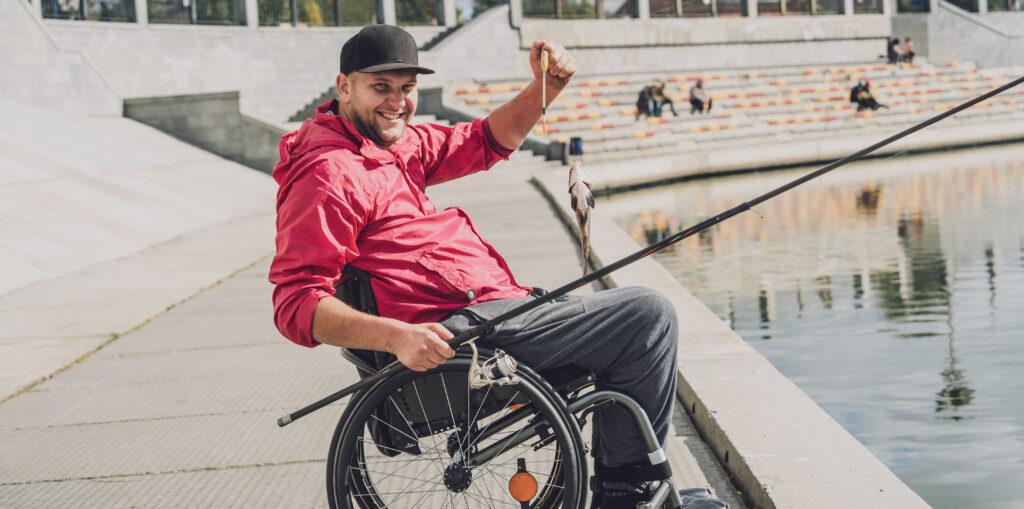
Yes, it is absolutely possible for people with cervical spinal cord injuries to enjoy adaptive fishing, including fly fishing. Kary Wright, a quadriplegic writer for our membership publication, New Mobility, spools out how it feels:
“As you look around, the scenery is unbelievable. Before you is the aqua-blue lake, clear to the bottom, fed by glacier water. The lake is rimmed by towering snow-capped mountains, and the smell of pine trees permeates the air as only high-mountain forests can. You hear the raspy “caw” of a raven off in the distance.
You sharply raise your fly-rod to the 2 o’clock position, pausing briefly to allow the fly-line to stretch out behind. Then, by thrusting the rod forward to the 10 o’clock position, you pause to let the line stretch out in front. You repeat the process several more times, 2 o’clock, 10 o’clock, 2 o’clock, 10 o’clock. … Then on the last forward cast you let the line gently drift down to the water, placing your fly on the water surface as if it were a live bug.
You glance around at the lake and mountain scenery, and you can hardly believe it. Here you are, a fly-fisherman, in some of the most beautiful scenery in the world, fishing with your best friend at a remote mountain lake, and you have totally forgotten that you are a quadriplegic.
Thanks to our Outdoor Access Working Group, here are resources to help you cast your line:
Arizona Adaptive Water Sports
This organization holds its events at Bartlett Lake in Arizona. Wheelchair-accessible boats with fishing captains, tackle, and fishing poles are provided. (602) 228-3660, jo@azadaptivewatersports.org
Chicago Adaptive Sports – No Limits Fishing
Chicago No Limits Fishing provides opportunities for individuals with disabilities to experience fishing and boating on the Chicago River and Lake Michigan. The program utilizes a U.S. Coast Guard-approved fully accessible pontoon boat at no cost to the participants. It will also outfit all participants with a USCG-approved personal floatation device and adaptive fishing equipment such as electric reels, rod holders, cuffs, etc. (312) 287-0629, chicagonolimitsfishing@gmail.com
Fishing Has No Boundaries
This national organization has 18 chapters in nine states FHNB provides recreational fishing opportunities for all anglers with disabilities regardless of age, race, gender, or disability. (715) 634-3185
Global Opportunities (GO) Unlimited
Located in New Mexico, Go Unlimited offers a wheelchair-accessible pontoon to various lakes throughout the state for a great fishing experience. Adaptive fly-fishing float trips down the San Juan River are also available. Group fishing trips for children with disabilities are another option offered through Go Unlimited, which can accommodate up to 30 children at a time, plus family and friends. (505) 480-2374, globalberg@aol.com
Lonestar Paralysis Foundation
Located in Central Texas, LSPF offers and funds various outdoor adapted recreation, such as fishing, at no cost to the spinal cord injury community. (512) 484-3683, doors.lonestar@gmail.com
National Wheelcats Association
This Tennessee-based organization sponsors individuals with disabilities in the Paralyzed Veterans of America (PVA) sanctioned bass fishing events. (270) 483-1685, msinger73@charter.net
New York State Department of Environmental Conservation
Here is a list, by county, of fishing access sites in the Eastern Adirondacks and Lake Champlain in Northeast New York for individuals with disabilities. (518) 897-1333, fwfish5@dec.ny.gov
Project Healing Waters
PHW is a national organization that helps active military service personnel and Veterans in need through a dedicated, developed curriculum of fly fishing, fly casting, fly tying, and fly rod building. View all PHW locations by state on their website to find a local program. (301) 830-6450, fieldsupportadmin@projecthealingwaters.org
RISE Adaptive Sports
RISE is in Irving, Texas, and offers adaptive fishing from the shore or a boat. To participate in any of the programs offered, it is required for participants to join RISE free of cost. (972) 292-8650, info@riseadaptivesports.org
View this post on Instagram
Safety first!
Being safe and knowing how adaptive water sports activities equipment should be handled and used is extremely important in making your experience fun. To have a successful day on the water, the following should also be considered:
- Pack a survival kit with your medications, seasickness pills, first aid supplies, repair tools and extra personal medical supplies such as catheters.
- Bring drinks and food if none are provided.
- Stay hydrated, wear clothing that protects you from the sun (hat, sunglasses, etc.), and remember sunscreen.
- Wear a properly fitted Personal Flotation Device (PFD) and, if required, a properly fitted helmet and wet suit.
- Always use the correct equipment for your ability level.
- Follow standard rules and instructions, know your limits and make sure you are well-trained.
- Know and recognize the common emergency and help signals.
- Do not go alone. Have someone in close proximity in case something goes wrong.
- Avoid adapted water sports at night or during dangerous weather conditions.
View this post on Instagram
Outdoor Access Working Group
Our United Spinal’s Outdoor Access Working Group collaborates with advocates across the United States to remove barriers and promote outdoor adaptive activities of all kinds. To join us, please fill out this online form.