
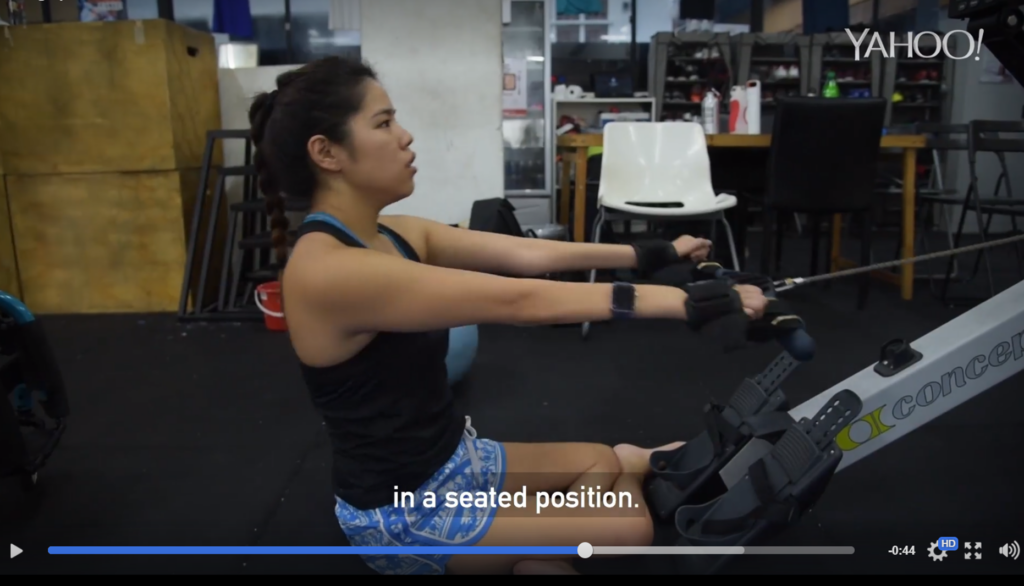
“In my head, I had this impression that Crossfit is very extreme,” said para-swimmer Yip Pin Xiu, 25, who started doing adaptive Crossfit earlier in March this year. “But it was a personal thing, I was afraid I couldn’t do it. But eventually after seeing them adapt everything, it was a lot more possible.”
At an event for inclusive sports, Pin Xiu’s fellow para-swimmer and friend Theresa Goh, who had been interested in Crossfit for a while, chanced across a booth for an adaptive training programme for people with disabilities (PWDs) by Innervate Fitness, a gym along Bendemeer Road.
“[Theresa] knew that this was something she wanted to do after Rio. [It was] just nice that she chanced into them. Then, the very first time she went she also called me along.”
Born with Charcot-Marie-Tooth disease, a type of motor and sensory neuropathy, Pin Xiu started swimming at the age of five to strengthen her muscles. She feels that her muscle strength has more or less stabilised.
“At first I was a bit worried because I wasn’t quite sure if I could do it. Because I think my disability is a bit more severe than Theresa’s. I didn’t know how they were going to adapt the exercises to me.”
Moses James, an adaptive coach at Innervate, explains the principles behind adaptive Crossfit.
“An adaptive Crossfit programme uses Crossfit-type methodology but with specific adaptations to maybe the equipment, or the way in which the exercises are performed to suit the individual’s needs. But the programme remains the same.”
Trying the exercises for herself made Pin Xiu realise she liked the training she could get outside of the swimming pool.
“They do it very properly. It’s a strength and conditioning programme that uses high intensity training. I like that it’s varied. Because after a while, swimming is the same. How many laps can you swim?
As CMT results in weakness and contractures in her hands, Pin Xiu performs weightlifting movements with the aid of wraps and hooks.
“We started off with a PVC pipe to get the mechanics right and the technique correct. I’ve been doing stretches, cleans, push press, push ups, many different things. It’s almost always never the same combination. I like the different exercises. Every time I go I don’t know what to expect.”
While she initially doubted her ability to participate in the programme, Pin Xiu finds that in just over half a year of doing adaptive Crossfit, she has become stronger overall.
“The movements are very transferable to daily life. The dips have really helped a lot in getting up to my chair, transferring, everything. Before, it was very difficult for me to get up from the floor to the chair. I needed something else in between, so it was very tiring. Now it’s easier.”
“I think a lot people have this mindset that they cannot do a lot of things, even before they try it. And I think other people also feel like someone who has never worked with someone with a disability before will put their expectations on them. I really don’t like that. I like to try [something] before I conclude that I can or cannot do it.”
The programme has also helped her reconnect with former swimming teammates and widen her social circles. “I really enjoy the community,” she said. “There are some people [with disabilities] who are not in the sports scene [but] they just come to keep fit and get active. I think this is really nice.”
The ultimate goal for the three-time Paralympian is to, still, “swim a better time.” “But I think this is part of the process that will help me reach my end goal.”
