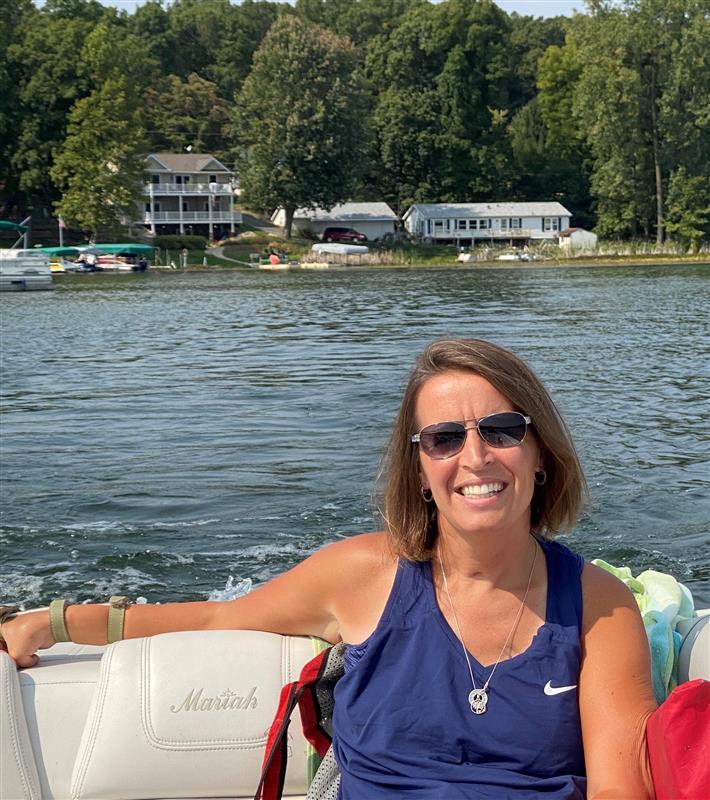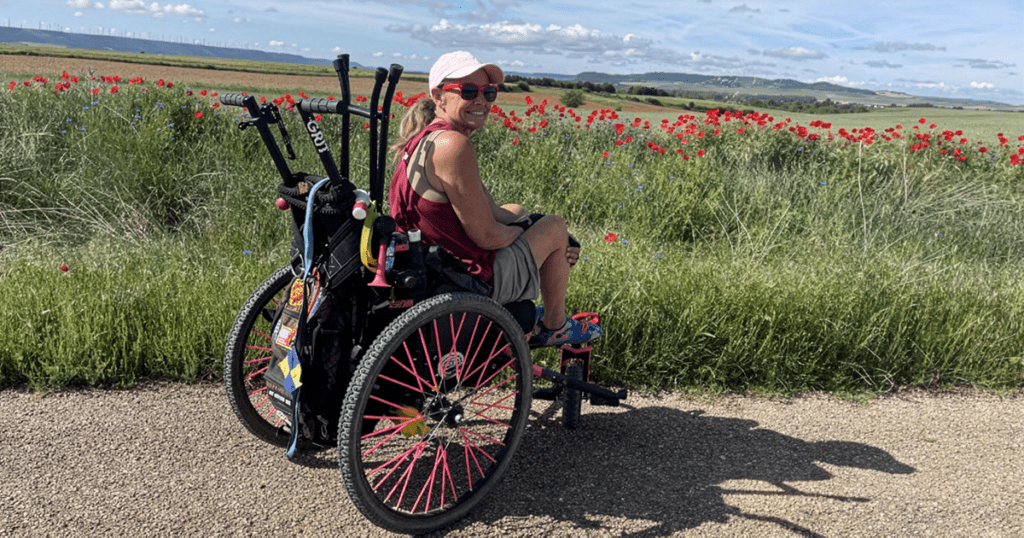
In the March 2026 New Mobility article, Learning to Let Go on The Camino de Santiago, Sarah Smith chronicled her 2024 journey as a wheelchair user on Spain’s famous Camino de Santiago pilgrimage trail. In 2022, United Spinal Outdoor Access Working Group member Kim Harrison completed the same 62-mile version of the Camino, dubbed the Accessible Camino. Before discovering that version, organized by the nonprofit I’ll Push You, Harrison thought the endeavor was out of reach. “It was a challenge I never thought I would be able to do knowing it was not accessible,” she says.
Having a team of push-assist partners, provided by I’ll Push You, changed everything. That initial experience helped Harrison quiet the doubt and gave her the “fever” to tackle the full 500-mile route.
When the opportunity came to take on the full 500-mile journey, she did not hesitate. Harrison started her adventure from St. Jean, France, on May 5, 2024, and wrapped up a day ahead of schedule on June 11, 2024, when she rolled into The Plaza del Obradoiro, the final destination of the Camino de Santiago, located directly in front of the Santiago de Compostela Cathedral in Galicia, Spain.
Managing Inaccessibility
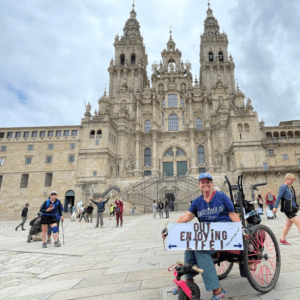 “There is no ADA on the Camino trail,” says Harrison. “Only dirt and rocky trails …. Even in bigger cities throughout the pilgrimage, we found lack of access.”
There were moments when she had to leave her chair outside to access buildings. “I did a lot of crawling in Spain.”
The Pyrenees mountains early in the journey brought some of the toughest conditions, including a 3,200-foot climb. That was a bit more than I was expecting,” she says. “I had to stop and rest a few times going up.”
There were also truly dangerous moments, like navigating a two-lane highway with no shoulder. “Cars were coming at us fast on curves. I was ‘hugging’ the guard rail, but it left me no clearance if a car got too close.” Ultimately, the team made the call to prioritize safety and arranged alternate transportation for that stretch, the only time Harrison used vehicle support on the entire journey.
Accommodations were equally inconsistent. “Only one hostel was designed for a wheelchair,” Harrison says. In many others, Harrison had to navigate dozens of stairs, sometimes 50 or more, just to reach a room.
Adaptation, Teamwork and Real-World Problem Solving
A trip like this is not just physically demanding. It can also be financially challenging. Harrison used Help Hope Live to fundraise for her journey. The organization provided guidance, support, and one-on-one assistance throughout the process. “They really helped with the logistics and wording,” she says. “It made a huge difference.”
For her first Camino experience, much of the logistics were handled by the organization leading the trip. For the 500-mile journey, she had to do her own research and quickly realized how little information existed for wheelchair users.
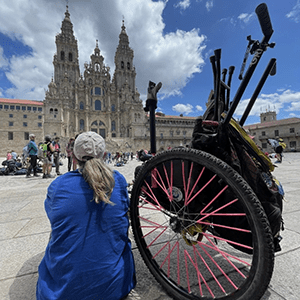
Her team of push partners played a critical role in making the journey possible. She started the journey with five push-assist partners, with a sixth joining at the halfway point. From lifting her chair over obstacles to helping navigate unpredictable terrain, they worked together every step of the way. That kind of teamwork was essential to the success of the trip.
Two members of her team had completed the Camino before and helped map out the route and secure lodging in advance. They booked albergues (hostels) ahead of time, so the group did not have to rush or scramble for accommodations at the end of long days.
“I followed a lot of Facebook groups,” she says, “but none of them were geared towards someone with a disability, let alone a wheelchair.” That gap in resources is something many in the disability community know all too well. Harrison had to prepare in creative ways and hope her ideas worked. “I packed and zip-tied two extra tires and tubes with a small pump and a repair kit for the ROHO cushion under my chair,” she says. “I also took my GRIT Freedom Chair wheels to a bike shop and had them install a Kevlar liner between my tubes and tire to avoid any punctures.” (It worked — Harrison had no flats).
Before the trip, she practiced getting up and down stairs by scooting on her rear end at a lighthouse in St. Augustine, Florida. “The only other training I really did was taking my GRIT Freedom Chair on dirt trails in Florida,” she says. “There were no hills to train on.”
Her husband Brian rode alongside her on his Cat Trike during training and stayed connected while she was in Spain. Friends also kept her motivated through encouragement both in person and on social media.
The Power of Visibility on the Trail
While the physical challenges were intense, some of the most meaningful moments came from the connections Harrison made along the way.
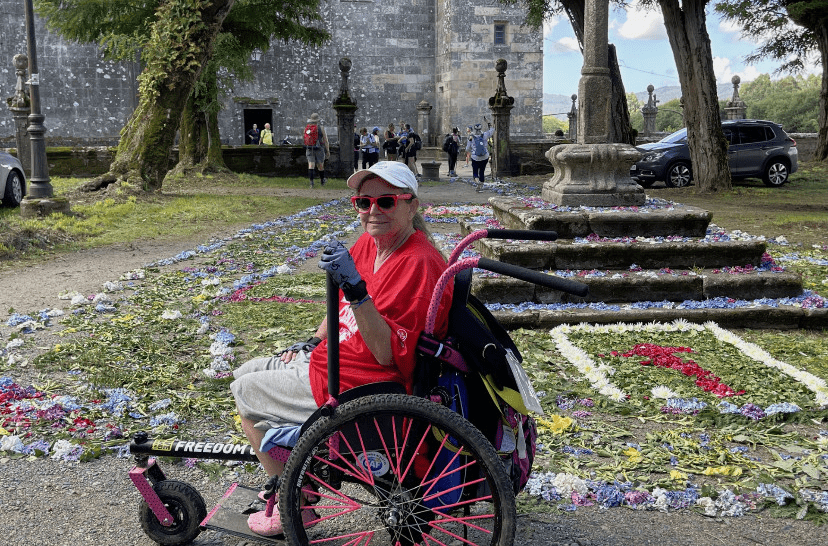
She customized her GRIT Freedom Chair with bright pink tape and spoke covers. That visibility often served as an icebreaker, sparking conversations with other pilgrims, nondisabled and disabled. “I love talking to others about the chair, my journey … the good and bad,” she says. “I had a few tell me they felt tired, ready to give up, then saw me roll past them. It motivated them to keep going.”
In one town, a stranger approached her after hearing about “the pink wheelchair” from others along the route. In another instance, a hostel owner added signage to help wheelchair users avoid stairs after hearing her feedback. These moments are powerful reminders that representation matters and proof that advocacy does not always require sweeping reforms. Sometimes, change starts with a conversation.
Moving Forward Together
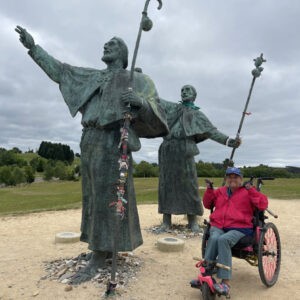 Harrison wants more wheelchair users to share their stories to spark positive changes and encourage people to push their limits. At the heart of her story is a message that resonates far beyond the Camino: “It’s not easy, but it can be done.”
Outdoor advocacy is about paving new ways for others to follow by pushing forward, leaning on community and creating visibility in spaces that were not designed with disability in mind.
If this story sparked something in you, whether it is curiosity, motivation, or even frustration about the barriers that still exist, know that you are not alone. To help expand access and break down those barriers in outdoor spaces, consider joining United Spinal Association’s Outdoor Access Working Group, where advocates across the country are working together to make recreation more inclusive for all.
Because the outdoors should belong to everyone.
Resources
- I’ll Push You Accessible Camino Group Trips
- Learning to Let Go on The Camino de Santiago
- United Spinal Association’s Outdoor Access Working Group