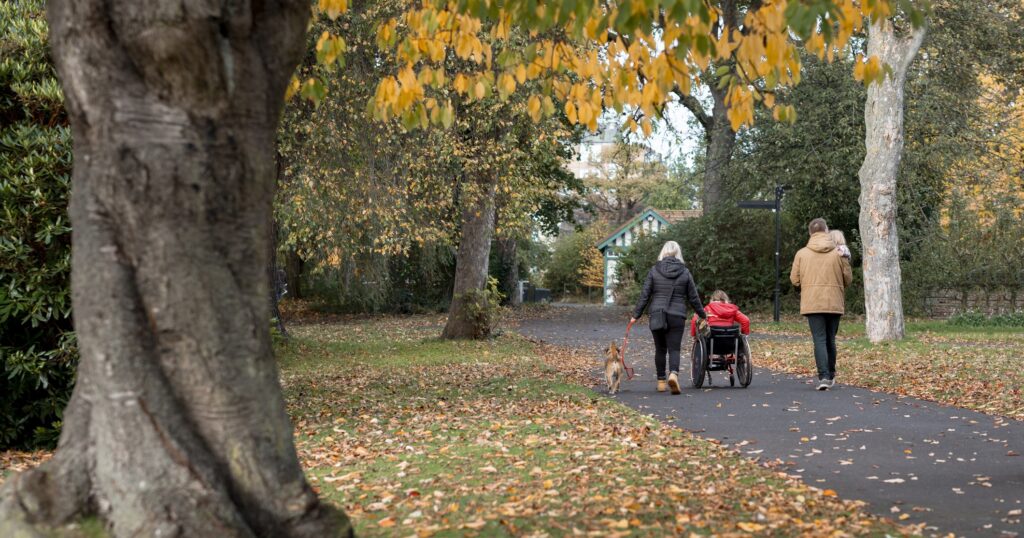
Fall is here, and there is no better way to take advantage of the beautiful autumn weather than to get out and enjoy some accessible trails. Many factors come into play when considering access to trails for the disability community, but we can all agree that accessibility should be part of the planning phases before trails and trail facilities even start construction.
This guide was compiled by the United Spinal Association’s Outdoor Access Working Group. Our members are advocates with a wide variety of abilities who are ultimate outdoor enthusiasts. They want to share their experiences and suggestions for enjoying trails and the outdoors.
What makes a trail accessible for wheelchair users?
The Forest Service Outdoor Recreation Accessibility Guidelines (FSORAG) and the Forest Service Trails Accessibility Guidelines (FSTAG) are the legally enforceable standards for facilities, route, and features in the National Forest System. FSTAG is a source of guidance for the greatest accessibility on trails while also protecting the characteristics of the natural setting.
Enforceable standards for trails that are used for recreational purposes are addressed in the Architectural Barriers Act (ABA) Accessibility Standards, and these ABA Standards stem from the Access Board’s Outdoor Recreation Accessibility Guidelines. In 2013, the Access Board amended the 2004 guidelines and added provisions for trails. These standards do not apply to private, state, or local land – only on Federal lands.
It is important for your own safety to make an informed decision on whether a trail is right for your needs and abilities.
Let’s start at the trailhead
A trailhead is the access point to a trail. Information signs found at trailheads for new or altered trails are required to provide information about the accessibility characteristics of the trail. These signs must have the following information:
- Trail identification
- Length of the trail or trail segment
- Type of trail surface
- Typical and minimum trail tread width
- Typical and maximum trail grade
- Typical and maximum trail cross-slope
Also, many trailheads have paper maps available. Take one with you and look at it before you set out to see if the trail is a loop or if any other trails cross it. Sometimes, remote or rural areas do not have Wi-Fi, so it is important not to rely on your phone unless you have information downloaded.
Surface Type:
For optimal accessibility, choose trails with a firm and smooth surface. Some trails may not be smooth, featuring sections with packed dirt and exposed roots, cracked asphalt, or gravel that may not be well maintained. Even so, they might be navigable using all-terrain wheels or a power wheelchair.
Trailhead signs should note cross slopes if they are greater than 2%. They should also note trail widths—usually 3 feet—and whether there’s space to pass, especially if the trail is less than 5 feet wide. Also, signs should list known barriers such as stairs, surface changes or hazards like street crossings or parts of the trail that motor vehicles also use.
Grade:
Trails are considered level/flat if they mostly have an estimated grade of 1% or less, gentle when 3% or less, and mostly gentle when 5% or less. They are considered moderately steep if they mostly have a grade between 5% and 8%, steep when 8%-12%, and very steep if there are sections over 12%. Grade information is estimated and may change over time.
Length:
People should use discretion when selecting trails because long trails can be labeled wheelchair-friendly if they have an accessible surface and grade. The most accessible portion of a trail will be labeled when aspects such as surface and grade changes or other barriers may limit access to certain parts of a trail. Remember that not all trails are loops. Also, alternative access points are marked when available.
Parking:
The number of designated accessible parking spaces near trailheads will be noted, along with their surface and whether they are van-accessible with access aisles. Also, there may be information on alternate accessible parking if none is available at the trailhead.
Points of interest:
Accessible observation areas near the trailhead will be noted. If the point of interest is not easily accessible from the wheelchair-friendly trail, that will also be noted.
Advice from our Outdoor Access Working Group members
When asked what makes a trail accessible for them, the Outdoor Access Working Group members stated:
- Access to information to plan ahead of time
- Signage at trailheads indicating accessibility
- Accessible and van-accessible parking
- Accessible restrooms along the trail
- Trails wider than 28 inches
- Firm and stable trail surfaces
- Trails longer than one mile
- Ability to independently get to the trail
AllTrails is a helpful app
Many Outdoor Access Working Group members use AllTrails to find and research accessible trails. AllTrails defines a wheelchair-friendly trail as one that can be partially or fully navigated for those with limited mobility or who use a mobility device. It is extremely important to use discretion when deciding if a trail is right for your specific needs, and it is highly suggested that accessibility information be confirmed with the local park sources.
View this post on Instagram
AllTrails reminds us there is no cookie-cutter approach to accessibility. Everyone’s experience is different based on the activity, the adapted equipment being used, and the individual abilities and skill level of the person.
The Rails to Trails movement
All over the United States, unused train tracks have been converted into multi-use recreational paths. These rail-trails are flat or gently sloping, with firm surfaces, making many ideal for wheelchair users.
The Rails to Trails Conservancy envisions our nation connected by trails, reimagining public spaces as safe and inviting outdoor recreation places. Perhaps the most famous rail-trail is the Great American Rail-Trail. The first cross-country multi-use trail in the nation, it offers more than 3,700 miles of trail from Washington, D.C., to Washington State.
View this post on Instagram
RTC Guidebooks can help you determine if certain parts of the trail meet your accessibility needs. The “roughness index” and “surface type” listings can help you decide if the ratings are good for your outdoor accessible mobility device. The RTC Guidebooks also provide the trail mileage, which can help estimate how long it will take to roll, walk, or bike the trail.
Ensuring future trails are more accessible
Outdoor Access Working Group member Richard Skaff works with public agencies and private non-profit organizations that own open spaces and trails to ensure that future trail designs incorporate accessibility for those with mobility disabilities. Here are his suggestions for making paths such as Rails to Trails more accessible:
- On long trails, accessible shelters and restrooms allow people in wheelchairs to hike the whole trail.
- Solar charging stations with battery storage for overnight charging at locations approximately 15 miles apart on Rails to Trails projects would allow those using power wheelchairs or other battery-powered conveyances like the 4-wheel electric TerrainHopper to recharge while the person is sleeping in an accessible shelter.
- Access to fresh and safe drinking water on longer trails.
View this post on Instagram
Richard uses his 21st Century Bounder electric wheelchair on trails and the 4-wheel drive TerrainHopper if a trail’s accessibility is dicey. “That equipment can make many of the presently inaccessible trails and open space locations accessible to those of us with mobility disabilities,” he says. Unfortunately, many people with disabilities are unable to afford to purchase off-road wheelchairs. “I’m now working with local, state, and federal parks agencies in an attempt to create programs that will make TerrainHoppers available for those with mobility disabilities, at no cost to them.”
Technology can enhance the outdoor experience
Working Group member and United Spinal Association Illinois Chapter Advocacy Coordinator Bill Bogdan shared information from a recent Outdoor Recreation Consumer Study by Booz Allen. It surveyed 3,000 people to gather data on how technology can enhance outdoor experiences and improve accessibility to federal lands. Of those 3,000 surveyed, only 39% view national parks as an accessible travel option for any level of ability or disability.
Other survey findings show that:
- Eight out of 10 U.S. adults say technology like findability tools and smart searches can enhance their park experience.
- Nearly half of travelers with a disability indicated they are more likely to visit a national park, national forest, or other federal land if they can book in advance.
- 44% of respondents are more likely to visit if they can find information online about the accessibility level of a park.
- Seven out of 10 say the ease of booking is an important factor when planning a trip to a national park.
This data is important because accessibility varies for everyone depending on their disability. People need access to data-enabled recommendations and personalized information to help them make decisions when planning a trip. Finding ways to make park and trail information more easily accessible online can empower more people in the disability community to explore parks that fit their needs.
We are not done yet
Although much progress has been made, our members report many barriers when accessing outdoor spaces. Here are a few:
- Information on the accessibility of parks or trails cannot be found on websites
- Lack of maintenance of accessible trails
- Freshly laid thick gravel on trails that were previously accessible
- No accessible restrooms on longer trails
- High thresholds onto bridges or boardwalks due to erosion
- Not being able to access the trail independently
- Open space and trail planners’ attitudes suggesting if trails are designed and built to be accessible, they will forever damage the natural settings
- Gate entrances not wide enough for outdoor accessible equipment to pass through
According to the National Park Service and the U.S. Department of Interior, in the more than 400 national parks across the U.S., some visitor centers lack accessible restrooms, water fountains, and entrances. Some parks have inaccessible paths between parking lots, sidewalks, buildings and interpretive programs that are inaccessible. Trails, beaches, and campgrounds also lack accessibility and inclusive opportunities.
Proper training for staff and volunteers on interacting with people with disabilities is also critical to providing services appropriately. Change and awareness are still needed, and the National Park Service must find ways to break down the existing barriers and make accessibility a part of the operation and planning, not an afterthought.
Join Our Outdoor Access Working Group
Please consider participating in United Spinal’s Outdoor Access Working Group. Join us in collaborating with advocates across the United States to help remove barriers to outdoor recreation and promote adaptive recreation activities of all kinds.
Resources
United Spinal Association:
Are There Requirements for Building Accessible Trails? Ask the ADA Expert (Marsha Mazz)
Online:
The 25 Best Accessible Trails in America (Outside Online/Emily Pennington)
Forest Service Trails Accessibility Guidelines (FSTAG) (USDA Forest Service)
Architectural Barriers Act (ABA) Accessibility Standards (U.S. Access Board)
A Summary of Accessibility Standards Accessibility Standards for Federal Outdoor Developed Areas (U.S. Access Board)
Accessibility Guide for Wheelchair-Friendly Trails (AllTrails)
Only 39% of Americans view national parks as accessible options. There’s a simple fix. (USA Today/Kathleen Wong)
ALL IN! Accessibility in the National Park Service (NPS and U.S. Dept. of the Interior)