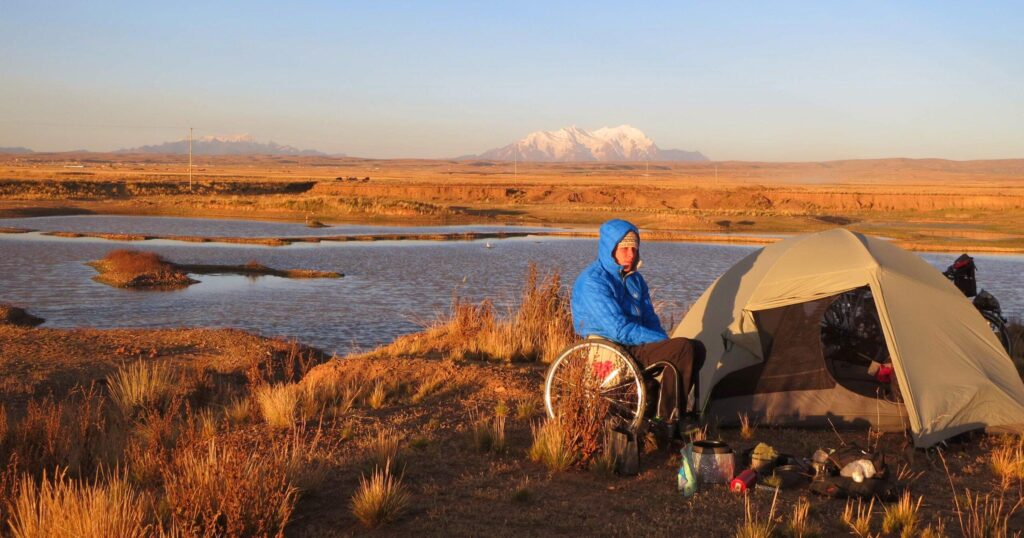
- The fall season is here, and United Spinal’s Outdoor Access Working Group has focused on accessible camping.
- First, we have two helpful lists. One is for campgrounds, and the other is a recommended packing list.
- Also, our Outdoor Access Working Group members share some of their accessible camping experiences, suggestions, and resources — including favorite campgrounds!
- It all comes down to preparation and planning!
September and October are great months to camp for many reasons, including pleasant temperatures, smaller crowds, and fewer bugs! Whether you sleep in a tent, cabin, yurt, a fancy RV, or prefer glamping, our Outdoor Access Working Group wants you to have the information and resources you need to plan a fun and accessible camping experience.
13 Questions to Ask Campgrounds About Accessibility
The United States Access Board is responsible for developing the accessibility guidelines for campgrounds and onsite facilities. The two pieces of legislation that are critical for providing the guidelines for campsite accessibility are the Americans with Disabilities Act and the Architectural Barriers Act.
For campsites to be considered accessible, the U.S. Access Board has specific requirements for aspects such as accessible parking, accessible restrooms, table height, and surface and slope requirements. About 4% of campsites must be accessible at larger campgrounds, but all campgrounds must provide at least one accessible site.
But as with everything, it’s best to check with the campground before you go.
We asked the working group members what makes a camping location better for them, and this helpful list was created:
- Accessible restrooms
- Roll-in shower
- Paved or accessible paths to the restroom and shower
- Accessible parking
- Electricity for charging equipment
- Outdoor recreation equipment rental
- Cabins with beds rather than a platform with a pad
- Accessible trails and trail width
- Accessible docks and kayaking
- Accessible fishing spaces
- Navigable slope and terrain of the camping area
- Accessible picnic tables and fire pits
- Hard-surfaced picnic areas
9 Packing List Recommendations
Camping as a wheelchair user is much easier and more enjoyable with the proper gear, preparation, and supplies. We highly suggest creating a packing checklist. REI provides a comprehensive camping checklist that works as a good starting point, and then you can add to it based on your specific camping needs. Below are recommendations to add to that comprehensive list.
- Emergency kits, including medical equipment
- Spare parts, such as washers and screws, wheelchair tire repair kit, tire tubes, armrests, and footrests.
- Chargers for equipment
- Backup power
- Medication
- Wheelchair accessories, like a Freewheel or NuMotion’s Freedom Trax
- A cot, such as a tent cot by Kamp-Rite, or air mattress
- An accessible tent like the Eureka Copper Canyon LX 6-person tent
- Portable ramps
Recommended Camping Destinations from Our Outdoor Working Group Members
Cabins and Glamping in Northern California with Bonnie Lewkowicz
Bonnie is the Program Manager of Access Northern California at Bay Area Outreach & Recreation Program and is a United Spinal’s Outdoor Access Working Group member. She mostly camps in cabins and shares some of her favorite locations in Northern California.
Many of the California State Parks now have “rustic cabins,” which are basically protected structures with bunk beds and a table. The restrooms are communal. Typically, there is no running water or electricity, which is a problem if you need to charge your equipment. These locations can be very difficult to reserve because they are popular – especially Steep Ravine on the coast in Marin County.
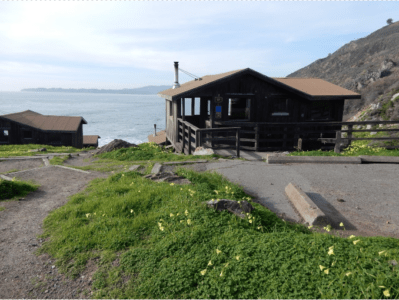
“This cabin feels like you are perched on the edge of the world overlooking the ocean,” says Bonnie. “It is a winding road to get there, but worth the effort.” The features at this location include an accessible restroom, picnic table, barbecue, and parking.
Samuel P. Taylor State Park Cabins
This camping location is an hour north of San Francisco in the redwoods. It makes a great home base for exploring the park as well as nearby Point Reyes National Seashore, and the Cross Marin Trail. According to the website, two of the five cabins are wheelchair accessible, but the website only shows one. The other accessible cabin is not available online, so it is available for same-day reservations for people who might visit the park. The features at this location include electricity, an accessible restroom and roll-in shower, an accessible picnic table, barbecue, and parking.
Bonnie’s favorite glamping location is further north on the California coast. It’s situated on 37 acres of woodland just a quarter mile south of the charming town of Mendocino and minutes from a few accessible trails at MacKerricher State Park and Van Damme State Park. This camping experience comes with heated beds, electricity, an accessible restroom and roll-in shower, accessible picnic table, and accessible parking.

Exploring Florida and Georgia with David Bottomly
The Florida Park Service highlights Access for All, which is its commitment to further progress the culture of inclusion at its parks. Each of the parks is different, so it is recommended to visit the specific park pages for information or contact the visitor information line at (850) 245-2157.
You can view the accessible parks by entering keywords or selecting the park type, experiences, and amenities. An example is Big Lagoon State Park where the following accessible amenities are listed:
- Beach wheelchairs are available at no cost. Ask at the ranger station.
- Boardwalks at East Beach Picnic Area and to the observation tower.
- Campsites with concrete pad, picnic table, ground grill and nearby restrooms.
- Picnic facilities with tables and grills.
- Seating at the amphitheater and Governor’s Pavilion.
- Service animals are welcome in all areas of Florida State Parks.
David also shared helpful information for accessible camping at Georgia State Parks. This website includes a list of parks and historic sites, along with links for reserving all-terrain track wheelchairs free of charge. The track wheelchairs are provided by the Aimee Copeland Foundation and All Terrain Georgia’s partnership with the Georgia Department of Natural Resources. You can find which Georgia State Parks have these track chairs available, how to get certified and reserve a track chair, and trail maps for the all-terrain chairs.
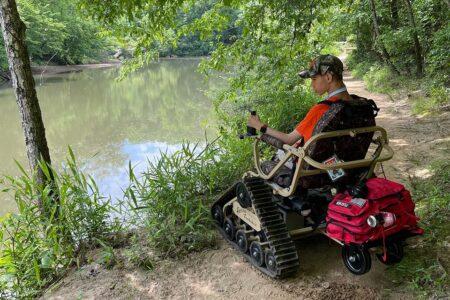
All-Terrain Track Chairs Available At:
- Cloudland Canyon State Park, Trenton
- Don Carter State Park, Lake Lanier
- Red Top Mountain State Park, Lake Allatoona
- Etowah Indian Mounds Historic Site, Cartersville
- Fort Yargo State Park, Winder
- Hard Labor Creek State Park, Rutledge
- Panola Mountain State Park, Stockbridge
- Picketts Mill Battlefield Historic Site, Dallas
- Smithgall Woods State Park, Helen
- Sweetwater Creek State Park, Lithia Springs
- Charlie Elliott Wildlife Center, Mansfield
Discovering Wisconsin’s Accessible Cabins and Island Campsites with Jeff Pagels
Jeff worked over 30 years as the Local Government Outreach Team Leader in the Wisconsin DNR’s Northeast Region, is a member of the United Spinal Outdoor Access Working Group and has spent his entire professional career working to improve park and recreational opportunities at the federal, state, and local levels.
The Wisconsin Department of Natural Resources is committed to providing outdoor recreation opportunities for people of all abilities around the state, which includes camping. ADA-accessible campsites and cabins in select locations are available to persons with disabilities. ADA campsites typically have a paved driveway and paved pathway leading to an accessible building with running water, restrooms, and showers. There are also two rustic cabins and eight barrier-free cabins reserved for people who need more accessible features available throughout the state.
Rustic Accessible Cabins
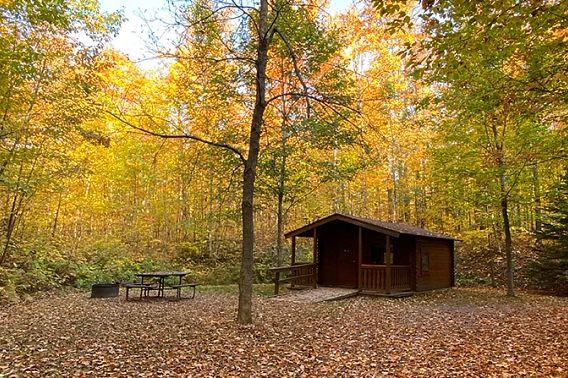
Rustic cabins can accommodate up to four people. These cabins have a bunk and full-sized bed with a mattress pad, electrical outlets, and an accessible fire ring.
Barrier-Free Large Accessible Cabins
- Buckhorn
- Harrington Beach
- High Cliff
- Kohler-Andrae
- Potawatomi State Parks
- Kettle Moraine State Forest-Southern Unit
- Richard Bong State Recreation Area
These barrier-free, one-bedroom cabins have a kitchen, central heat and air. They also feature a fully accessible bathroom with a roll-in shower, two adjustable hospital beds, a patient lift with a sling and a shower wheelchair.
These cabins are available only to people with disabilities and their guests and must be reserved ahead of time. You can find the large accessible cabin reservation request form and the rustic accessible cabin reservation request form, along with the accessible cabin availability, on the Wisconsin DNR website. Site descriptions and photos of many sites can be found on the Wisconsin State Parks Reservation Website and may show details such as maximum vehicle length, driveway length, and site access.
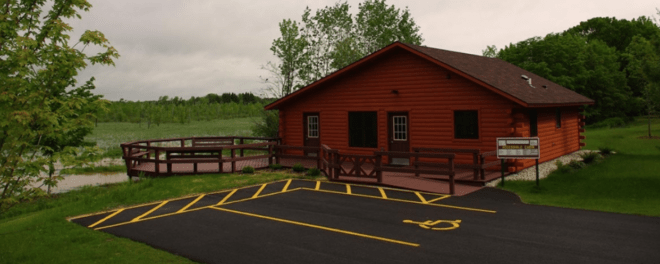
The accessible campsites typically have a paved driveway and pathway leading to an accessible toilet/shower building or restroom facility with running water. These sites are intended for visitors with qualifying conditions and their families or guests. The disabled visitor must be an occupant of the site during the entire reservation period.
For the more adventurous person looking for an authentic wilderness experience, there are accessible canoe campsites that are available. These sites are rugged with beautiful scenery.
- 18 primitive island campsites available for public use accessed via boat only
- The Cedar Tops West campsite has been improved with accessible facilities. It can be reserved by contacting the Hayward DNR Office at (715) 634-7433. If not occupied by a reservation, this campsite is also open on a first-come, first-served basis.
Turtle-Flambeau Scenic Waters Area
- 66 campsites scattered throughout this area
- 58 of these campsites are designated family campsites accessed via boat only
- Site number A1 is a family site that includes facilities that make it more accessible to persons with physical disabilities. This site can be reserved by persons with disabilities at no charge by contacting the Mercer Ranger Station at (715) 614-5120. If not occupied by a reservation, this campsite is also open on a first-come, first-served basis.
The DNR adaptive equipment fleet includes adaptive kayaks, beach wheelchairs, beach access mats, and cross-country sit skis. Peninsula State Park has an Outdoor Wheelchair Program that includes a motorized chair. This all-terrain outdoor wheelchair can be used on rough and rocky surfaces. You can reserve this wheelchair at no cost through the Friends of Peninsula State Park.
Find a free camping site in Massachusetts with Abby Swaine
Abby is on the Board of United Spinal’s Greater Boston Chapter and is a member of United Spinal’s Outdoor Access Working Group.
John Dillon Park in the Adirondacks
This park’s mission is to offer free camping for individuals, friends, and families with functional differences. These gorgeous and secluded sites offer nine lean-to platforms with the following features:
- Ramps
- Wheelchair-accessible sleeping platforms
- Accessible toilets
- Picnic tables
- ADA-compliant fire pits with swing-away grills
- Portable charging stations
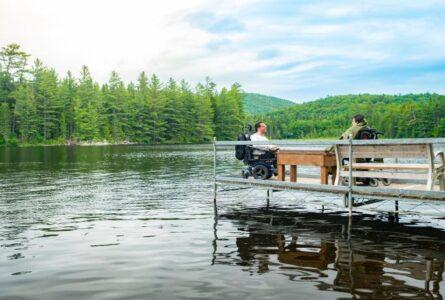
The park has staff on call 24 hours a day and services that include assisting with getting your gear to your campsite and setting up tents, delivering firewood, and trash removal.
Along with secluded camping, there are 3.5 miles of hard-packed trails. There is also a dock suitable for fishing, adaptive kayak boarding, and an accessible pontoon boat that offers campers the ability to take a scenic boat ride around Grampus Lake.
Jason Thurston is the Outreach Coordinator at John Dillion Park. He sustained a C6 spinal cord injury in 2004 and is very interested in getting more use of the park from people with mobility disabilities. He can be contacted by email at dillonpark@paulsmiths.edu or by phone at (518) 891-1771.
Activities – Take a Hike!
One of the most popular activities when camping is exploring accessible hiking trails. Alltrails.com lists the most popular wheelchair-friendly trails in the United States, including trail maps, driving directions, reviews, and photos. Another great resource is TrailLink, which is a service of the Rails-to-Trails Conservancy. This website provides descriptions, photos, and reviews submitted by trail users and trail managers. There are also interactive trail guides available for specific states that allow you to locate trails and important accessibility information.
A few important tips for hikers with a disability:
- As a person with a disability, you can apply for a free lifetime National Park Access Pass at nps.gov/planyourvisit/passes.htm.
- Before you head for the trail, check to make sure the trail is open that day.
- Do your research — refer to online information and guides.
- Check the weather
- Always share your schedule
- Go at your own pace
- Find others or groups to hike with
- Keep all life-saving medications readily available
- Carry any back-up medical equipment you may need
- Take time for breaks
- Don’t be afraid to ask for assistance
- Make sure your cell phone is fully charged … and your equipment.
- Make sure you have the proper equipment for your specific needs for a safe and fun hike.
Planning and preparation are extremely important for any accessible vacation, and especially accessible camping. More thought is needed because of being in remote locations, where a store or pharmacy is most likely not right around the corner. As wheelchair users, the equipment that is needed is specific to your needs ranging from wheelchair parts and accessories to specific types of tents, cots, and outdoor cooking utensils.
There is so much beauty to see throughout the United States and these resources are readily available to help make your accessible camping experience fun, peaceful, and relaxing.
Additional Accessible Camping Resources:
Accessible Cabins and Campsites:
Search for Accessible Camping (Recreation.gov)
Barrier Free Travel (barrierfreenationalparks.com)
Accessibility in National Parks (NPS)
Wheelchair-Accessible State Park Cabins Offer Affordable Family Lodging (Emerging Horizons/Candy Harrington)
7 Accessible Campsites for Outdoorsy Fun (ameridisability.com/Erica Thomas)
The Perfect Wheelchair Accessible Campsite (wheelchairtraveling.com)
Top 9 Wheelchair Accessible Campgrounds (BraunAbility)
Wheelchair-Accessible Yurts Across the US (Emerging Horizons/Candy Harrington)
Wheelchair-Accessible Glamping Sites in the US (GlampingHub)
Wheelchair Accessible Campgrounds and RV Parks (whenwerv.com)
11 Accessible Good Sam Parks for Disabled Travelers (Good Sam/John Sullaway)
Accessible Camping Tips:
How People with Disabilities can Enjoy Camping Again (Gone Camping Again, Elise Burley)
The Able Traveler: Accessible Camping Made Easy (Candy Harrington, Barrier Free Travels)
Guide to Adaptive Camping (REI, Ken Knapp)
Disabled Camping 101 (Pelican)
What Makes an Accessible Camping Experience? (accessibility.com)
Accessible Camping Equipment:
Activity Adaptions & Adaptive Equipment (Access Outdoors Occupational Therapy)
Camping Gear Checklist for Wheelchair Users (BraunAbility)
New Mobility:
5 Tips for an Awesome Accessible Camping Trip (Tiffiny Carlson)
Accessible Family Camping Hacks (Seth McBride)
Accessible Outdoor Adventures for All (Matt Tilford)
The Great American Southwest (Ashley Lyn Olson)
The Glory of Glamping (Ashley Lyn Olson)
United Spinal:
Exploring Accessible Camping (MobileWomen)
If you are interested in participating in United Spinal’s Outdoor Access Working Group to collaborate with advocates across the United States to help remove barriers to outdoor recreation for the disability community, please fill out the online form at https://unitedspinal.org/working-groups/