
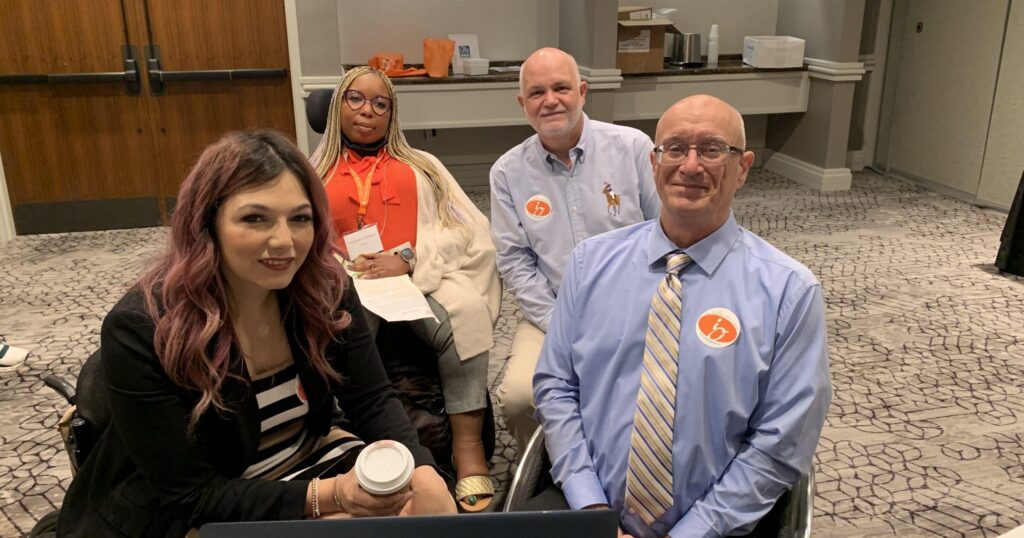
Today, over 100 United Spinal advocates from across the nation are meeting with their Members of Congress to discuss issues impacting the disability community. Learn more about our Virtual Advocacy Day policy priorities and help us amplify our impact by taking action.
“Our attendees are doing the critical work of communicating the needs of our community to their lawmakers at just the right time to make a real difference,” says Steve Lieberman, United Spinal’s Director of Advocacy and Policy. “Members of Congress are deciding now what their priorities are for 2025. It is important to get our elected officials to support the needs of wheelchair users.”
Virtual Advocacy Day Priorities
Spinal Cord Injury Model Systems
For over 50 years, the Spinal Cord Injury Model Systems program has been a comprehensive, multidisciplinary system of care, research, and resources for people with SCI.
Over time, federal funding for SCI Model Systems has not kept pace with the SCI community’s needs. In 2022, funding increased to $8.5 million, and the capacity of the SCI Model Systems was restored to 18 funded centers. That was the first increase from $6.5 million in total annual funding since 2006. The purchasing power of these federal funds has not kept up with inflation or the approximate 50% growth of the SCI community since 2000.
United Spinal asks Congress to support increasing funding for SCI Model Systems to $16.8 million, $2.1 million for the Model Systems Knowledge Translation Center and $1.8 million for the National Spinal Cord Injury Statistical Center in the fiscal year 2025 appropriations bill. The funding will also support Joint Model Systems for spinal cord injury, traumatic brain injury and burn injury communities with a request for $150 million at the National Institute on Disability, Independent Living, and Rehabilitation Research.
View this post on Instagram
Lifting the “in the home” restriction on coverage of mobility devices
Our community knows how important the right wheelchair is to our independence. We continually face challenges in getting the right wheelchairs to meet our medical and functional needs so that we can fully participate in our homes AND communities.
Because of the restrictive interpretation of Medicare’s “in the home” language and the adoption of Medicare coverage policy by commercial insurers, wheelchair users face constant insurance denials and delays in obtaining appropriate equipment. This results in health injuries and secondary health conditions.
United Spinal urges Congress to lift the “in the home” restriction, support Medicare coverage of standing systems in power wheelchairs and conduct a full review of current coverage.
View this post on Instagram
Are you a member of United Spinal Association interested in making a difference for wheelchair users? Join our Grassroots Advocacy Network today. For more information on our extensive advocacy and policy activities, visit our advocacy and policy page.