
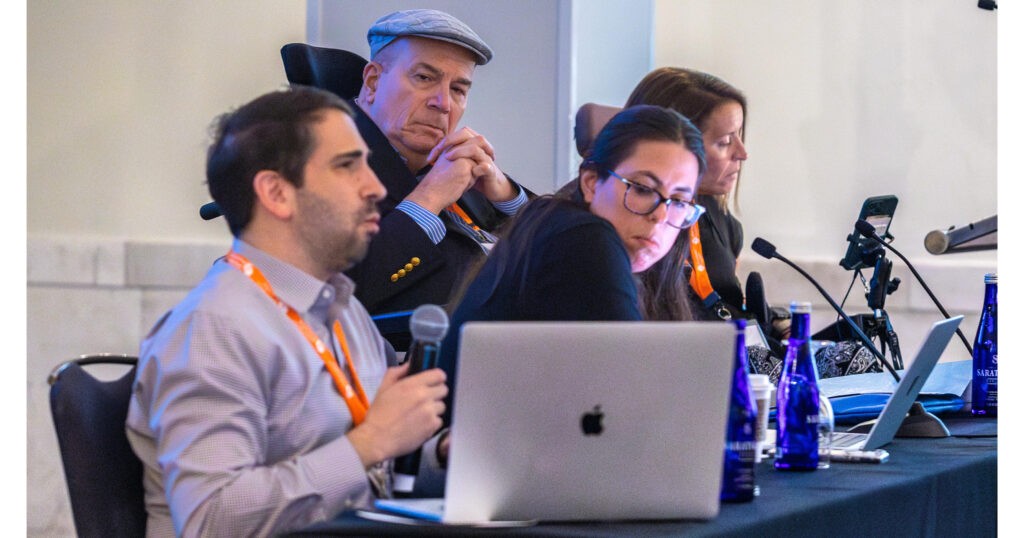
I’m Kent Keyser, a policy fellow at United Spinal Association. United Spinal advocates for wheelchair users, like me, especially for our quality-of-life issues from A to Z, and we have always advanced accessible transportation.
I want to share with you about SecureRide, a stakeholder-led coalition whose goal is to develop an automated independent securement system. This would allow us to ride on all kinds of transportation and independently lock ourselves in. Initially, our goal was to develop a wheelchair securement system that can be operated independently or with assistance. It soon became obvious that automated independent securement was the way to go.
Here’s why: To secure our wheelchairs when we travel on roads and highways, we have to rely on somebody else, who we hope has been well trained, to tie down two straps from small O-rings on the rear sides of our wheelchair to an anchor device on the floor. And then two more straps on the front sides of our wheelchair. All that can take several minutes.
That is something my fellow bus riders and even drivers know well. There is a lot of eye rolling and sighs when I roll on board, and most drivers ask haltingly, “So, do you need to be secured?” I feel guilty delaying everybody. But that 4-strap tie-down has been in the standard for decades.
And it would probably remain the standard for decades into the future, but several years ago, companies got serious about putting autonomous vehicles on our roads. Wheelchair users said, “We have to figure out how we can roll into a vehicle and secure ourselves automatically.
Our industry allies reached out to build a solution
About a year and a half ago, United Spinal got a call from General Motors. Bill Nixon, the policy integration manager at GM, explained that they were working on creating a truly accessible autonomous vehicle and within a matter of months, SecureRide was born.
I must thank General Motors for its strong and continuing commitment to SecureRide. And for allowing us to work with Bill Nixon, who is presenting with me today. Bill has been a true Godsend. He is an engineer, always eager to learn and to offer multiple leadership talents. I’m proud today to call him one of us, because he is extremely committed to both accessibility and to our community.
Also, I want to tell you about Wayne Grau, Executive Director of NCART, whose members are wheelchair manufacturers and suppliers. Wayne has spent a career helping our wheelchair community, and his knowledge and insights are invaluable. Thanks for being one of us, Wayne, in your work, advocacy and spirit.
We did not want to reinvent the wheel; instead, we have been building on existing work to develop securement system standards for more seamless multi-modal transportation. That way, we wheelchair users can more quickly travel from paratransit to a bus and then a train and back again. An automated securement system would save me almost an hour on a round trip like that, as I wouldn’t have to have different people tie down 48 straps in six vehicles.
So, our vision is imagining a world where wheelchair users can use a single attachment feature to move independently across transportation modes to get where they need to go
Without having to worry if someone is correctly securing us.
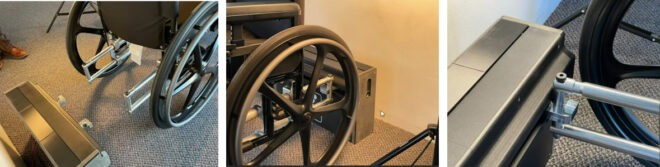
Whether planes, trains or autonomous vehicles, we want to travel safely and confidently
If we can quickly confirm that we are properly secured, the whole trip becomes much more efficient — and what a time saver.
From the start, we made every effort to make sure that the attachment feature on our wheelchairs has minimal impact to the regular use of their chair – that means it can’t weigh very much. Extra weight means extra work for manual wheelchair users, and adding extra weight for some people means they may not be able to make it up a ramp.
And it means we do not increase the footprint, the size of the wheelchair. I know that in my tiny little townhouse, if you add an extra inch to the length of the rear of my wheelchair, then I probably would not be able to make the sharp turn I need to make to get through my front door.
Finally, it means maintaining our ground clearance. Most of the current independent systems have a post on the bottom of the wheelchair that catches on door thresholds or cords or anywhere that is raised in our pathway.
While we initially focused on securement in autonomous vehicles, it became obvious that the need was not just for vehicles of tomorrow. It would also work well in vehicles today, like I described the paratransit bus train ride. So, we want to make certain that the anchoring devices in various types of vehicles are integrated into various public/private transportation modes to accommodate the specific needs of ground, rail – and, yes – air travel. Importantly, a single solution for multiple transportation modes will speed up adoption and increase its scale.
