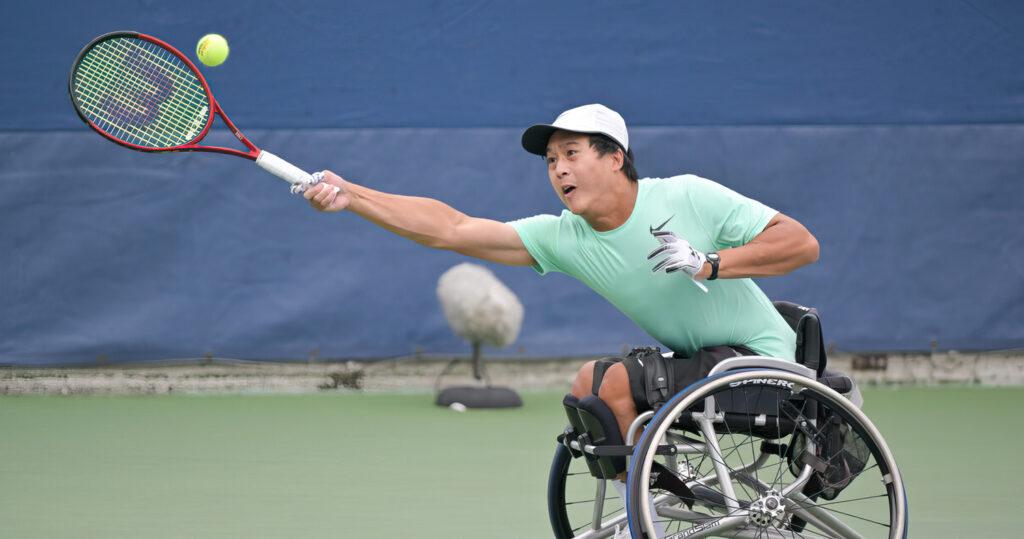
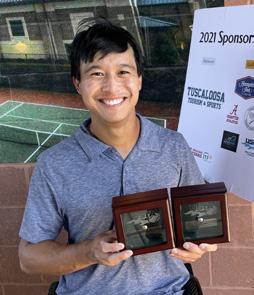
 When a fall from a climbing pole resulted in T11-T12 paraplegia, Jason Keatseangsilp thought there was no way he could compete in tennis at the most elite level. But after 10 years and over 10,000 hours of practice, he found himself playing in the 2022 U.S. Open.
Follow the Bouncing Ball
Keatseangsilp, now 28, was on the cusp of becoming the top-ranked high school varsity player in Arizona and helping to push his school to its eighth consecutive state title, before his 2011 accident.
After rehab, Keatseangsilp tried to get right back on the court and attended a community event hosted by the University of Arizona’s wheelchair tennis team. He quickly realized the magnitude of the challenge he faced.
“I couldn’t transfer into the tennis wheelchair without a wooden transfer plank,” says Keatseangsilp. “Then, when I got into the sports chair they were like, ‘Oh yeah. Jason used to play tennis before his injury,’ and when they would hit the ball to me, I couldn’t even move in the chair. It was so hard. I knew if I was going to go back and play wheelchair tennis, it was going to be a very long and intense journey.”
During high school, Keatseangsilp had grown frustrated being unable to give 100% of himself to both tennis and academics, so after his experience at the wheelchair tennis team event, he resolved that he wouldn’t return to the court until he got his degree in biomedical engineering from University of Arizona.
Five years later, in May 2017, he decided the time had come and shifted his focus from academics to tennis. He wished to rediscover his passion, but he also wanted to see how far he could go in the sport if he put the time in. He returned to the tennis school where he trained before his injury and dedicated 10-20 hours a week to tennis and strengthening.
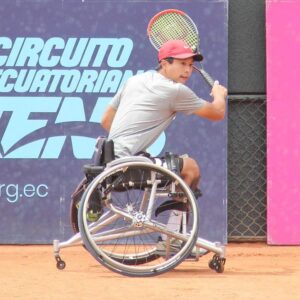
Keatseangsilp entered his first wheelchair tennis tournament as an amateur in the fall of 2017 and wound up winning all five of the amateur tournaments that he entered. He turned pro in June 2018 and worked his way up to a career-high ranking of 31st out of 500 players in the world by the summer of 2022. On the encouragement of the sport’s leading coaches, Keatseangsilp applied for one of the two wild card spots at the U.S. Open.

It was soon after that he got “the single greatest call” of his life, informing him he’d been awarded one of the coveted spots. “I’d been representing Team USA in my travels and giving back to tennis in my own community, and I think all of that culminated [in awarding] me a wild card,” says Keatseangsilp.
He lost his singles match in straight sets, and his doubles partner had to withdraw due to injury, but he took away a lot from the experience. Especially impressive was how wheelchair athletes were treated as equals with nonwheelchair athletes. “We shared the same locker rooms, and our matches were played at the same time in the same arena on the same jumbotron. We weren’t a sideshow. The wheelchair events were fully integrated with the same amenities, services and treatment as our able-bodied counterparts. My locker was right next to Rafael Nadal and that was crazy,” says Keatseangsilp.
For all of his success, Keatseangsilp believes he can become even better. His next goal is competing in the Paralympics. “Not many people can say they’ve achieved their dreams, and I can objectively say one of my dreams came true. I still have the same drive, and I’d love to qualify for the U.S. Open again. But, because Paralympic qualifying is starting this year, that’s my biggest goal.”
A Racket of a Different Kind
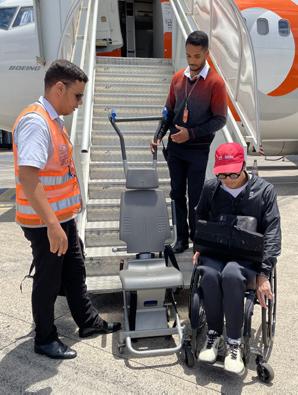
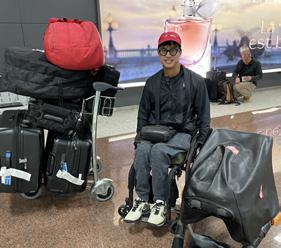
Tennis and life have taken Keatseangsilp all over the world and given him a better understanding of the difficulties of accessible air travel. While domestic travel can be nerve-wracking, Keatseangsilp feels even greater stress when traveling abroad.
Now that I’ve taken over 100 flights in the past five years, I’m most comfortable flying in the States because we have all these major airlines that have so much capital, so if something goes wrong, you just complain and you get compensated. You have contingency.
“One of my biggest fears was having a 10-hour delay in Madrid and not even being able to talk to most people. [Because of the language barrier,] I couldn’t even communicate, much less talk about what will happen with my wheelchair and stuff. If it got damaged or delayed, I honestly don’t know what I would’ve done. Who would I complain to and how do I solve this? In Ecuador, the airport didn’t even have a jet bridge, so four burly guys carried me off the plane in my day chair and I was so scared I was going to fall out. It really made me grateful that even though the U.S. isn’t perfect, we have the ADA and it’s so powerful.
 How do you pay it forward as a member of United Spinal Association?
When someone who is newly injured asks me where they can go for information, I tell them to subscribe to NEW MOBILITY.
Can’t live without:
My Stimulite cushion is my [lifesaver] for my butt. When I don’t have it, I’ve paid the price of developing pressure sores in my travels.
Most accessible place you’ve been:
 Israel. I was impressed there was even a ramp down to the Dead Sea.
Advice for your younger self:
Health comes before anything.