

United Spinal Association member Rhonel Cinous is flying to the moon! Virtually, that is, as a member of the Artemis I mission’s virtual crew.
Cinous, who uses a power wheelchair, never dreamed he would be part of a virtual crew for NASA’s upcoming Artemis I mission to test Callisto, a technology demonstration payload embedded in the Orion spacecraft and developed by Lockheed Martin, Amazon, and Cisco.
Amazon announced its involvement to help develop Callisto in January, and has since invited United Spinal Association to participate in the Artemis I virtual crew. Callisto will be used to test commercial technologies, including Alexa, to see how they could assist future crewed missions to the Moon and beyond.
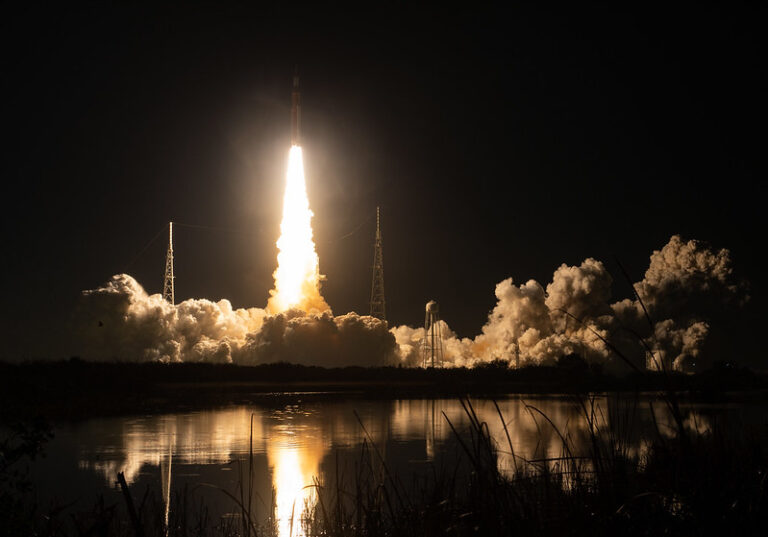
After months of delay, Artemis I finally launched at 1:47 a.m. this morning. It will orbit the moon over the next 25.5 days before splashing down off the coast of San Diego. NASA hopes Artemis I will prepare the way for a manned spacecraft to return to the moon.
Artemis I is the first integrated test of NASA’s deep space exploration systems — the Orion spacecraft, the Space Launch System rocket and the ground systems at Kennedy Space Center in Cape Canaveral, Florida. The mission will also test Callisto, a technology demonstration payload developed by Lockheed Martin, Amazon, and Cisco.
Throughout the mission, Amazon, Lockheed Martin, and Cisco will invite guests to NASA’s Johnson Space Center in Houston, Texas, to become virtual crew members. Amazon invited United Spinal, which chose Cinous, a C5-6 quadriplegic leader with the Tech Access Group, to be its representative.
New views of planet Earth from @NASA_Orion as #Artemis I journeys to the Moon. Orion is 9.5 hours into a 25.5-day test flight. pic.twitter.com/CBaA4ZOK4X
— NASA (@NASA) November 16, 2022
“I was awestruck when I found out I was part of the crew,” said Cinous, a Haitian-American based in Miami. “This is the first time something like this will be attempted, and I’m humbled to be part of it and represent the disability community. This opportunity came about exactly as I have been talking about how I can best use assistive technology and where it can take my career. Now I can test digitally accessible, voice-activated communications, and I’m excited to help drive technology to new levels,” he said.
He wonders how assistive technology may help his career as a podcaster — his current show is Ramp. It. Up! As an Artemis virtual crew member, “I can test digitally accessible, voice-activated communications, and I’m excited to help drive technology to new levels.”
Amazon believes voice technology in particular has the potential to make astronauts’ jobs simpler and more efficient onboard the Orion spacecraft. Virtual crew members, like Cinous, will be able to simulate potential Alexa interactions with future astronauts, asking the voice AI various requests.
“This virtual crew opportunity will show the world that individuals like myself with a mobility disability still have opportunities,” says Cinous. “It might be digital or virtual, but you can be a core part of it. You can even be part of a groundbreaking team guiding a first-of-its-kind experiment to put Alexa on a spacecraft.”
Alexa, What is Artemis I?
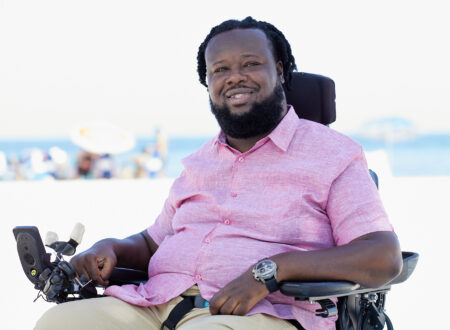 Cinous is a leading voice for United Spinal’s Tech Access Initiative, advocating for inclusive technology to empower wheelchair users to find greater independence and quality of life. He discovered the organization by joining one of its spinal cord injury support groups.
“I joined the Miami Chapter, got a peer mentor, Ryan Gebauer, looked up New Mobility magazine and got active via Zoom when meetings went more virtual during the pandemic,” he says.
Before his injury, Cinous used Amazon’s Kindle to read vast volumes of content across his phone, tablet, and laptop. Post-injury, he explored the possibilities of voice-activated commands via his smartphone. Currently, he uses an Echo Dot to interact with Alexa.
“You can use Alexa to set up your home environment,” he says. “You can check the front door via Ring, play music, turn on a light, control a fan, and more. It can be boundless in the ways it gives you independence.”
Alongside Alexa’s journey during Artemis I, Amazon will introduce new ways to make space exploration more accessible to its customers. This will include new interactive experiences to Alexa-enabled devices like Echo, Echo Dot, and Echo Show, such as the ability to provide customers with in-depth information on Artemis I. Just ask your Alexa-enabled device, “What is Artemis I?”
“This is a bigger story than my own,” says Cinous about being an Artemis I crew member. “If one person looks at this and their takeaway is to go above and beyond any limitations they have — or that people put on them — it will be a successful mission.”

Steve Wright posts disability advocacy and Universal Design ideas daily at his blog: Urban Travel, Sustainability & Accessibility. A frequent contributor to United Spinal, his byline has appeared in New Mobility for two decades. The award-winning writer, planner and educator promotes design for dignity on Twitter at @stevewright64