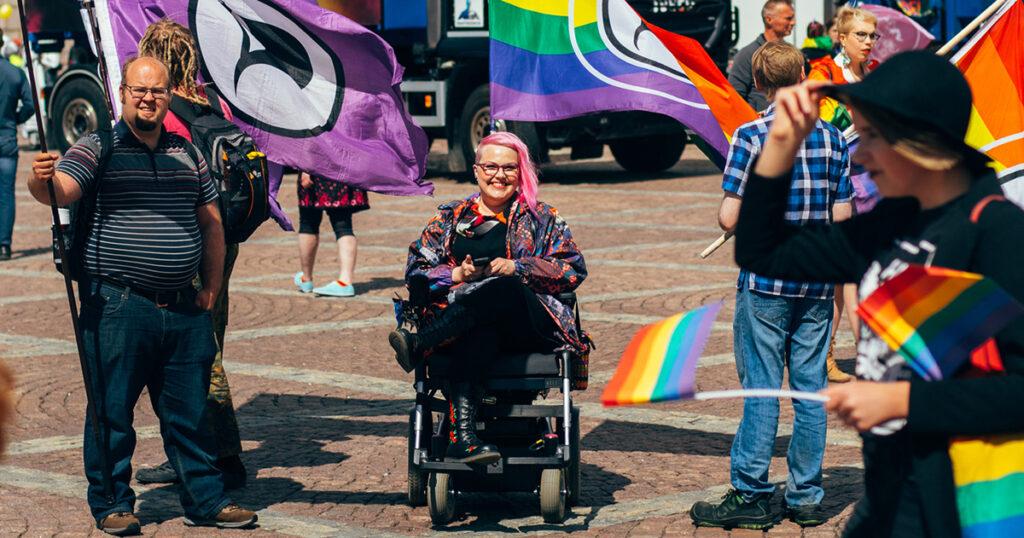
Pride Month is here, but the LGBTQIA+ community has been in the spotlight—or under the microscope—all year. This is for painful, not positive reasons. Plainly put, inclusion is under attack. Boycotts against companies that show solidarity with their queer employees and customers have made headlines. States have moved to legislate against incorporating LGBTQIA+ issues in school curriculums. Every aspect of transgender life is under attack in the majority of American states.
The fight of LGBTQIA+ Americans is our fight, as well—and our fight is their fight.
I want to talk about these issues not only as an LGBTQIA+ ally, but also because of my steadfast conviction in the necessity of addressing the struggles of everyone who is part of our community. Our community is not a monolith: we are Black, Latino, Asian, women, and LGBTQIA+. We will not achieve disability justice if our work and our message does not fully represent and uplift these intersecting identities—and the way members of our community challenge multiple forms of marginalization at once.
Over one-third of the LGBTQIA+ community is comprised of people with disabilities. Therefore, queer communities are often also communities of people with disabilities who only have themselves to rely on. We can change that. We can also learn a lot from the valiant, creative, and often grueling social struggles around HIV/AIDS treatment and research that consumed the 1980s and 1990s, led by organizations like ACT UP, in fighting both medicalized discrimination and for the adequate funding of the things we need to live a long and successful life. Moreover, back in the day, contemporaries from ACT UP and the independent living movement influenced each other—and LGBTQIA+ activists found a home in the disability community, and vice versa, as a result.
Contemporary struggles illuminate further connections. We have to remember that gay marriage has only been legal for less than ten years. With the 2015 Supreme Court ruling of Obergefell v. Hodges opening the door to marriage equality for millions of Americans, many people considered the decades-long fight for social enfranchisement of lesbian, gay and bisexual people a done deal. Not so. It wasn’t true then, and it is quite evident it is not now.
Imagine someone telling you that the fight for disability justice were over after the passage of the Americans with Disabilities Act—it’s like that.
As we in the disability community know from the post-ADA political landscape, even when we appear to achieve big gains in civil rights and recognition, it’s often incomplete. It took until last year to make marriage equality (for both queer people and interracial couples) the law of the land, not just a court decision vulnerable to being overturned. And that is still not enough. Many people with disabilities have faced the difficult fact that the civil right to marry is necessary, but not sufficient for true marriage equality.
The backlash against LGBTQIA+ people in the US tells us that, for marginalized people, juridical recognition of our rights is not the end of our struggles—but the beginning of a new phase of the fight. Communities that have faced deep historic discrimination must sustain our organizations beyond these crucial victories that impart important lessons and give them momentum. Legal integration is only the beginning.
We know that history is on the side of progress. However, the path there is never a straight line, and even temporary setbacks in fights for equality can endanger millions of lives and deepen the undercurrent of hate that we must unsettle and abolish in American society. Moreover, whenever the precious gains made by marginalized communities are threatened, I can’t help but think that our community could be next. If we let the current attacks on our brothers and sisters in the LGBTQIA+ community become permissible without pushback, we are giving permission to harm the disability community. In this era, we need to maintain an uncompromising “All for one, and one for all” attitude.
As fighters for disability justice, we should also engage in dialogue with members of the queer community who do not have disabilities around persistent issues of accommodation and visibility, so we can fight more effectively together for a world that is safe for LGBTQIA+ people—and unsafe for queer bashing. Pride Month has been the occasion of raising constructive grievances as well as celebration for people who are members of both communities.
This month, and every month, I speak and roll in solidarity with our LGBTIA+ siblings who are under attack. If you are a wheelchair user who is also a part of the queer community, there is a place for you in United Spinal. Join us on the first Tuesday of every month at our Rolling with Pride meetings, and build kinship and organization that can win true justice for both people with disabilities and queer people alike.