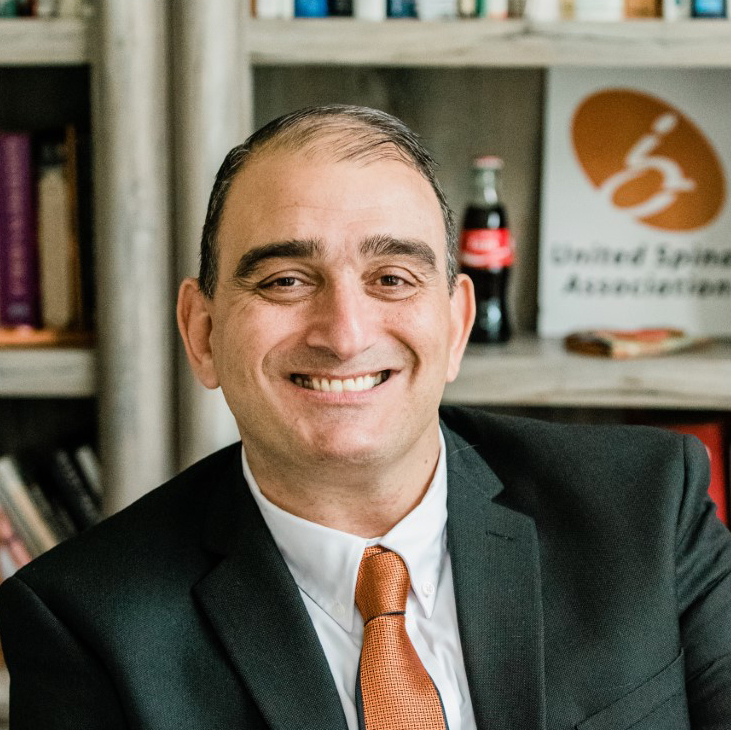

President & CEO
United Spinal Association
Returning home from a magnificent trip to Italy, I rolled to the immigration desk with my four kids and wife by my side, ready to relax after an endless transatlantic flight. One of the airport workers began conversing with my kids about the trip. They eagerly shared their experiences with her, abuzz with excitement.
She said, “Oh my god, you guys are so lucky that your mom can work, so you can have these joys in life.”
Apparently, ableism gives people with disabilities the power of invisibility. Or, even worse, she thought so little of me that she thought I would prefer to be invisible. I know how that is. I’ve experienced ableist denigration in too many ways to recount.
I don’t know what her assumptions were, personally, but I do know, ultimately, the roots of ableism are impersonal. They are structural and, to a person with a disability, they are obvious everywhere we go—or try to go, barriers be damned.
Our collective experience of ableism from both sides of the equation begins with childhood socialization, in the education system. The outcomes speak volumes. According to the Bureau of Labor Statistics, 1 in 5 people with disabilities do not have a high school diploma compared to 1 in 10 among people without disabilities—when 90% of us are rated as capable of graduating high school, were it not for a lack of funding, training and a will to see us succeed.
It continues on in the employment sector, where the unemployment rate among people with disabilities remains twice that of people without disabilities, even with all of the legal and cultural gains we have made over decades, and with bodies like the Equal Employment Opportunity Commission meant to look out for us. There are also the countless people who have left or are considered permanently out of the labor force. This is not a case of being work-shy. It’s exclusion.
These factors and others combine to reinforce our invisibility in popular culture, the media and the halls of power. Our contributions to society go unseen. Many more contributions are unable to be made at all, because of rank discrimination. We internalize ableism in ways that are self-defeating and sow competition rather than collaboration, reproducing ableist thinking and reinforcing ableist structures against ourselves and each other. All of this forms a vicious cycle, which we must break in order to abolish ableism.
We remain only partially integrated into US society, and what keeps us there is the time-worn myth that we are a burden to society and our families and friends, and the cold reasoning that our lives cost more to maintain than we are worth. That reasoning is deep in the ideological fabric of everyday life. It arises when our boss says our requested accommodations are too costly (They’re absolutely not.), when we need something retrofitted or rebuilt, or when we require specialized healthcare or equipment to thrive.
There is also a more benevolent form of ableism. Consciously or unconsciously, it peddles in the tropes that make up what we call “Inspiration Porn.” People with disabilities shouldn’t be congratulated for leaving the house or for meeting the normative expectations of people without disabilities. Allies should instead work with us to promote the leadership of people with disabilities, and to campaign for an inclusive and accessible world where it is taken for granted that everyone has the same opportunities. Diversity and inclusion initiatives should have real measurable impacts on our community, not just remain in the realm of symbolism, tokenism and feel-good messaging.
So how do we address ableism?
First, people with disabilities have to organize: speaking with a confident and united voice and “StrongWheeled Together” (while maintaining a healthy and democratic culture of debate and discussion in our organizations), and being strategic about where our key opportunities for progress are at work, at our colleges, and in the policy environment, locally and nationally. We have to be ready to support each other, as well, maintaining strong networks that develop real leadership that translates into real power—elected office and leadership in the business community, media, think tanks, and universities— so we can fight for jobs and social programs that benefit our entire community from a position of strength. We have to stoke a passion for advocacy and justice in each other, even and especially when times are tough. It is up to us to represent ourselves—no one else will do it for us.
We have to be out in the world engaged in popular education and other grassroots forms of dialogue about our experiences and disability liberation. We have to be ready to “call in” the people around us who are potential allies and could be moved to a better place, and call out the people who are bitterly opposed to the recognition of our dignity and humanity.
We have the ability to stop ableism. People with disabilities can use our collective social power—20% of Americans have disabilities and far more people than that are our allies—to set the direction in which our country and our communities must be headed.