
In 1990, the Americans with Disabilities Act’s time had finally come, and its passage was long overdue. It was the first major upgrade toward a more perfect union since the Civil Rights Act passed almost a quarter of a century ago and the most important disability rights law since the 1973 Rehabilitation Act.
The Civil Rights Act did not cover disability, but the Rehab Act at least prohibited the federal government from legally discriminating against people with disabilities. It served as a hard-fought and critically important initial step toward addressing injustices perpetrated against Americans with disabilities.
Yet it still took nearly two more decades for the ADA to become law. It brought with it such groundbreaking concepts as “reasonable accommodation,” “essential functions,” and “least restrictive environment.” These ideas, wonky and jargony, to be sure, became the linchpins safeguarding the rights of disabled Americans.
The centerpiece of the ADA is “equality of opportunity” for people with disabilities: equality in employment, education and community participation opportunities.
In pursuit of the ADA, our advocates’ demands were simultaneously groundbreaking and elementary. They insisted on a law that allowed people with disabilities the chance to thrive, experiencing freedoms that had never been provided before. And they demanded that the law ensure the most basic opportunity for dignity and respect.
The ADA Exists at the Intersection of “Must” and “May”

The ADA stipulates that private employers and state and local governments with 15 or more employees cannot discriminate against qualified individuals with disabilities in the job application process. But it neither requires nor recommends that people with disabilities be actively sought after for the skills and diversity they might bring to the workplace.
The law calls for nondiscrimination based on disability in public places so that disabled Americans can enjoy their communities and patronize local businesses. However, it does not prohibit the foundational ableism at the heart of so many urban development and architecture plans. Historically, architects and designers treat accessibility as a retrofitted afterthought rather than a central part of the design.
The ADA assures that people with disabilities can participate in their civic duties and vote with a semblance of freedom and independence. But there is no guarantee that people with disabilities will be seen in decision-making bodies or positions of leadership for which these votes might be cast.
Legislative mandates are only one part of social change. The ADA was crafted and exists in an oddly contradictory reality of mandate without societal adaptation. This intersection between “must” and “may” has led to many problems.
Employers rebuff disabled employees’ requests for reasonable accommodations because they are assumed to be too costly or unnecessary. Businesses accept fines or citations rather than including accessibility as an important part of their business model. Communities and organizations develop without the invaluable insights or even participation of those who see the world from a vantage point sharply different from those without disability.
While many challenges arise in this contradictory existence, it is also at this intersection that the true opportunity lies. A stronger, more inclusive, more just understanding of disability might emerge.
The Promise of the ADA
The ADA’s effects on the lives of people with disabilities are multitudinous in number and immeasurable in impact.
Following the passage of the ADA, people with disabilities could:
- Make rights-based claims for access into buildings into which they may have been previously legally denied entry. The law has opened doors of possibility and inclusion that had been beyond reach for far too long.
- Be a part of a classroom populated by their peers. Now they may learn in an environment prepared to meet their needs without denying them the chance to thrive.
- Demonstrate their talents and request necessary accommodations in the workplace. Today, they can secure the dignity and self-respect of having a job and living without fearing poverty.
- Begin to view their lives as deserving of the very same inalienable rights that most others freely enjoy. Pre-ADA, they had been systematically and systemically beyond their ability to access. The law’s passage signaled a necessary yet laggard shift in how our society values human contributions and worth.
That was the promise of the ADA, and it remains the promise of the ADA. But it is a promise that has yet to be realized.
A Celebration and Call to Action
This July, we celebrate the 33rd anniversary of the signing of the ADA. This anniversary is a retrospective recognition of how far we have come and a prospective call to action for how far we have yet to go.
Despite all the achievements made possible by the ADA, the full inclusion of people with disabilities has yet to be realized. People with disabilities still experience staggering disparities when it comes to accessing basic human rights like employment, education, healthcare, freedom of mobility, safety during natural disasters, and the ability to live within the community.
Thirty-three years after the passage of the ADA, it is still abjectly shocking to see people with disabilities accurately represented in media or holding positions of power or influence. They still do not participate in their communities at a rate that reflects their percentage within them. And often are not even treated with the compassion, respect, and humanity that most nondisabled people expect.
The lives of people with disabilities, though undeniably made better under the ADA, have miles to go before resembling the lives of people without disabilities. The mandates at the heart of the ADA only opened previously inaccessible doors to a modest degree.
As disability rights have evolved into disability justice, the cries for “nothing about us, without us” have transformed into “nothing without us.”
The work of the ADA, and everyone who cares about its legacy, must follow the same path.
Let the Past be Prologue
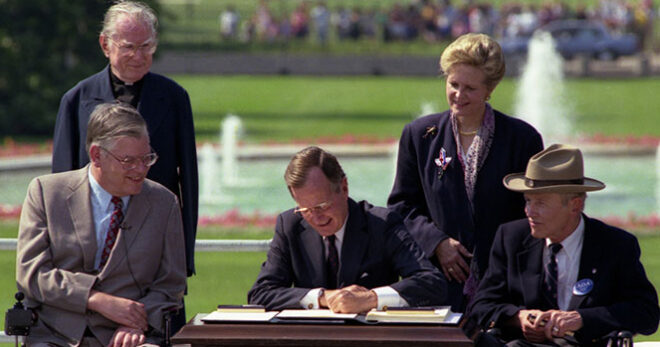
The photograph of the signing of the ADA is iconic.
Against the lush-green backdrop of the White House South Lawn sits President George H.W. Bush at a make-shift Resolute Desk, flanked by the prominent wheelchair users Evan Kemp and Justin Dart. Looking over his shoulder are Rev. Harold Wilke, born without arms, and Sandra Parrino, chair of the National Council on Disability. Behind them are the blurred faces of a throng of advocates.
We can reflect upon that photograph. But let’s not deny ourselves a true opportunity to give meaning to the real work of the ADA. We must not accept that memorialized moment 33 years ago as sufficient or even monumental.
Realizing the vision of the ADA is:
- Imperative if we truly wish to create a society that respects diversity, pursue equity, and values inclusion. That long-ago photo is startling in its lack of diversity outside of disability.
- Cannot be achieved on the backs of any one group of people. Instead, it must be viewed as a collective commitment that brings about a better world for everyone.
- Synonymous with deconstructing the antiquated and wholly inaccurate misrepresentation of disability as a form of human weakness or suffering. Let’s reconstruct disability representation to showcase the virtues that disability necessarily engenders: creativity, resilience, problem-solving, leadership, and compassion. These are all qualities we hold as most coveted.
- A commitment to creating a world in which everyone feels like she is a part of and we are all seen for our contributions, not the impediments we encounter.
- Recognizing its significance not only on July 26 but every day, by everyone and for everyone.
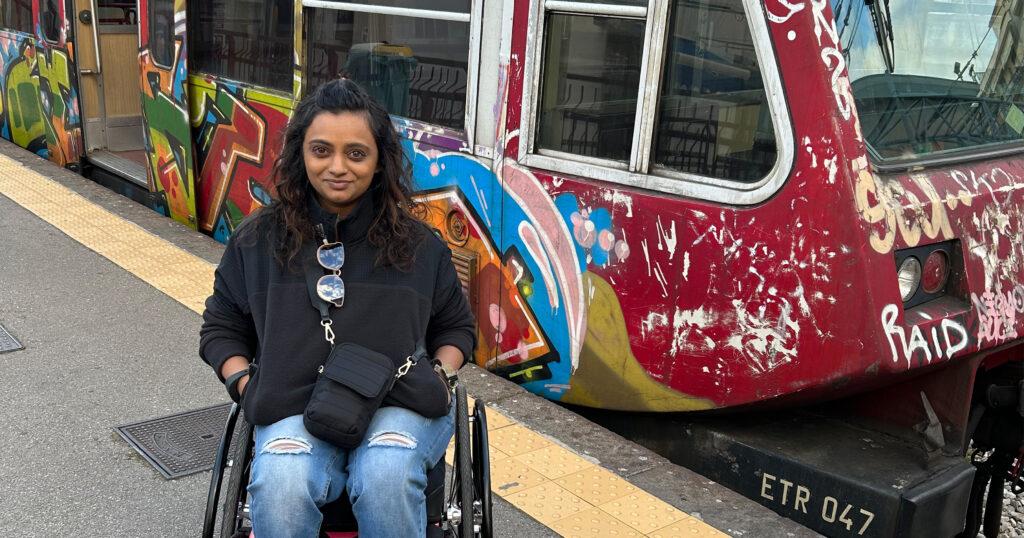
The image at the top is of our member Gretchen D’Souza and the image of the adaptive rock climber was taken at an event held by our Pittsburgh Chapter. For more information about the ADA, download our Understanding the ADA and other useful publications. United Spinal members may ask our ADA expert questions by replying to our monthly newsletter.
