After years of battling tumors on his spinal cord, Gene Murphy wasn’t sure what to expect when he became paralyzed in 2012. He never expected he would find a new cause and community he loved.
Riding the Internet to Success
As a businessman, Murphy, 59, made a habit of getting in on the ground floor of lucrative opportunities and riding the elevator to the top. In the 1980s he was selling Apple computers to schools, and wiring networks with a high school friend. He remembers telling his friend, “Everybody’s going to have to cable their building. They don’t have a choice; they’re going to have to do this. Our boss is getting the majority of the money, so why don’t we do it [for ourselves]?”
In 1995, the two friends started a technology-networking business called ProMedia in his friend’s basement. The printer was on the washing machine and the phone was on the dryer. They relied on contacts they’d developed in their previous companies. “We designed and installed the infrastructure —the computers, the wireless, the phone systems, the security systems — and we ran all the cable and put all the electronics in,” says Murphy.
At the same time that he was trying to get his start-up off the ground, he was diagnosed with tumors wrapped around his spinal cord at T10 and T12. Every few years he’d go in for another surgery and take steroids so that the tumors would subside and allow him to regain his mobility, only to grow back a few months later and render him at least partially paralyzed.
That rollercoaster ended in 2012 when he became fully paralyzed from the waist down once and for all. “I was done with all the steroids and all the surgeries and just thought, ‘Enough is enough, I’m just going to live my life now,’” says Murphy.
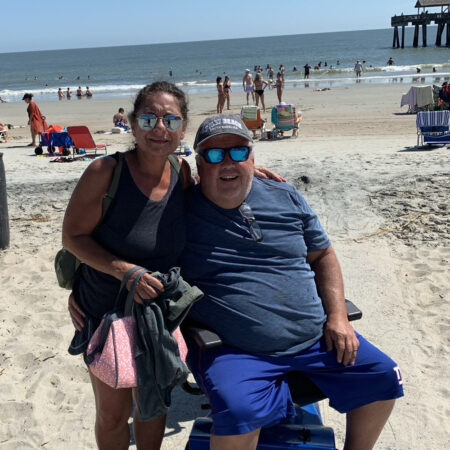 ProMedia was successful enough that Murphy and his friend were eventually able to sell it to a large Australian technology conglomerate in 2015. The sale gave Murphy the flexibility to live the way he wanted. Since becoming paralyzed, he has embraced the SCI community and used his business experience, influence and expertise to give back. “When I first became paralyzed, I stopped doing a lot of things in my life like flying to places, because I didn’t want to have to deal with the complications,” says Murphy. He found a welcoming refuge at Push to Walk, a nonprofit organization in Oakland, New Jersey. Push to Walk is an abilities-based gym specifically geared towards providing customized exercise programs for individuals with paralysis and other mobility issues. “When I went to Push to Walk, it was like ‘Cheers’ – everybody knew my name.”
Being there gave Murphy an opportunity to compare notes with other wheelchair users on how best to do the regular tasks associated with living with a disability. “I just loved going there, and they helped me so much physically and emotionally,” says Murphy.
He eventually joined the Push to Walk board and has fully embraced his role as a fundraiser and vocal advocate for the organization. He has enjoyed connecting with other organizations, such as United Spinal Association and the Christopher & Dana Reeve Foundation, getting involved in peer mentoring with newly injured people. “I went through some dark years focusing on what I couldn’t do, but after a while it clicked for me,” he says. “What I now try is to get through to people as a mentor: ‘Yeah, I get it. This isn’t fun, but don’t let it ruin your life. You still have so much to give and so much to accomplish.’ How you deal with it is a choice, and I make the case to choose to live life to the fullest.”
Don’t Complain, Share Your Lane
 Gene Murphy talks about how his SCI gives him a new appreciation for the little things in life.
“I appreciate everything, whether I’m out at a show with friends or hanging out with my family. Sometimes I look at nondisabled people who seemingly have everything going for them, and I don’t see the same attitude. For example, I go swimming at this beautiful gym with two pools, and there must be eight lanes per pool. Yet, when it gets crowded, so many people don’t want to share their lane with somebody else. They’ll make believe they don’t see them when they get in the pool, or they’ll complain: ‘I can’t believe I had to share my lane today. This is crazy.’ Meanwhile, I’m in complete amazement, like, ‘My God, you know how lucky you are? You’re here, you’re in a nice place with a beautiful gym, swimming in a pool and you’re complaining you have to share your lane with somebody?’ I’m telling people, ‘If you ever see me, you can jump right in my lane.’”
Can’t live without?
My Amigo scooter and my BraunAbility accessible van — because they give me the freedom to go anywhere I want.
 Has your disability changed how you parent?
I didn’t let it hold me back. I got involved in every aspect of their lives. I was very active in both my children’s lives, and I still am today in their adult lives.
Recreation that no one would expect?
I surf with Operation Beachhead on the Jersey Shore, by bodysurfing on a surfboard with grab handles.
Why did you join United Spinal?
I joined United Spinal to open myself up to the resources they have. One of the biggest things that truly helped me was NEW MOBILITY