

This month, we’d like to celebrate the contributions of women with spinal cord injuries and disorders (SCI/D) to the disability rights movement. Below are a few women leaders who helped lay the emancipatory groundwork for present-day campaigns for equality and disability empowerment. Our history should not be hidden history, and we encourage all members of the younger generations fighting for social progress to take this short list as a starting point for further reading and discovery.
Judy Heumann
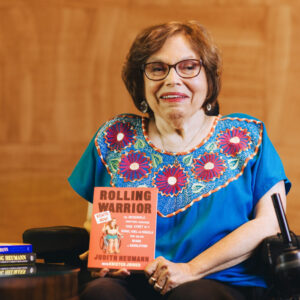 Judy Heumann, considered an independent living pioneer from Berkeley, CA, began her activism in NYC, where she grew up. After contracting polio at 18 months, her parents insisted that she attend public school, and battled to get her an appropriate public education before it was mandated by law. She went on to Long Island University and became a licensed NYC teacher. When she showed up for work, she was told she was ineligible for the position. Her response was to form Disabled in Action, a civil rights organization—still alive and well in NYC. She led sit-ins to get President Carter’s Secretary of Health, Education and Welfare, Joseph Califano, to sign the first set of Section 504 regulations, prohibiting discrimination against people with disability by recipients of HEW funds. (Primarily state and local governments.) Among her many other accomplishments and career landmarks, she was a cofounder of the World Institute on Disability, and served in the Clinton Administration as an Assistant Secretary of the Office of Special Education and Rehabilitation Services at the Department of Education, going on to blaze a trail for people with disabilities at the World Bank as an Advisor on Disability and Development. You may have seen her featured in the recent Netflix documentary, Crip Camp.
Denise McQuaid
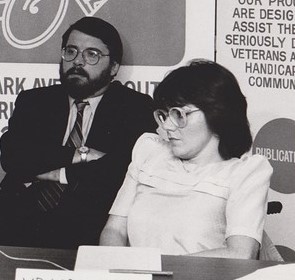 After contracting polio as a child, Denise McQuaid ran the first independent living center in Brooklyn, NY during the 1970s. She was an early disability activist and became a NYC folk hero (a song was actually written about her) when she quickly switched from sitting in her wheelchair to sitting on the first step of the bus on 7th Avenue in Midtown Manhattan, because the driver did not have a key to operate the lift. United Spinal Association, then called Eastern Paralyzed Veterans Association, had forced NYCT and MTA to buy accessible buses. The MTA decided that, despite having accessible rolling stock, the drivers would not operate the lifts. That policy changed because of Denise’s hours-long stand off with the authorities. When the lift finally was used to allow her to board, TV lights lit up the night as she smiled triumphantly. Ironically, Denise went on to become a transit executive and worked for NYCT in its paratransit division for decades.
Marca Bristo
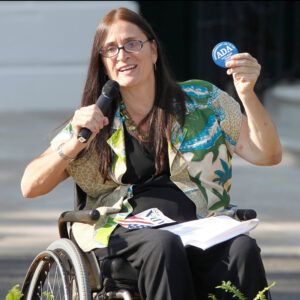 Paralyzed at age 23 in a diving accident, Marca Bristo went on to be a key player in the drafting of the Americans with Disabilities Act and was a formative figure in shaping the independent living movement as we know it. She founded the influential Chicago nonprofit Access Living in 1980, which initiated early and highly successful campaigns for accessible transit and schools, as well as for housing for people with disabilities. She was a plaintiff in the landmark Jones v. Chicago Transit Authority lawsuit, the settlement of which mandated wheelchair lifts on all mainline city buses in 1989, and, like Denise McQuaid, she engaged in daring civil disobedience to make our community’s voice heard. Her fight for accessible transit was a lifelong one: in later years, she collaborated with the CTA on its All Stations Accessibility Plan to make all the entire CTA rail system accessible to wheelchair users. Additionally, she went on to help found the National Council on Independent Living in 1982 and was its second president. Marca was nominated by President Clinton to lead the National Council on Disability in 1993, which she did until 2002.
Marilyn Golden
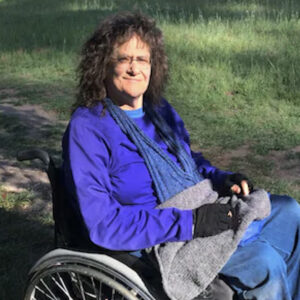 Marilyn Golden incurred a spinal cord injury while a college student. She was a quadriplegic who used a manual wheelchair. She was probably the world’s foremost expert on accessible transportation, and access to the built environment. President Clinton recognized this by appointing her to the US Access Board. She died in 2021 and was a longtime employee of Disability Rights Education and Defense Fund (DREDF) in Berkeley, CA. As United Spinal General Counsel Jim Weisman reminisced in his obituary for Marilyn, “Marilyn, a Senior Policy Analyst at the Disability Rights and Education Defense Fund (DREDF) in the San Francisco Bay Area for decades, was an expert. Her expertise was not limited to accessible transportation and accessible building design—although on those subjects, I watched her hold her own with the most hostile transit operators, the most reluctant builders, and the most reticent government officials. Her true expertise, however, was getting people to do what she wanted them to do.”