
All of us have talents, but some of us discover our talents after acquiring a disability. Quadriplegic Gilbert Tan, 56, used to design elevators, glass lifts and escalators before a spinal cord injury at 22 years old left him paralysed from the chest down. Formerly an architectural draftsman for Hitachi, the total loss of finger movement meant a prolonged period of adjustment and recovery. He spent six years in and out of hospital after the swimming accident.
“The first three years were the most difficult, a lot of adapting, arguments and quarrels in the family.”
While Gilbert admits that his art pieces in primary and secondary school were “above average,” he had never seriously dabbled in painting. “[Just] fooling around with poster colours,” he said. As a draftsman, he was familiar with measured drawings and two dimensional, “black and white type of architectural drawings.” “I did learn a bit of interior design so I know about perspective and composition, that sort of stuff,” he said.
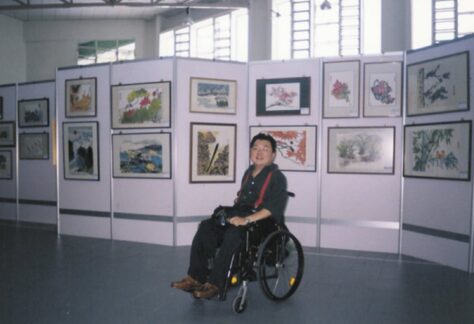
It was only during his recovery period that he was told of a local mouth artist who similarly experienced an injury to his cervical vertebrae. “During one of those hospital stays I was told of Tan Kok Leong and I was shown his paintings. When I was discharged, I went back and started trying out what I had started in secondary school.”
Self-depreciating in his assessment of his early drawings, Gilbert started to delve deeper into his art, starting with Chinese ink painting. “My first few paintings were quite ridiculous,” he laughed. He steadily progressed and got a certificate in Basic Western Art from Nanyang Academy of Fine Arts (NAFA) once public transport became accessible.
“I went to NAFA to paint with other students. Out of 15 [students] in the class, in the end [there were] only three. They gave up. I got my certificate in Western Art after 20 years of painting. I sort of roughly knew the sort of things I should avoid.”
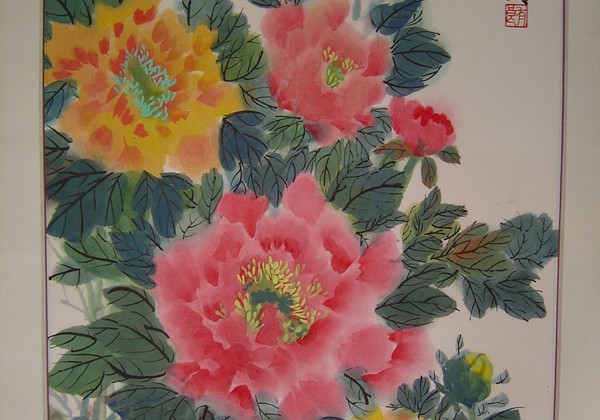
The NAFA course taught him pencil sketching, water colours and charcoal. “Some people don’t know. [They said], ‘Wah, you bite the charcoal!’ But I use a brush where all the bristles drop out and I stick the charcoal stick inside. Anyway, I said [to them] charcoal is cleansing, you eat charcoal when you have diarrhoea.”
An associate member of the Mouth and Foot Painters Association since 1994, his paintings have been exhibited in seven countries, with some being permanently displayed in the Smithsonian Institute Washington DC, London and San Francisco. “I was asked by Handicaps Welfare Association to donate a painting and the Smithsonian Institute selected this one. People bought others – I was surprised they were willing to pay money for this,” he laughs.
Gilbert has pushed himself in different ways in his art. One was during a live telecast of a fundraiser for a local charity. Partnering with Hong Kong celebrity singer Frances Yip, he completed a Chinese ink painting within two songs. Another way he literally stretched himself was in one of his biggest paintings of a peacock.
“I had to fold the rice paper sideways and paint the peacock in three different foldings. [I had to] turn sideways to paint the rock, because my neck is not that long. [I had to] fold it in such a way to reach the paper canvas.”
In an article he wrote on his blog about mouth painting, he describes the initial, painstaking process of figuring out how to hold the brush and control his brushstrokes. Even the smallest involuntary movements of the face and body could lead to problems when painting.
“At first, I was thinking rather naively that placing it between lips would be enough leverage to paint. But it proved otherwise. The rubbery lips were too weak to control the brushstrokes […] the solution in the end was to actually bite the brush with the back molars.”
“A particularly unpleasant problem was drooling. Saliva dripped out of mouth edges as attempts to reposition brushstrokes proved erratic, even clumsy […] Unwanted blotches appeared on the paper even when I breathe too deep. Thus, there is a need to restrain each corresponding gasp of air and be aware of every facial muscle twitch. So breath control is vital for brushstrokes that need to be finely executed. However, blinking my eyes is a luxury to freely do without any visible impact. Thank God!”
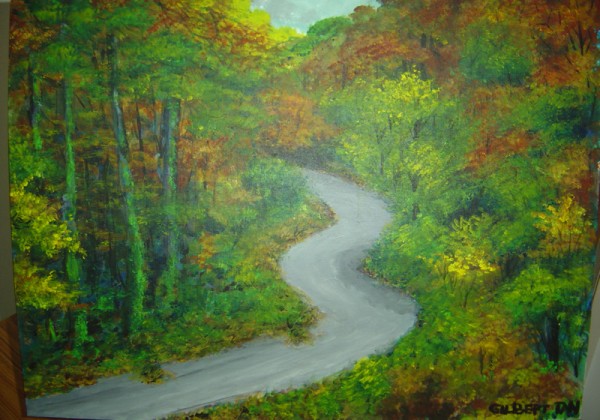
After 25 years of painting, Gilbert does not paint much anymore. “My body aches and pains are taking a toll. I’ve done thousands of paintings and recently discovered that my gums and teeth are developing pain from biting the brush. The neck aches and muscle knots… these are the things that make me ask myself if I want to push myself so hard?”
Perhaps after retiring from painting, Gilbert will enjoy other forms of visual entertainment instead. “I’m 56 this year, I’m quite happy. In June [2016] I got my concession pass for ‘Popcorn Tuesday’. Once you’re over 55, you get half price [at the cinema].”
“Which is great, I’ll go to see blockbuster movies instead!”
Be sure to share Gilbert’s story with others to encourage to try new things – they just might discover a hidden talent!
