
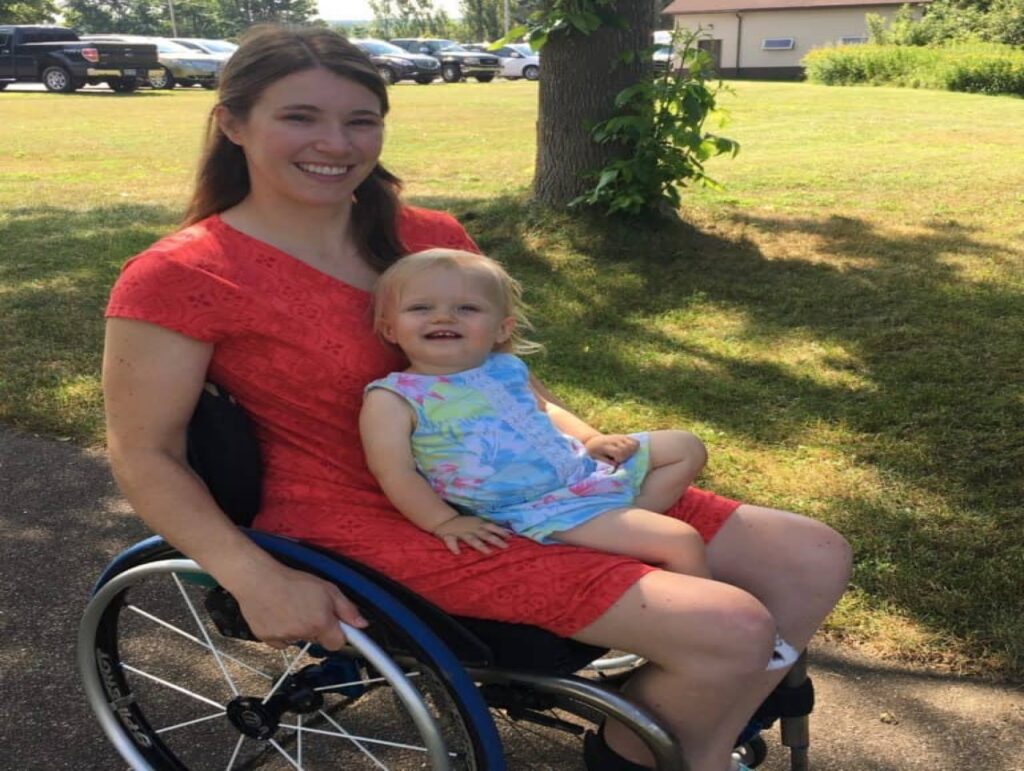
“One of the things I love about kids is that they are unfiltered. They don’t know about being polite or politically correct or not asking certain questions for one reason or another,” says Kelly Brush Davisson, a paraplegic. Kelly works as a Nurse Practitioner with many of her patients being children.

Kelly states that often children react to her wheelchair in ways that adults would see as inappropriate. She says, “…before I can even introduce myself the 5-year-old says, “Why are you in that?”. My response is usually the same, “What do you mean? [pause] Oh, my wheelchair?”.
Kelly states that children’s reactions to her wheelchair varies greatly based on their age. Some children stare at Kelly’s wheelchair and appear very curious. Kelly’s favorite reaction from children is when they ask, “Why do you need that?”
“I much prefer kids—and adults—to ask about my chair than to either stare or just wonder silently and not ask.”
“People are curious because it is something different that they don’t understand. They aren’t trying to be hurtful or inappropriate, they are just trying to learn and understand. I love that! I want to explain!,” says Kelly.
Kelly’s responses vary depending on the child’s age. “It is typically some variation of, “I hurt my back a long time ago so now my legs don’t work well so I use this to get around,” she says. Kelly continues to say she immediately shows the child something cool about her chair rather than having them feel sorry for her.
“If a parent or older kid asks I sometimes elaborate more about how my spinal cord was damaged. Often that’s followed by, “Oh, I’m sorry” or “That’s too bad,” for which I respond, “It’s not bad, I’m still able to do everything I used to do.”
Kelly is interested in seeing how children’s reactions will change over time, especially the children that know her well. For example, Kelly has a daughter named Dylan. She says, “I’m sure one day Dylan will ask about my chair and I bet there will even be a day that she’s embarrassed that I’m in a chair (I mean, I’m her mom, it’ll just be one of many things that will embarrass her…). I also hope there will be a day that she’s proud. But most of all, I hope that when people ask her about why her mom is in a chair she comes up with an answer that she’s comfortable with and explains it simply, just like I have with my patients.”