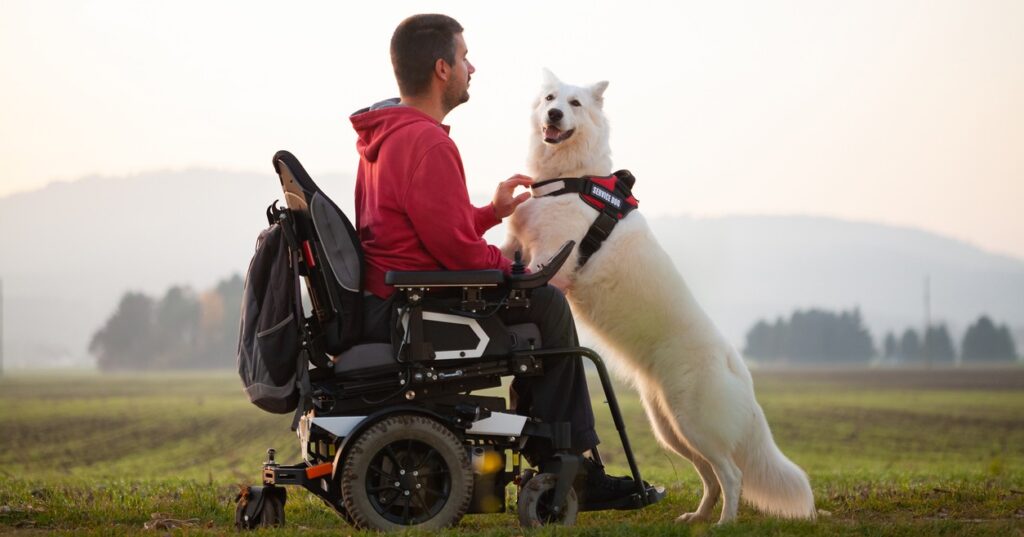
Care support comes in many shapes and sizes, and we do not want to overlook the care that our four-legged friends can provide.
The United Spinal Association Care Support Working Group members share lived experiences to provide information on service dogs and the profound impact that these incredibly intelligent and highly trained dogs have on the disability community.
Types of Assistance Animals
- Service Dogs are trained to perform specific tasks for people with disabilities.
- Future Service Dogs are in the process of learning how to assist someone with a disability.
- Facility Dogs work full time in healthcare, rehabilitation, criminal justice, or education settings to help patients achieve treatment goals.
- Emotional Support Dogs provide comfort for people with mental health conditions.
- Therapy Dogs are certified to visit facilities like hospitals, schools, or nursing homes to provide comfort and companionship.
The United States Department of Justice regulations implementing Title II and Title III of the Americans with Disabilities Act provide a clear definition of a service animal:
“A service animal means any dog that is individually trained to do work or perform tasks for the benefit of an individual with a disability. Under the ADA, governments, businesses, and organizations that serve the public generally must allow service animals to accompany people with disabilities in all areas of the facility where the public is allowed to go.”
If the dog only provides comfort and emotional support, it does not qualify as a service animal under the ADA. Emotional support dogs are not trained in tasks and do not have the right to go into public entities. If the dog is trained to perform a task related to a person’s disability, it is a service animal under the ADA.
This distinction is extremely important. According to Canine Companions, when untrained pets or poorly trained service or emotional support dogs are in public places where they are not allowed, it can result in a negative impact on people with disabilities and the trained service dogs they rely on for independence.
Within the service dog category, many are trained for specific tasks, according to the United Disabilities Services (UDS).
- Allergy Detection Dogs can detect and alert to the odor of allergens, such as peanuts, gluten, or eggs, before the person even comes into contact with it.
- Autism Service Dogs assist people with autism navigate social settings by providing companionship, help with making connections and interrupting harmful behavior.
- Diabetic Alert Dogs alert their person to highs and lows in blood sugar.
- Guide Dogs help blind and low-vision individuals navigate the world. They use selective disobedience, which means they obey commands but still make choices based on their own assessment of a situation.
- Hearing Dogs assist their deaf and hard of hearing partners. When the dog hears a particular cue, such as a fire alarm, doorbell, alarm clock, or the person’s name, they alert their owner.
- Mobility Assistance Dogs are paired with people who have a spinal cord injury, brain injury, muscular dystrophy, arthritis, or cerebral palsy. They help with everyday tasks such as retrieving objects, opening doors, and turning on lights. Some are trained to brace their person with balance issues, pull their owner’s wheelchair, or help with transferring.
- Psychiatric Service Dogs help people who suffer from depression, anxiety, and post-traumatic stress disorder (PTSD). They sense when their owner may be experiencing negative symptoms.
- Seizure Alert Dogs are trained to assist their owner before, during, and after a seizure. They can help their owner regain consciousness, move them away from an unsafe place, use deep pressure stimulation to help stop a seizure, and bring medicine.
Rules for Service Dogs & Handler Responsibilities
A properly trained service dog is always under the control of the handler. According to the ADA, rules and responsibilities of having a service dog include:
- The dog must be housebroken.
- Covered entities are not required to care for, supervise, or clean up after the dog.
- The dog must be vaccinated according to state and local law.
- The dog must be harnessed, leashed, or tethered.
Common Misconceptions About Service Dogs
- There is no requirement for service dogs to wear any identification such as a vest, or for the owner to carry identification to prove that the dog is a service dog.
- A service dog can be any breed of dog, even in locations where specific breeds are banned.
- There is no requirement for service dogs to be “certified.” Some organizations sell service animal certification or registration documents online. These documents do not convey any rights under the ADA, and the DOJ does not recognize them as proof that the dog is a service animal.
- Service dogs are not required to complete a professional training program. Owners can do their own training.
View this post on Instagram
Laws Protecting Service Animals and Their Owners
Federal Legislation that protects people with disabilities and their service dogs includes:
- Americans with Disabilities Act of 1990 – Mandates that service dogs are allowed to accompany their owners in most public places where the general public is allowed.
- Air Carrier Access Act of 1986 – United States air travel providers are required to recognize service dogs as working dogs and therefore can accompany their owner on domestic flights.
- Fair Housing Act – Prohibits the discrimination of individuals seeking rental housing by landlords or rental agencies. This means that people with disabilities who use a service animal are exempt from general policies that restrict pets, animals based on size or breed, or require a pet fee.
- Section 504 of the Rehabilitation Act – Prohibits discrimination against people with disabilities in federal government facilities and entities that receive federal financial assistance.
When at a public facility or a place of public accommodation, a person with a service animal can only be asked two questions.
- Is the animal required because of a disability?
- What work or task has the animal been trained to perform?
A person cannot be asked about the nature of their disability or if they have proof or documentation proving that the dog is certified, trained, or licensed as a service dog. A person also cannot be required to pay a surcharge, even if people accompanied by pets are required to pay fees or be denied access based on the breed of their service dog.
Denied Access?
Nicole and her service dog, Olive, have experienced being denied access due to an owner of a local restaurant who was not educated on the rights of service dogs and their owners.
“When I returned home, I politely sent him information on ADA laws and explained that it is not a violation, and he could not ask the questions he did. I also contacted the County Health Department to help educate him,” she says.
As the owner of a service dog, it is crucial that you know and understand your rights. If you experience any denial of access, it is important to report the incident. You can take the following steps:
- Remain calm but assertive
- Politely explain to the person responsible for the refusal that your service dog is trained to perform specific tasks that assist you with your disability
- Provide information about the laws that protect your right to have your service dog with you in public spaces.
- If you are still refused entry, ask for a supervisor or manager.
- Document the incident, such as the date, time, location, and the names of any individuals involved. Photographs and videos can be helpful when reporting the incident.
- Contact the appropriate authorities, such as your local disability rights organization or the Department of Justice to file a formal complaint. You also have the right to file a private lawsuit in Federal court, which will charge the entity with discrimination according to the ADA.
File a Complaint
- Issues with Employment – File with the Equal Employment Opportunity Commission (EEOC)
- Issues with Air Travel -File with the Department of Transportation (DOT)
- Issues with Housing – File with the Department of Housing and Urban Development (HUD)
The National Empowerment Center lists Protection and Advocacy Systems by State. Here, you can find your designated protection and advocacy system that offers advocacy and assistance with legal and civil rights issues pertaining to disability.
The ADA specifies that the only time service animals can be excluded is if admitting service animals would fundamentally alter the nature of a service or program. In addition, if a particular service animal is out of control and the handler does not take effective action to control it, or if it is not housebroken.
Nicole & Olive
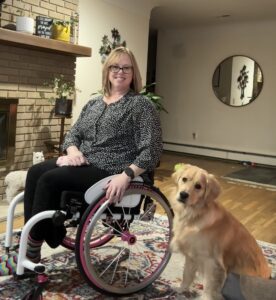 Nicole Roy has a spinal cord injury, and she expresses how much her service dog, Olive, has positively impacted her life.
“There is a unique bond built between a service dog and handler that goes beyond any relationship you have with pets. Olive and I have truly bonded, and she has learned a lot about my needs and alerts me when my blood pressure spikes. She helps with nerve pain and spasms by laying on my legs and helps to calm me down. The level of trust is amazing,” she says.
“Having that extra support gives me peace of mind,” says Nicole. “Knowing she can assist with tasks like opening doors and picking up things I drop is really helpful when my pain levels are high. The fatigue is debilitating at times, and her support makes a big difference.”
Shanta & Jzoc
Shanta Favors is a member of the Care Support Working Group and former Ms. Wheelchair Michigan 2024. In this Q&A, she shares her experience with her service dog, Jzoc.
How has a service dog positively impacted your life?
My service dog has truly transformed my life in ways I could never have imagined! He is more than just a companion. He’s my unwavering support system, guiding me through daily challenges with boundless loyalty and care. With him by my side, I feel a renewed sense of independence that allows me to conquer life’s hurdles with confidence, minimizing feelings of anxiety and isolation.
He empowers me to engage fully in various activities, whether I’m at home or exploring the community. From expertly helping me with my compression socks to retrieving items I can’t reach, he eases muscle spasms and seeks help when I need it most.
Why do you feel that a service dog is an important aspect of care support?
Service dogs are extraordinary companions that go beyond just providing physical assistance; they are lifelines of emotional support and guidance. This remarkable partnership not only enhances independence but also fosters an unbreakable bond, ensuring that no one ever feels alone.
The profound impact of these service dogs enriches lives, instilling hope and confidence, making every day a testament to the power of unconditional love and support.
What would you like people who are not familiar with service dogs to know or be aware of?
Service dogs are not pets; they are working animals with a unique role that requires focus and discipline. Awareness and understanding of their role can promote a more inclusive environment and enhance societal support for those who rely on service dogs for assistance.
Resources
Online:
Service Animals and Emotional Support Animals
Frequently Asked Questions about Service Animals and the ADA
International Association of Assistance Dog Partners
United Spinal Association:
Traveling With A Service Animal
New Mobility:
Service Dogs: Making the Grade
Everyday Advocacy: Hospitals and Service Animals
Grieving the Loss of a Service Dog
Join our Care Support Working Group to collaborate with advocates from across the United States. Find support through our virtual events. Sign up for our newsletters.