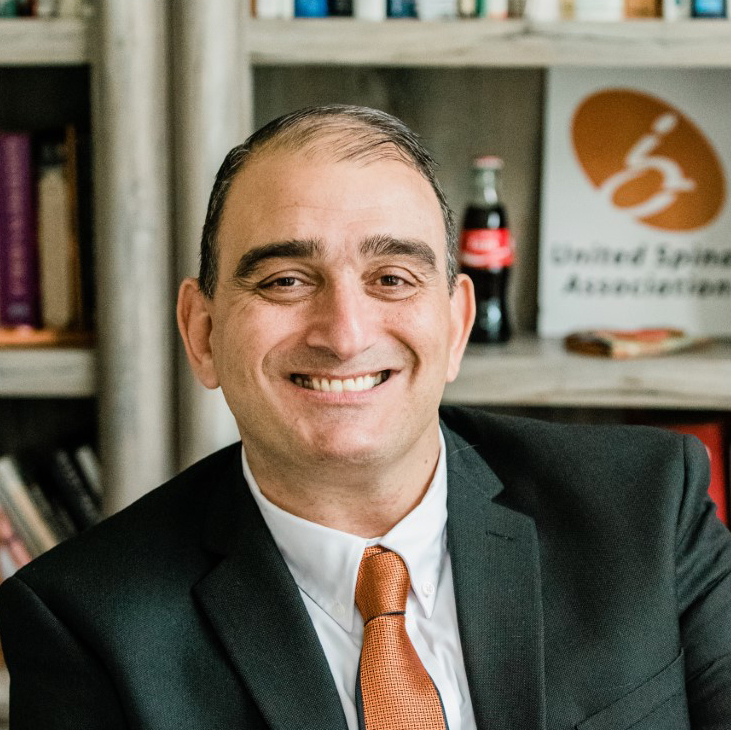
President & CEO
United Spinal Association
The occasion of Hispanic Heritage Month is always interesting for me, as someone with a strong and living relationship to Venezuela, the United States and Italy—and as someone with a heavy identification with the disability community.
The definition of an American is fluid enough—at least to right-minded people—that I feel a deep sense of belonging in the US, while inhabiting multiple national and ethnic identities at once.
I’m not only a Hispanic immigrant to the US—I’m also the child of Italian immigrants to Venezuela. When I was a kid, I never felt like I was fully Venezuelan—I was called the Italian kid. When I came to the States, I was called the Latin guy. And here’s the kicker: when I go to Italy to visit my relatives, Italians call me the American.
So, who am I? I answer that question through the work I do with my fellow Hispanics, with people with disabilities and my Atlanta, GA community. Of course, our identities originate from things we cannot control—but their meanings are not necessarily fixed. We produce our identities through the work we do and the people with whom we collaborate on what’s important to us. We give these identities meaning through our social relationships with other individuals, with our neighborhoods and cities, and with institutions.
I learn about myself as a person with a disability through my lived experience as a disabled man, my work as a disability advocate, my experience running multiple nonprofits and the volunteer work I do for my church—my community gives my life and work meaning. Likewise, I experience being Hispanic in America in a similar way. In turn, I impart my experiences as a Latino with SCI/D to the disability community as best I can, going beyond the frame of being “the Latin guy” in America to actually establishing material ties between people with disabilities in my country of heritage and in the United States. The other nonprofit in which I am involved, Wheels of Happiness, gives direct assistance to wheelchair users back home in Venezuela.
Being a socially-conscious Hispanic in America isn’t just about an immigrant experience in the US—it’s also about internationalism. The disability community is global, and we need to act like it. Especially in times where climate change, authoritarianism, famine, and other factors threaten so many of us, with the effects most sharply felt by people in the developing world, the perspective of Latin immigrants in America doesn’t just shine a light on racism or xenophobia in our adopted homes—it brings a perspective on issues that unite all of us across borders.
Moreover, when we turn our attention to our adopted home in the United States, we need to focus on the people who are underserved. My wife and I are extremely lucky to have come here for a graduate school education that pointed us on an upwardly mobile path. I am also keenly aware that this is not the situation for many of my fellow Hispanic immigrants.
I hear the stories of United Spinal members who are undocumented immigrants from Latin America, and they are predictably frustrating and unjust experiences of exclusion from the benefits of living in the richest country in the world. It is hard enough for individuals with disabilities to seek out accessible places to work and live. For those of us who are recent immigrants, this task becomes twice as monumental.
If our identities are given meaning by the practical work we do with others and the advocacy we do on behalf of ourselves, we should think about intersectionality the same way. When organizations like United Spinal work with disabled members of immigrant communities to overcome language barriers and legal threats to undocumented members of those communities and help obtain adequate healthcare, accessible housing, and opportunities to comfortably settle in the United States, that gets at what such an intersectional practice should look like.
In the past generation, Hispanics have been the primary driver of labor force growth—without us, it would have been downright anemic. The pandemic made “essential worker” a household term—and that is precisely what we do. We help build, we help feed, and we help move America. We also now occupy 10% of all managerial jobs in the United States, up from 5% at the beginning of the century—we are moving on up.
On the other hand, people with disabilities have been historically excluded from the labor market, with many of us driven to give up, demoralized. An intersectional practice would also tap into the dynamism and forward motion described above, and link people working for Hispanic advancement in the United States with their peers in the disability community who have been stonewalled by ableism.
The vitality of the Hispanic community would not be possible without one of our best qualities. I feel like my house has always been full of relatives, friends, and neighbors cooperating, collaborating and weathering life’s ups and downs together. Straddling the individualistic world of the US and the more collectivist culture from back home hasn’t always been easy, but it has always been rewarding (and sometimes a bit awkward—especially for my kids.). Fostering mutual trust and identifying with something bigger than yourself to provide a community of care and support is something that we bring from Latin America to US society.
It’s this multicultural perspective that’s helped me realize that it’s only when we come together collectively in a genuine and inclusive way that we can ensure the maximum possible freedom for the individual and move our society forward . People with disabilities should be able to live as independently as possible—for Hispanic people with disabilities, independent living is also contingent on being able to live a life as free as possible from racism and xenophobia. Behind lives of fulfillment are complex structures of support and years of anti-racist and civil rights campaigning.
This Hispanic Heritage Month, let’s pledge to do the work that expands the definition of freedom to match the lived reality of everyone in our communities—and replaces stigma and internalized ableism and racism with pride. On this occasion, I am especially proud to be a disabled Hispanic American.