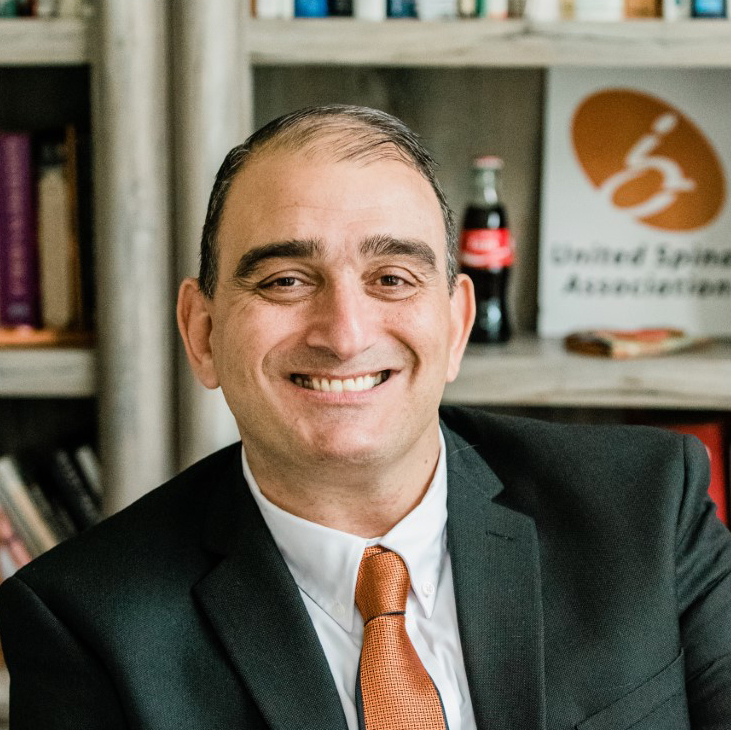
President & CEO
United Spinal Association
Many people with disabilities find themselves contending with dual stigmas based on structural discrimination and outdated attitudes: the stigma of disability and the stigma of mental illness. According to the CDC, 32.9% of people with disabilities living in the United States experience frequent mental distress, nearly five times more often than people without disabilities—with more than half of all people with cognitive and mobility disabilities reporting mental distress.
Those of us in this position are forced to navigate two separate complex systems of care in order to achieve the same goals: wellness, social integration, independence and a high quality of life. This comes with battles for recognition and an understanding from mental health professionals of what it means to be a person with a disability—and a struggle within ourselves to unpack how our experience of disability in a world that can be inaccessible, unaccommodating and ableist brings to bear a heavy weight on our mental health that can last what seems like a lifetime.
Moreover, often times professional health is only available if we are fortunate enough to be able to access mental health services, and if we are confident and self-assured enough to obtain care appropriate to our needs, rather than be discouraged by bad experiences or shame. Mental healthcare occupies a difficult place in the healthcare landscape where the right practitioner can be hard to find—and potentially out-of-network, and therefore, out of reach. This is compounded by needing to find someone who has the cultural competence, intellectual background and specialized experience and training to work with people with disabilities. However, with advancements in telerehab and telehealth, accessing therapy has become easier in today’s landscape than ever before. Physical barriers, like having the right transportation to get to and from therapy sessions no longer have to be an additional hurdle for some people to overcome as they can receive therapy virtually from the comfort of their own home.
Because of my own personal experience, I know first-hand how transformative therapy can be—and how much one can be left wondering about what could have been accomplished while it was deferred. When I was little, I was affected by spells of depression that impacted my childhood: in particular, my social life. I never did anything about it, except seek temporary catharsis in blasting loud music before going to school. I thought that being sad was the inevitable consequence of my “bad luck,” and chalked it up to life simply being sad. In retrospect, if my parents or I had realized that I was clinically depressed and sought help, my childhood and adolescence could have looked quite different.
Since I started addressing my depression with professional help, my relationship with my family and friends improved dramatically. I became more optimistic, positive, and most importantly, just plain happier.
What is interesting is that I first received therapy intervention because my doctors anticipated that I would be depressed because of my injury. What my injury did—besides worsening my depression for a period—was it allowed me to accept my depression. The thing is, there are people that snap out of clinical depression and grief that results from injury—and some don’t. We need to normalize the vast variety of ways people deal with this experience, and make it acceptable to have highly uneven, or even difficult, paths to emotional recovery. We need to think about it more like how some of us suffer from excruciating neuropathy, while others are unscathed. Therapy and medical intervention need to take into account the multiplicity of the disability experience with mental health.
I also want to say that we need to be very careful with “toxic positivity.” I am sure that readers have encountered people that are incessantly positive after their injury, sending the message that if you struggle with depression, anxiety and other mental health issues, it is your fault, because it is solely a matter of willpower, attitude and personal responsibility.
However, I want you to know that sometimes, you cannot do it without help, just as you cannot address an allergy by yourself. The fact that some people can do it on their own in no way invalidates the experiences of people who need professional help. We need to embrace each other’s experiences and differences. Seeking help is your right and United Spinal Association and government agencies can empower you to do so.
Our goal should be to remove the historical stigma around having mental health issues—to normalize them so that that they are regarded like high blood pressure or cholesterol. When we look at issues with our physical health, the context of that things we cannot control, like environmental factors and genetics, is taken into account. Unfortunately, many remain quick to blame mental health issues on personal failings and slow to look at the overall context in which they arise. We can change this, and highlight the similarities to make it even more clear. In both cases, what we can control is treatment, pharmaceutical solutions and the behavioral changes and changes in outlook they encourage.
I have been doing a lot of thinking about how an organization like United Spinal can step up to help members of our community achieve a greater understanding about their own mental health journey and seek help—or speak up for themselves to obtain the right help. We understand the complex position our members with mental health needs are put in. This is one of the reasons why mental health became an important pillar of our Strong Wheeled Together campaign.
Not only do we need to educate and inform mental health professionals about the needs of our community, but we need to be practitioners ourselves and represent our community in the field. Having a bigger and authentic presence will also strengthen our community network—something we are aiming to achieve, while at the same time being bold about the mental health issues our community faces throughout the course of their journey.
We will be developing educational materials and resources for both members of our community as well as mental health professionals who work with people with disabilities. We also hope that throughout our Strong Wheeled Together campaign we can destigmatize, normalize, and validate the mental health issues our community often encounters. Look for our “Mental Health Monday” weekly posts on our social media channels to learn more!
We take care of ourselves so that we can take care of others. Mental health is an instrumental component of wellness for you and your loved ones, so don’t let the stigma and false perceptions stop you from advocating for yourself. It is ok to say that you feel blue, and it is ok to seek help when you are blue.
*****
Policy Corner:
- The Biden Administration, in acknowledging that the COVID-19 pandemic has deepened an existing mental health crisis, has proposed a raft of measures in the 2023 Budget to robustly address this area of need. Community-based centers and clinics and mental health staff in schools would receive increased funding, programs for young people and those at risk of suicide would receive unprecedented backing, and the budget would also fortify our nation’s crisis services and National Suicide Prevention Lifeline.
- The Substance Abuse and Mental Health Services Administration, a branch of the Department of Health and Human Services, is devoting almost $105 million of grant funding (thanks to the American Rescue Plan) to support the National Suicide Prevention Hotline as it transitions to becoming a 988 dialing code and to bolster the crisis response system around it to make this transition especially impactful. Response rates, staffing capacity, and reliable routing of the calls are special priorities.