
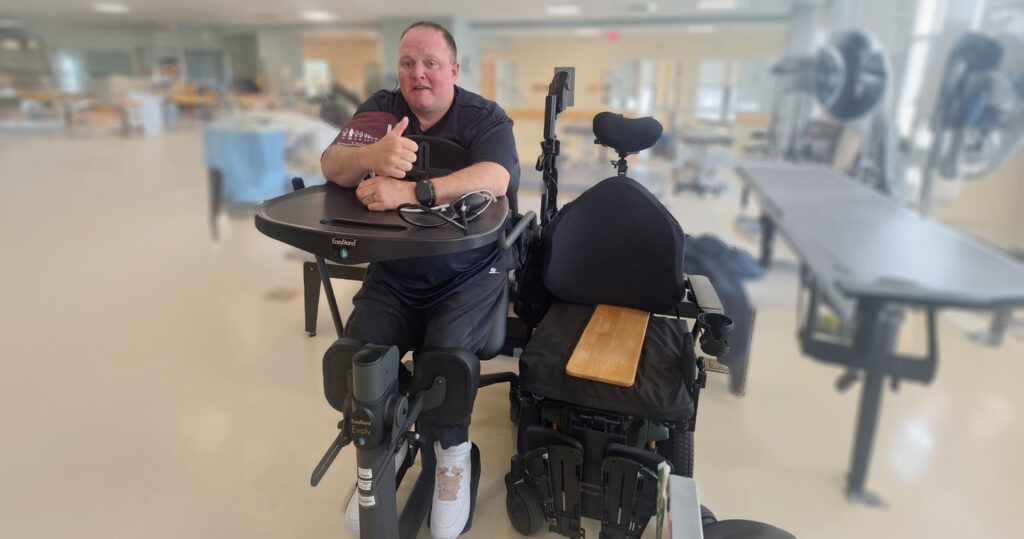
Shane Butler is no stranger to dealing with the complexities of life after spinal cord injury. He got his first introduction to SCI life after a 2008 car accident that left him with spinal fractures from T9-12 and degenerative arthritis.
Butler relearned how to walk and manage the complications of his injury. Then, over ten years later, he broke his neck in a diving accident, acquiring another, more significant spinal cord injury at C6-7. This new injury left him a full-time wheelchair user and presented other complex issues, including pressure sores, prompting Butler to look for new solutions.
Butler had heard about United Spinal Association’s Resource Center during his stint in rehab and he became a United Spinal member. The Resource Center connected him with Jane Wierbicky, an information specialist with over 30 years of experience as an SCI/D nurse.
Wierbicky was instrumental in helping Butler develop a multi-pronged approach to managing his pressure sores. “She helped me figure out how to take care of them, sending me the information on the exercises to do in bed and how often to do the pressure reliefs,” Butler says.
Weirbicky says she treated Butler the same way she treats everyone who contacts the Resource Center. “We really want to help. It doesn’t matter if you’re a wheelchair user or have a family member who uses a wheelchair, whether you’re looking for information on health complications, how to pay for home modifications or want to find better options for rehab. We try to take the time to get to know someone’s needs and then connect them we the best information we can.”
In addition to pressure sore management, Weirbicky connected Butler with Molly Sebo at the SCIBoston chapter of United Spinal, who encouraged him to apply for the Travis Roy Legacy Grant Program. These grants are for individuals with SCI/D who demonstrate financial need and can help cover the cost of durable medical equipment or vehicle modifications up to $5,000. Butler used this funding to obtain a special mattress to help prevent pressure sores.
SCIBoston also paired him with a peer mentor with lived experience as a wheelchair user. “I have a mentor, Jerry. I talk to him all the time, whenever I’m going through those insane moments that we can’t handle. You have somebody that you can go to that understands,” says Butler.
Butler still keeps in touch with Wierbicky. “I check in with her and give her the updates on everything that’s going on with me, because she’s been one of the most helpful resources that I’ve had. She knows the ins and outs of everything that’s going on in my life and helps me navigate the next steps.”
United Spinal’s Resource Center and Chapter Network provides a lifeline for people like Butler and strives to provide comprehensive support to the SCI/D community.