
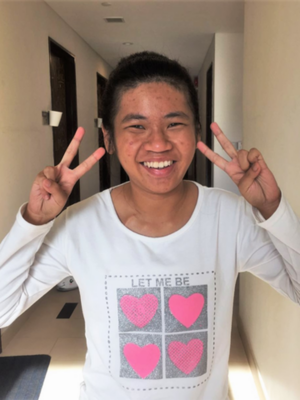
Since she was a kid, Charmaine Tan thought up of many strategies to keep reading. Born with retinitis pigmentosa, a progressive deterioration that causes eventual total vision loss, Charmaine had tunnel vision and only lost her ability to read two years ago.
“I could see a bit, but not very good. The other kids want[ed] to play running around. It was hard for me to play [but ] kids don’t understand that. I [would] just sit at the side and read my book.”
Having just started her degree in English Literature at the National University of Singapore and currently living by herself in the campus hostel, Charmaine is used to facing challenging situations after years of education in mainstream schools. The choice to go to a mainstream school was a happy coincidence, a choice made for her because of her tendency to get travel motion sickness. “Most of the blind children go to special schools, but I couldn’t go because it was too far for me.”
As the only blind student in all her schools, she faced some situations that she laughs at, in retrospect.
“My teachers, they tried very hard to help me. They tried to write very big on the whiteboard, but because my condition then was is tunnel vision [small vision field, like looking through a small hole], so that didn’t really help.”
Charmaine admits to being a “very shy kid” and was not able to communicate her needs to her teachers. “I would just say, ‘Oh I can see this, I cannot see that.’ They were very confused, and they would put the paper close to my face and say, ‘Can you see this?’” She feels that if teachers are given more information on what visually impaired children can or cannot do, they would be able to better help their students “grow and find themselves”.
15 years on, she feels that society in general has more knowledge on and awareness of visual impairment. “Right now, I feel like people are more aware that there is such thing as total visual impairment, partially blind or totally blind. They are aware of the differences and they are aware that there are different conditions. Back then, I was just blind to them.”
When she was a student at Pioneer Junior College in 2012, her usual way of reading (with a magnifying glass) was starting to become difficult as she was gradually losing her sight. Audio software, introduced to her by her junior college, reduced her dependence on other people to read out her textbooks to her.
Due to frequent hospitalisations during her junior college days because of renal failure, Charmaine took five years to complete her A Levels. She used much of this time to learn to use a computer, to type, and use word processing programmes and other software. “In secondary school and primary school, I was exempted from any e-learning or any projects. The teachers just said, ‘Okay, you are blind, you don’t have to.’”
“They [thought] that they were helping me, and I [thought] that they were helping me also, because I didn’t think that computer skills were useful then. I came to [junior college] and learned computer skills. And right now, there are still many things I haven’t learned yet. It’s a bit late, but it’s not too late, I hope.”
Learning from the many incidents of miscommunication in her academic life, Charmaine wants to become a literature teacher. “I like to encourage people to be willing to communicate with each other positively. And not be afraid of what you say. At the same time, you should be considerate of others’ feelings.”
“It’s my way of contributing back to society. The thought of being a teacher and hoping to educate the next generation and make it a better one.”
This article is a part of our #AbleFamilies campaign in Singapore. Stay tuned for real life stories, advice and experiences from people who believe in and represent the potential of all kids. By now empowering the thousands of kids with disabilities in Singapore and supporting their parents and caregivers, we strengthen the next generation of citizens to promote a more inclusive Singapore.
