
“Most parents worry about how good a job they’ve done bringing up their children. But having a profound disability gives me some additional pause for thought.”
Mike’s words echo the sentiments of many parents who live with a disability. Mike is blind, and he recently shared this thoughts on how his visual impairment affected his daughter Caitlin, now an adult, as she was growing up. Caitlin admits that she still has difficulty telling new people she meets that her dad is blind. Not because she is ashamed, but because people most often assume that her dad is helpless. “And then I think they must consider me unusual as well, because I’m your daughter,” says Caitlin.
But Mike isn’t helpless. And his reliance on Caitlin for assistance for everyday matters as she was growing up hasn’t negatively affected Caitlin as some research might suggest.
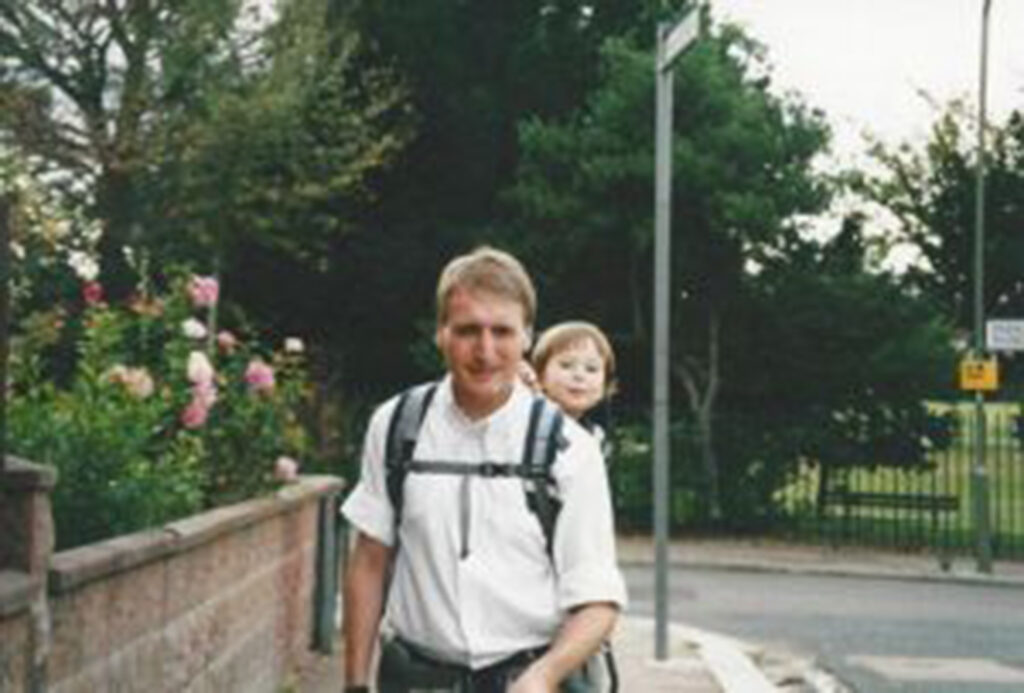
When Caitlin was a baby, Mike recalls how he used to carry her in a backpack:
“Before Caitlin got too big, I could simply strap her into the baby-carrier and head out, wherever I wanted, using my white cane to walk. … I felt so proud carrying her while, over my shoulder, she chattered on about her day. I was in charge, like dads are supposed to be.”
Still, this simple act of father/daughter bonding often brought criticism from others who thought Mike’s act of carrying his daughter in a backpack while crossing busy roads was dangerous. Although Mike tried explaining that he was in fact being safe and responsible, his message oftentimes wouldn’t get through, something Mike found saddening and frustrating.
As Caitlin grew, she began to naturally do things like take Mike’s arm and help lead him. Mike says, “Caitlin insists that being an occasional guide always felt natural, never a chore. “It’s like you’re an extension of me and I have a sense of the space we’re taking up,” she explains.”
And when Caitlin was nine, Mike gave a presentation on Braille to her class. “It was well received,” he shares. “Each child left the room with a Braille alphabet card, a secret message to decode later and, so I hoped, the impression that Caitlin’s dad, whilst different, was also an interesting and articulate man.”
There’s no doubt that parenting with a disability has its ups and downs. Mike and Caitlin both recall having anxiety in their respective roles through the years. But it’s clear that Mike and Caitlin’s father/daughter relationship certainly didn’t suffer long-term negative consequences due to Mike’s blindness. Now that Caitlin is an adult, Mike often asks himself a very important question: How have I done as a parent?
“Caitlin reckons she never suffered from any lack of love or attention. Maybe there’s a positive connection between the young woman who now sees herself as being especially observant and sensible, and some of the added responsibilities she assumed at an early age.”
Caitlin’s response to Mike’s observation? “‘I like being sensible – and who’s to say I wouldn’t have been sensible anyway?’”