- United Spinal’s Emergency Preparedness Working Group focused on hurricane preparedness for the disability community.
- We spoke to people with disabilities who experienced devastating hurricanes.
- Grassroots Advocacy Manager, Annie Streit, shares their experiences, recommendations, and resources to help the disability community prepare ahead of time for hurricanes.
- The bottom line: At least have a plan.
United Spinal’s Emergency Preparedness Working Group presents this hurricane preparedness information.
The goal is to help members of the disability community who live in areas affected by hurricanes set a plan in place. Factors such as health concerns, mobility issues, medications, and assistive equipment make evacuation, sheltering, and recovery far different for people with disabilities.
The Atlantic hurricane season spans from June 1 to November 30, with the season’s peak around September 10. Most of the hurricane activity takes place between mid-August and mid-October.
Lessons Learned from Hurricane Ida, August 28, 2021
These stories from people with disabilities in New Orleans who have experienced hurricanes are shared by Dr. Mary Delahoussaye. She is the director of New Orleans-based Split Second Cares, and a member of our Emergency Preparedness Working Group member.
Devon Walker, C4 burst fracture, complete spinal cord injury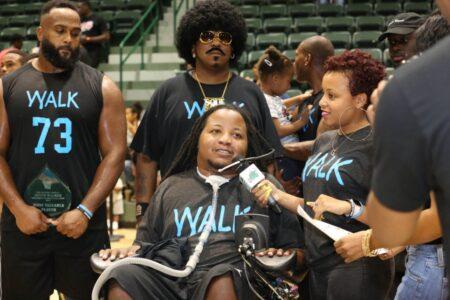
“The storm was predicted to be a category 4 with major damage and prolonged power outages, and I’m vent dependent. It was only because of prolonged major power outages that we chose to evacuate to Houston. For smaller storms, it’s better for me to stay with all my equipment needs.”
Hurricane Ida forced Devon, a vent user, to evacuate to Houston. With the assistance of his mom and nurse, he packed two weeks of supplies, and they left two days before the hurricane hit. The normally five-hour trip took almost 12 hours, and they had to stay in a hotel for five days.
Upon their return home, the house generator went out after one day. Devon slept in his chair because his air mattress would not work without power, and he used a portable vent connected to his chair battery. Luckily, repairs were made to the generator, so they were only without power for a day.
Adrian Bickham, C4 incomplete spinal cord injury
“We would have evacuated no matter what with this size storm because we knew the power would be out. All evacuation decisions are made on the potential for power to be out, plus the memory of staying for Katrina is what made the decision to evacuate.”
Adrian and his father evacuated about a day before the hurricane hit, and the drive to his aunt’s house was delayed because of heavy traffic. Adrian had the ability to stretch his legs and do pressure reliefs during gas breaks to avoid causing problems such as pressure sores. There was a total of 10 people at his aunt’s house, eight of whom were evacuated there. Despite the number of people, Adrian had his own room and brought his walker, commode chair, and manual wheelchair. This allowed him to continue with his normal routine during the 11-day stay at his aunt’s home.
When returning to his home, Adrian didn’t know if they had power until he arrived. “It would be better if there was a better communication system to tell if power was back,” says Adrian. He recommends that local disability communities come together to create a network of people who use personal assistance. These networks could create rosters of PCAs willing to evacuate or help develop plans to set up PCAs at the evacuation point. “People will continue to need assistance,” he says. “Just because a hurricane came and we were evacuated doesn’t change that.”
Ricky Franklin, T12-L3 incomplete spinal cord injury
“I pray to God that everyone has a support system because that really is the key to survival!”
Ricky sustained his spinal cord injury just a couple of months before Hurricane Ida hit. His family was hesitant to leave and did not evacuate until the power went out because of the heat. Their initial plan to evacuate to Texas was curtailed because of road closures. Right before the hurricane hit, they headed to Florida. It took 16 hours to reach their destination.
Chris Morel, C5-C6 complete spinal cord injury
“We were in the house with no power, nothing to cool with and getting over-heated for three days. It was very scary. I had autonomic dysreflexia from heat.”
Chris and his parents decided to shelter in place so that he was close to all his supplies and equipment. Chris gathered extra catheters and bowel program supplies to prepare for the hurricane, parked his accessible van at a high spot to avoid flooding, and rented a gas generator. ABC Medical contacted Chris to make sure he had an emergency plan set in place.
Unfortunately, the gas generator broke after two days. Chris and his family were in their house for three days with no power and nothing to help avoid getting overheated. Chris also was unsure of when he would be able to charge the power assist for his chair again. This was detrimental because, without the power assist, he was unable to push his wheelchair independently.
“Staying was better than leaving because at least we knew we had everything I needed,” says Chris. He also was concerned about driving his accessible van through high flood water and the availability of accessible hotel rooms available.
Remembrance from Hurricane Katrina, August 29, 2005
Nelita Manego-Ramey, T6-T7 complete spinal cord injury
“We have to plan everything and can’t do things impromptu. These storms just don’t allow for that. We need to plan for our destination to be accessible, plan for how long it will take to get there and plan for rest stops to be accessible!”
Nelita had to plan the evacuation for herself and her 10-year-old daughter, because her husband was out of town. “Timing is everything! What time you leave is really important,” she says.
They left the same day the mayor called for mandatory evacuation. While packing for her daughter, Nelita also frantically packed her essentials, including catheters, blood pressure supplies, and one manual wheelchair. Unfortunately, packing her bathroom equipment completely slipped her mind.
After the levees broke, Nelita and her family were forced to relocate to the inaccessible basement of their friend’s home in St. Louis. They eventually moved into a hotel room until they could return to their home.
Nelita’s experience with Katrina taught her not to wait. She now books an accessible hotel room when there is any chance of a hurricane entering the Gulf. She also ordered shower equipment that stays at a family member’s home in another town to be in place if she must evacuate.
What Hurricane Katrina Taught Us

No disasters are natural. That’s the opening line of the documentary, The Right to be Rescued. This documentary was released just a few days prior to the 10th anniversary of Hurricane Katrina, and it tells the experiences of people in the disability community during this devastating hurricane.
Simply stated, there was no rescue plan. What we learned from Hurricane Katrina is that the lack of emergency preparedness had an immensely negative impact on our community. Severe weather events, such as hurricanes, are growing in strength and number, and when communities do not have emergency plans that serve everyone, it is inevitable that people will be left behind. And people will die. Especially people with disabilities.
“We are survivors. We live in a world not created for us. We know the layers of advocacy,” said German Parodi, co-executive director of the Partnership for Inclusive Disaster Strategies, in How People with Disabilities Weather Natural Disasters. “At least have a plan. Have something. Even if it’s just to bring your glasses. We all should spend a day thinking about what we’d do in case of a disaster.”
To put together a good emergency preparedness plan, take what you know, learn from past shortfalls and consider all possible outcomes. Setting a plan in place is better than having to frantically come up with one in the middle of a disaster, such as a hurricane.
“You can never be prepared enough for a hurricane,” says Andy Weyant, a member of our Emergency Preparedness Working Group, about Hurricane Sandy. “I was not fully prepared for the extended power outage during Hurricane Sandy. Prepare for the worst, and you will get a better-than-expected turnout no matter what actually happens.”
Hurricane Preparedness Suggestions for the Disability Community
“People with disabilities and older people are often among those most adversely affected in emergencies, and at the same time are among those least likely to have access to emergency support.” — Office of the United Nations High Commissioner for Human Rights
- Make sure that the person with the disability can direct their care. In any emergency, the proper skills to verbally direct anyone, untrained or not, to help meet their needs are extremely important.
- Have a local support network of at least three or more people that are able and willing to help in an emergency.
- Maintain a list of family, physicians, and a relative or friend who should be notified if you are injured. Include a backup contact person living outside the immediate area.
- Develop an evacuation plan that includes aspects such as transportation and a meeting location.
- Find out if your state or city offers a special assistance emergency directory. Ask your emergency management office or local fire station how to register.
- Contact utility companies for priority turn-on service – especially if you depend upon electricity for life or function.
- If you use a vent, secure a generator and bag-mask equipment.
- Have additional power sources, such as portable chargers for electronic devices.
- If you have difficulty regulating your temperature, put a plan in place to keep cool or warm.
- Tenants in high-rise buildings should have knowledge and access to escape chairs.
- Have access to at least a seven-day supply of essentials like food, water, catheters and medication.
- Similarly, ensure you have enough supplies for your support animal.
- Stay informed and sign up for weather alerts and information in your area. Contact your emergency management office for evacuation routes and local alerts.
The American Red Cross has a detailed guide to help people with a disability prepare for a disaster, and United Spinal Association’s Ready to Roll Emergency Preparedness Program offers great resources for emergency preparedness planning. Learn how to assemble an emergency preparedness kit and create a plan. You can view personal stories from people with various disabilities who share how we helped them after Hurricane Ida.
More Resources:
National Oceanic and Atmospheric Administration, Tropical Cyclone Climatology
National Library of Medicine, Preparing Individuals with Spinal Cord Injuries for Extreme Storm in the Era of Climate Change
Sierra Club Magazine, How People with Disabilities Weather Natural Disasters
Rooted in Rights, The Right to be Rescued
Centers for Disease Control and Prevention, Disability Impacts All of Us
Muscular Dystrophy Association, The Best Way to Prepare People With Disabilities and Their Communities for Natural Disasters
Get involved by joining our Grassroots Advocacy Network and opens in a new windowtake action on issues impacting our community. For more information on United Spinal Association’s extensive advocacy program to improve the quality of life of all wheelchair users, visit our advocacy page.