
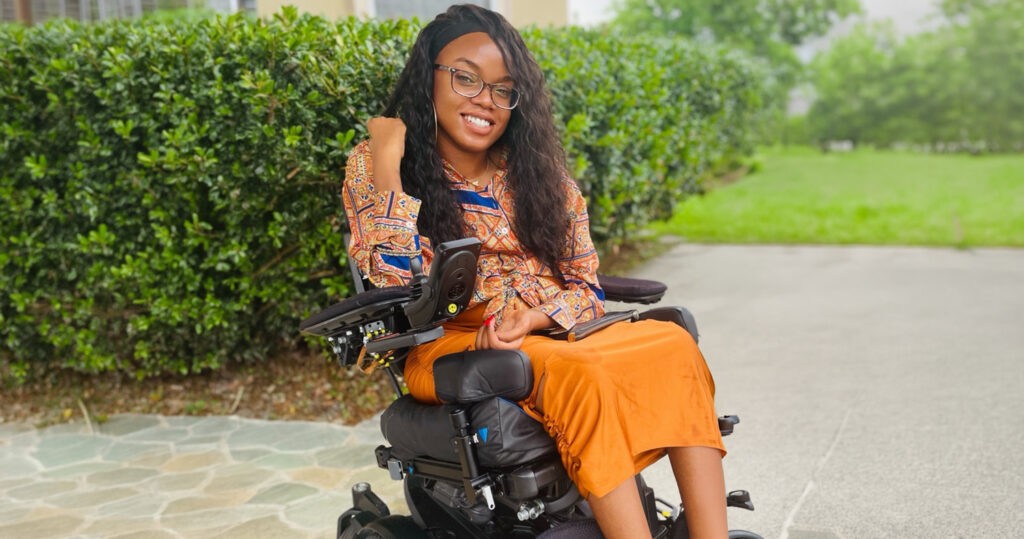
Felecia Woolens is an attorney from Metairie, Louisiana, and a board member for United Spinal Association. She advocates for improved access to healthcare and independent living for people with disabilities, a primary goal in her efforts to change the way Louisiana and other states structure healthcare laws. She expanded on her journey with Annie Streit, United Spinal’s Grassroots Advocacy Manager, on Meet an Advocate. Here are the highlights of their conversation.
Annie: Tell us about yourself and your spinal cord injury?
Felecia: I have been an attorney for four years. I received my bar license during the 2020 pandemic, which was challenging in itself. But I did it. I am a C5-6 quadriplegic. I was involved in a car accident with my mother. The truck hydroplaned and I actually came out of the vehicle, but the seatbelt had me around my neck. So that is how I broke my neck.
I started off in a power-assist wheelchair and then I gravitated toward a fully electric wheelchair. But now I’m actually trying to go back to using a power assist chair. Besides that, I’ve just been living life the best I can and trying to persevere and enjoy my profession.
Annie: You have been a board member for United Spinal for two years. Can you tell us how this happened and about this experience?
Felecia: I reached out to Josh Basile, who was a board member, about his journey trying to change Medicaid policies in D.C.. And he was like, “we’re looking for another board member.” He asked me for a resume, and I was selected.
It’s been so exciting. I’ve met some amazing people. And I think United Spinal is one of the best resources for people who use wheelchairs.
Annie: What are some of the responsibilities you have as a board member?
Felecia: Voting on different policy changes within the organization. We also just discussed how to move forward as an organization. [We talked] about strengthening our standards in the community, how we can be better advocates, [and] making sure that we actively and accurately cater to the community.
Annie: You attended Xavier University for your bachelor’s in political science and then Loyola University College of Law. Did you face any barriers while you were getting your degree?
Felecia: I think I was one of the first people at Xavier who used a wheelchair. I went back to school after my accident. So, at first I wasn’t sure what I was going to do. I started online classes.
I’m more of an in-person type of student. That’s what really drove me to actually go and attend classes. If you’re newly injured, that can be a very intimidating process.
Actually, at Xavier, it’s funny. The disability office was situated in the middle of a plot of land. It was a small office and there were steps and no ramp. Whenever I had to meet with administrators, I had to go sit by those steps and wait for someone to come down to help me.
Generally speaking, and I don’t think this is any fault of the college, but the sidewalks in New Orleans are notoriously terrible. If you visit New Orleans or live here, you will quickly realize that. So, trying to get from class to class was a struggle.
Annie: After Xavier you went to law school. What kind of law do you practice?
Felecia: I have the most experience in contracts, specifically breach of contract and federal fraud when it comes to loans. Also, disability law, criminal defense, and some environmental law. I think out of all of those, disability law is definitely my favorite.
Annie: Your next plan is to have round-the-clock care outside of family so that you can live independently, can you expand on that?
Felecia: I’ve spent the last two years trying to lay out this plan, but unfortunately have hit some roadblocks. With Medicaid laws in Louisiana, you’re cut off if your income is over a certain level. You’re basically having to choose between staying on Medicaid and having your care or forfeiting your career in order to be eligible for Medicaid.
I am not technically Medicaid eligible because of my income, and I am someone who needs 24-hour care. Private nursing agencies around my area start at $30 per hour. So $30 per hour times 24 hours per day in a 30-day calendar would come up to around $20,000 per month. I don’t have that type of money.
Annie: What are the top three issues that you would like to change?
Felecia: I want to focus on changing Medicaid policies. We need more certainty that we will have caretakers and adequate healthcare. Another big one for me is accessible travel. I know United Spinal is doing some great work with regard to this.
On my most recent trip, I had a layover in Atlanta and they almost dropped me. I had to reach out and go through a grievance process with that. I know a lot of my peers have experienced issues with traveling with their wheelchairs.
And finally, making hotels and rentals more wheelchair accessible. You’ll see something on a website that says they’re ADA compliant. Well, what does that mean? Does that just simply mean wider doorframes? I can’t begin to explain how many times I’ve entered a hotel bathroom and there’s something blocking me from actually getting under the sink so I can properly wash my face.
Annie: You wanted to talk about voting.
Felecia: I encourage everyone to visit the ADA.gov website and look under the voting tab because there is a lot of information on your rights at the polling places. Your voting stations have to be accessible. You cannot be denied the right to vote simply because you have an intellectual disability. Ballot boxes must be accessible. There are provisions for bringing service animals into polling places. I think voting is so important in general, but especially for the disability community.
Annie: What advice do you have for someone new to the disability community after sustaining something like a spinal cord injury?
Felecia: This is a bit cliche, but I will definitely say find supportive communities. Having that support can get you through some major hurdles. And, just try to stay active or do things that you enjoy. I enjoy going to church and reading my Bible. I like to try new foods. I love going to festivals. That helps me find my way through life and not focus on the challenges or the drawbacks that I may find about having a disability.
Get involved with our Grassroots Advocacy Network.