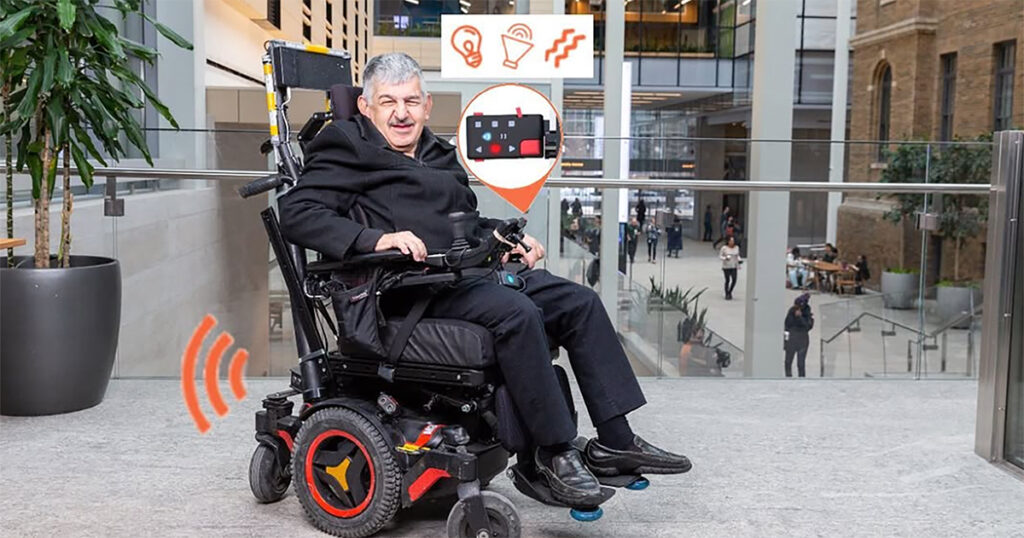
Revolutionizing (But Not Controlling Mobility): Braze Mobility created the world’s first patented blind spot sensors that can be added to any wheelchair, transforming it into a “smart” wheelchair.
I was on a layover in Seattle, people-watching while eating an overpriced chicken pesto wrap. Nearby, I noticed the airport’s autonomous wheelchair service, designed to drop passengers off at their gates without needing an airport employee to push them. In theory, it’s a promising idea.
But then I saw a woman stranded in the middle of the walkway. Her chair had stopped, and no one seemed to be around to help. Technology was meant to empower her, but it effectively left her more vulnerable. It was a reminder that flashy innovation without adequate support doesn’t always translate to dignity or independence.
It felt much like the saga of Waymo cars in San Francisco—parked in a residential lot, confusing one another, and honking nonstop into the early morning. The machines were doing exactly what they were programmed to do—yet the humans around them were the ones left getting an earful.
That’s why Braze Mobility stands out. They’re doing something a lot of companies talk about but rarely pull off—translating high-level research into real-world solutions that empower wheelchair users, not strand them in an airport walkway or honk at night. Their blind spot sensor technology doesn’t just sound innovative on paper—it works because it gives people control over their sense of agency.
And that makes sense. People experience anxiety when they don’t feel in control of their own environment, especially when mobility is involved. Research has consistently shown that a lack of autonomy can increase stress, reduce confidence, and make even simple tasks feel overwhelming. By restoring a sense of control, Braze’s technology helps reduce that anxiety and reinforces the user’s independence.
No more gouges in walls
Earlier in her career, Dr. Pooja Viswanathan set out to help older adults showing signs of cognitive decline. But she quickly realized it wasn’t enough to simply design a device for real consumer impact–it meant building assistive technology with them. That insight led to the creation of Braze Mobility’s blind spot monitors: tools developed through collaboration, research, and direct feedback from wheelchair users themselves.
Braze’s sensors detect obstacles—walls, furniture, people, pets—and give feedback in three different ways: lights, sounds, and vibration. That means users can feel and hear what’s happening around them, instead of guessing. It’s designed specifically for power wheelchairs, which are the heaviest and most difficult to maneuver of all mobility devices. Importantly, the blind spot sensors don’t control the wheelchair, nor do they stop it from running into objects—they simply give the user better information so they can make their own decisions. The Sentina Plus Kit is the standard setup, and it includes:
- Sentina (Large Sensor): Covers the rear blind spot with a 180° field of view. Mounted on the back of a power chair, this one does a lot of heavy lifting.
- Echo Heads (Smaller Sensors): Positioned at the front for left and right coverage—key for avoiding close-range hazards.
- Controller Interface: This sits beside the joystick, letting users easily switch modes, feedback types, and power settings.
This kind of hardware could also help cut down on how often a wheelchair needs repairs. By giving users better awareness of their surroundings, it helps avoid bumps, scrapes, and collisions—small accidents that can lead to big repair bills down the line.
There’s also a smartphone app if you want to dial in custom settings—ideal for people who need more precise control or have different sensory preferences. This opens up even more control options. For users who may not be able to operate the physical buttons on the chair, the app gives them an accessible way to adjust the system using their phone.
Braze Mobility isn’t trying to take control away from users—it’s giving it back to them. That’s the kind of assistive tech we need more of: tools that respect the user’s agency, reduce risk, and expand independence without overpromising. It’s not about making wheelchairs smarter. It’s about making the people in them feel seen, heard, and in control.
For more adaptive tech content, sign up for our TechAccess Newsletter and attend our TechTalks.