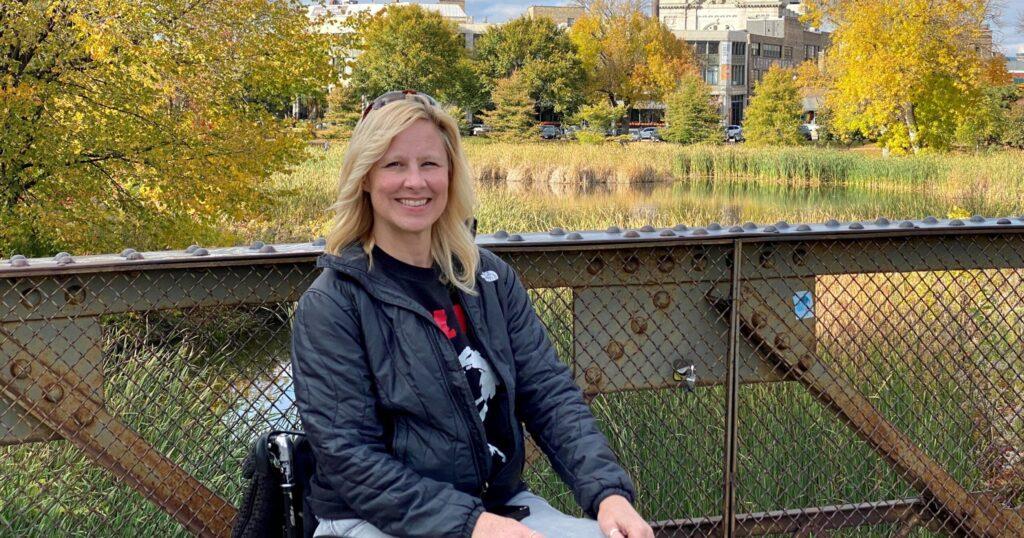
Char Vine lives in Sacramento, California, where she founded a non-profit organization called The Lionheart Community that focuses on providing support, resources and recreation to those living with spinal cord injuries and disorders. Char, a United Spinal member, lives with a T11 complete SCI from a snowboarding accident when she was 27.
I caught up with Char in November of 2023 to chat with her about her mental health journey. Her experiences with mental health, she said, were pretty minimal pre-SCI. “It wasn’t really on my radar or my family’s radar. We were taught to bury everything and not really talk about mental health problems. I probably wasn’t very mentally healthy in my early years.”
“I wasn’t able to be vulnerable.”
 Her lack of experience with processing emotions contributed to her mental and emotional struggles while in rehab post-SCI. “There was a therapist that came in, but I was pretty resistant to it because that wasn’t something I grew up with,” she said. “I did talk to the therapist a bit, but just kept it very surface. I wasn’t able to be vulnerable at that point.”
It wasn’t only her resistance to therapy that made Char’s time in SCI rehab difficult. “At one point in rehab, I got suicidal,” she said. “They had switched my pain meds on me – I wasn’t very in tune with pharmaceuticals back then. I felt an instant shift, literally overnight. I wouldn’t leave bed, and my whole personality changed.”
Char’s mother immediately noticed this shift. “My mom was like, ‘What the hell happened to you? You weren’t like this yesterday.’” Her mother demanded to see a list of all her medications and quickly discovered that the new pain med’s side effects included suicidal thoughts and tendencies.
Char resumed her previous medication, and within a day or two, her personality switched back. “Thank goodness my mom was there because the hospital wouldn’t have caught it.”She believes that people with spinal cord injuries should be given support for the mental side effects that medications can have. “It should be a consideration,” she said. “Nobody traced [my personality switch] back to my medications.”
Charcot Spine Complications
About 15 years into her injury, Char developed Charcot spine. “My doctors said that if I got the surgery to fix it, I would lose a lot of my independence,” she said. “They told me I should wait as long as possible to get the fusion surgery.”
She ended up putting it off for six to seven years. During that time, she developed constant complications, causing multiple visits to the emergency room and about 15 other surgeries. Eventually, she felt her quality of life was so poor, and she was so afraid of having the Charcot correction surgery that she was “ready to check out.”
“My body was just filled with fluid, and I was so uncomfortable. Some of my hardware had bent, so any time I moved, it would scrape bone in my hip area, causing major dysreflexia. I just felt like shit all the time, like so many things were wrong, and it would be impossible to ever heal from all of it.”
Char thought, “I’ve lived enough of an independent life. I’m ready to say goodbye. So that’s what I started doing. I started wrapping my life up and saying goodbye to everybody. My mom was sick about it. She was the one who fought for me to go to therapy. She said, ‘Please, just try to talk to somebody before you do this.’”
Finding Help
When Char finally did end up connecting with a therapist, it came from an unexpected direction.
“It was actually my urologist who put in an order for a mental health referral,” she said. “I was fighting with her about an incontinence issue. I had started experiencing incontinence overnight. She didn’t believe me about my symptoms and kept dismissing me.”
It turned out Char had been correct: there was something wrong, and there had been a direct cause. Due to certain exercises that she began doing on a machine the day before, a hematoma formed near her bladder and began pressing on it, causing the sudden incontinence.
As for the mental health referral, Char said that the urologist was not looking after Char’s well-being. “She told me she was concerned about me because I was lying to her. Eventually, I started crying in her office and, apparently, to save face, she referred me to psych.”
Char was provided with a list of Medi-Cal practitioners. “I ended up seeing one of the first people I called,” she said. “Her first office had a step in the front, so I went through the back, where there was a little lift.” A few years later, the provider moved to a building with an elevator, which Char considered an improvement.
“I hadn’t realized how much grief I had.”
Initially, Char did not go to her therapy appointments with an optimistic attitude. “I didn’t think that therapy was going to help me because I saw my problems stemming from the Charcot spine, which was a medical issue,” she said. “I had never really put my body and mind together before then.”
When asked if she was ever concerned that her therapist, a seemingly nondisabled person, might not be able to understand her life as a person with a disability, Char said it didn’t matter to her. “I wasn’t going there to save myself — I was going there to appease my mom. I was going there to fail, not to succeed. In fact, it was probably better that she didn’t because then I had no expectations.”
When she went into the session, she started crying. “I hadn’t realized how much grief I had and how I had never expressed it to anybody,” she said. “You don’t want to dump all of that suffering onto your friends, so it was like, ‘Oh, here’s someone I can just dump everything onto and tell her how awful it all is, and I don’t have to stop – I can tell her the entire list.’”
Char didn’t have to worry about her therapist feeling upset or being impacted in a traumatic way, so she said, “I just started letting it all out.”
In addition to helping Char process her grief about her SCI, the therapist coached her through her decision to go through with the challenging surgery to repair her Charcot spine. “She would present scenarios,” Char said. “She would very kindly ask questions like, ‘What if you just looked for a surgeon?’”
All In or All Out?
Char did eventually find that surgeon. The procedure would be risky, and the surgeon wouldn’t perform it unless she were fully committed. “He gave me the responsibility of living my life,” she said. He told her she had to do as much as possible to make sure the surgery would be successful. “I remember leaving that appointment feeling like someone had just punched me in the face,” she said. “I thought to myself, Are you all in, or are you all out?”
Once Char decided to go through with the surgery, she began mentally and physically preparing for it. Her therapist helped her set intentions and get clear on what she wanted: a successful surgery and a better quality of life. She began exercising and improving her nutrition, readying herself as much as possible.
When Char finally had the surgery performed in December 2016, it was a success. “I was surprised at how easy it all went. It was generally so much easier than my first spinal injury surgery.”
Balancing Body and Mind
Although the surgery did improve her quality of life, there were still issues Char had to face. “I had a lot of grief about my SCI, then after that, a bunch of family stuff that wasn’t really about the chair,” she said. Once her health was back on point, she says she still felt miserable and became aware of unresolved issues from her childhood. “I was like, What is going on here?”
She found help for these underlying issues from yet another unexpected source: Pilates instructor James Crater. During her workouts, Crater would notice certain things. “He would say things like, ‘I notice there’s a grimace on your face – what’s coming up for you?’ I would hold things in my body, and we would talk through this as we worked.”
After a while, Char started doing the exercises in a much more balanced and symmetrical way. “I realized that there’s this huge connection between my mind and body and how I hold and process emotions.”
Char also credits Crater for introducing her to the relationship between her mental state and the autonomic nervous system. She feels that her nervous system had “been in a trauma state” for a very long time. “I think I just grew up that way – it wasn’t really a safe environment, you know? I always felt under threat,” she said.
Char feels this trauma state wreaked havoc on her body. “I felt like I was in a fog all the time. Crippling anxiety, waking up with my stomach in knots, feeling like a cartoon character with an anvil over my head just waiting for it to drop,” she said.
“I learned how to manipulate my body to downregulate and get into a state where it could start to heal,” she said. “I can’t even tell you the last time I woke up with anxiety, but I sleep so much better now.”
Moving Forward
Around four years into seeing her therapist, Char decided it was time to move on. “I just felt like I knew what she was going to say,” she said. “I started understanding how to take care of my mental health better.” She became confident that, using everything she had learned, she now had the ability to look after her own mental well-being. “I know what’s best for me now.”
She has a routine to maintain her mental health. “I try to meditate and have some quiet time – mostly when stretching. I find online therapists that I like a lot,” she said. “And getting out into nature is very calming for me.”
Char has had a long journey, from facing an extremely challenging surgery and wanting to end her life to the person she is today. “I feel more confident than I’ve ever felt. I’m working, I’m helping build The Lionheart Community, my health is good,” she said. “I feel like I’m finally living my purpose.”
988 Suicide and Crisis Lifeline provides free and confidential emotional support to people in suicidal crisis or emotional distress 24 hours a day, seven days a week, across the United States. Find a virtual or in-person support group on United Spinal’s Peer Support Group page. Contact our Community Support team for more information about all United Spinal’s chapters and programs. Join us by signing up for a free membership.