
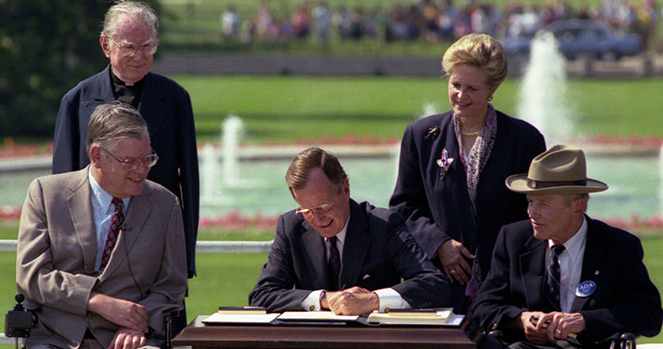
On July 26th, 1990, approximately 1,000 people with disabilities assembled on the White House lawn to watch President George H. W. Bush sign the Americans with Disabilities Act (ADA). As he signed the bill, President Bush said, “Let the shameful wall of exclusion finally come tumbling down.” Everyone cheered. People with disabilities pondered the future, as they reveled in their success in getting the law passed.
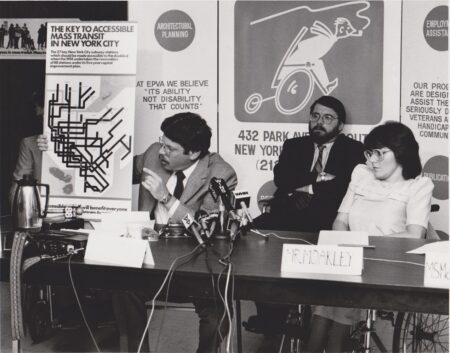
United Spinal Association is proud to be a part of the legacy of the Americans with Disabilities Act, the landmark civil rights law that protects our members and other people with disabilities from discrimination. Our organization has been active in disability rights since its founding in 1946, and has promoted integration, inclusion, and accessibility for a long as it has existed.
The law has caused great change in some areas—where change was desperately needed—for example, access to mass transit and the built environment. Schools, theatres, arenas, workplaces and mass transit are becoming accessible, and of course, are accessible when newly built. People without disabilities expect access for people with disabilities, and they notice non-compliance because ADA has raised awareness of architectural barriers.
State and local governments have accepted responsibility to serve all people—and not just those without disabilities—and make modifications and accommodations in their programs, as needed.
The stigma of disability, especially physical disability, has been gradually reduced, as the world becomes easier to manage for those with disabilities. The stigma of mental disability, both intellectual and emotional, has been a more difficult problem to address effectively, however.
Success and Challenges
Access to buildings is quantifiable. Compliance can be measured, evaluated, and reported. Barriers can be eliminated from building plans using ADA design guidelines. State building codes have, for the most part, been harmonized with ADA requirements, ensuring access for those with physical disabilities to new construction.
The ADA’s barrier removal requirements apply to privately-owned places open to the public, such as businesses, stores, and restaurants. For the last thirty years, barriers which could have been removed in a “readily achievable” manner, i.e. without great difficulty or expense, should have been removed. The responsibility is continuing, and if not removed between 1990-present, they should be now.
The ADA changed the way Americans and the legal system defined discrimination. Until the ADA passed, nondiscrimination, be it on the basis of race, religion, or gender, meant merely refraining from treating the protected class worse than the rest of the public. The ADA, however, made it a discriminatory practice not to reasonably accommodate disability, that is, passive nondiscrimination may not be enough. Merely refraining from treating people with disabilities badly is not all that is required by the ADA. Assuming undue administrative or financial burdens is not required to accommodate a patron or employee with a disability, but reasonable steps must be taken to accommodate their needs. The failure to do so is a discriminatory practice. The ADA changed nondiscrimination from a passive act to one that requires action, i.e. barrier removal, reasonable accommodation, etc.
Perhaps ADA’s greatest success is the resulting collective consciousness of the needs and rights of people with disabilities, among both people with disabilities and their non-disabled peers. Media and politicians have adopted politically-correct speech to acknowledge the dignity of people with disabilities.
In the United States, access to the labor force has been the great equalizer for those fighting discrimination. Unfortunately, the statistics concerning employment of people with disabilities are roughly the same as they were thirty years ago, according to the US Department of Labor. Over 65% of people with disabilities are not in the labor force. The causes of unemployment vary, but include the inability to overcome discriminatory attitudes of employers, benefits systems that still punish those leaving Medicaid to go to work, and transportation difficulty, to name a few.
We have embraced the ADA’s nondiscrimination mandate, just as we helped draft the Act, and lobby for its passage. The Act’s simple beauty is that it merely requires reasonable behavior. We have cajoled, persuaded, argued, lobbied, and litigated for ADA compliance and enforcement, with notable successes.
Using ADA, we have made taxis and rideshares provide accessible service, obtained commitments to install curb ramps in major cities, made countless buildings accessible via our intervention, trained hundreds of architects in accessible design, made hospitals and universities accessible, and gotten public works projects to modify their designs to serve those who use wheelchairs, as well as those who walk.
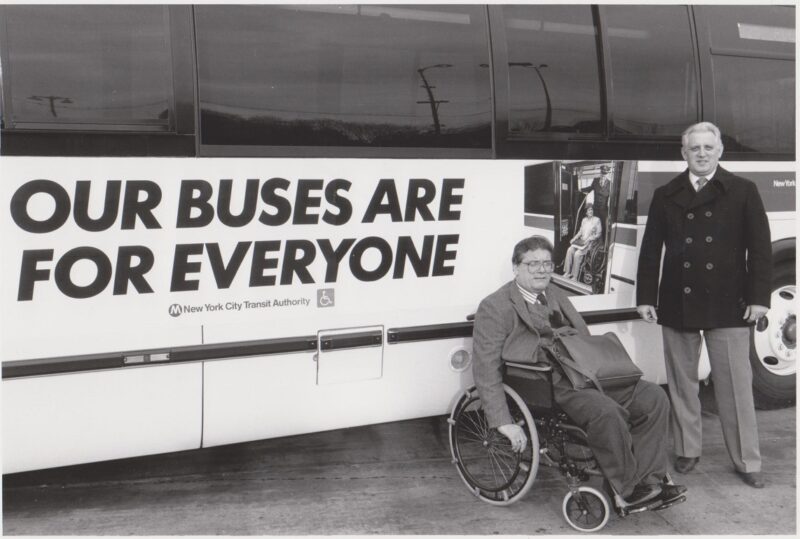
Because of United Spinal Association’s advocacy prior to 1990, older rail systems in NYC and Philadelphia agreed to make key stations accessible, their bus systems accessible, and provide paratransit for those who cannot use the accessible mass transit system to meet their travel needs. ADA contains the identical requirement for all cities in the US.
The ADA is a guide for individuals, businesses and government about how to address disability-related issues. Unnecessary separate or special treatment is a discriminatory practice, regardless of motivation. Most disability discrimination is not rooted in ill will, like other forms of discrimination. Instead, it is based on unnecessarily low expectations and unfamiliarity—or condescension often masquerading as kindness. ADA instructs those who do not want to discriminate how to include, hire, and serve people with disabilities without offense.
The Challenge of the Future
The ADA applies to things that didn’t exist in 1990. The internet and autonomous vehicles used in transit, for example, must comply with ADA, despite the fact that neither ADA’s drafters nor the overwhelming majority of Americans could imagine either at the time.
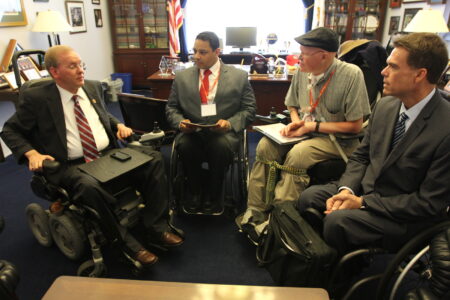
Our challenge, as disability advocates, is to make our communities accessible and welcoming to people with disabilities. No one should be institutionalized because the environment around them cannot accommodate them. Smart homes in smart cities will further emancipate those whom ADA serves, but it is up to us to ensure that new products and services are designed to be used by people with sensory, cognitive, and physical disabilities—that access is fundamental and not a second-generation issue. Even today, thirty years after the ADA’s passage, it is necessary to remind business and government of the needs and the rights of people with disabilities.
The ADA has enhanced the quality of the lives of tens of millions of people with disabilities.
Download our free Understanding the ADA educational booklet at https://www.unitedspinal.org/pdf/understanding_the_ada.pdf.