
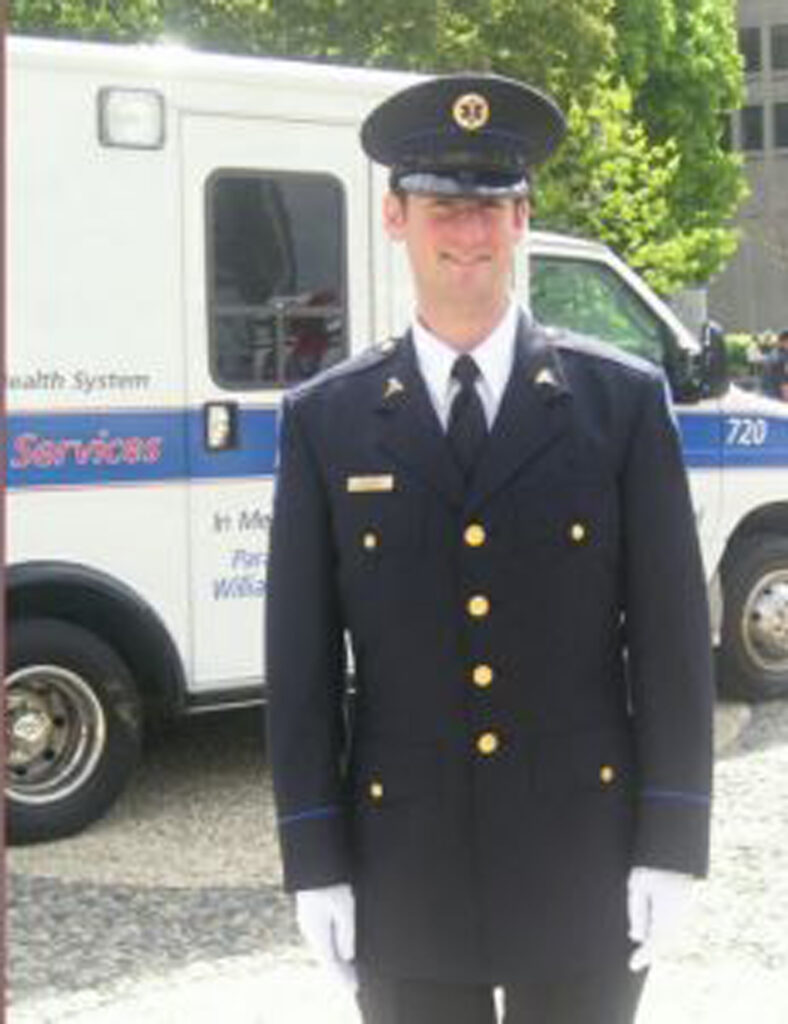
Avi Golden was an active EMT and paramedic when his life took an unexpected turn. In early June 2007, at 33 years of age, Avi was admitted to Columbia Hospital, in New York, for surgery on an mitral valve prolapse (MVP) repair that was discovered near the aortic valve in his heart. Like many people who go in the hospital for serious, but seemingly routine, surgery, Avi thought he’d be out and recovering in short order. However, that was not to be. During the surgery, Avi experienced a stroke on the left side of his brain, leaving him with right-sided paralysis, and profound aphasia.
Avi remained in Columbia Hospital for two months and then was moved to a rehab hospital in the North Shore – Long Island Jewish Health System – for two more months of intensive in-patient rehabilitation. By early October, he was discharged, and began outpatient therapy at home (which he still receives for his arm and leg). During his stroke rehabilitation, Avi received “traditional” physical, occupational and speech therapies, but he also utilized a rich mix of non-traditional therapies that included acupuncture, massage, tai chi, yoga, constraint therapy, water therapy, computer games and special speech software. Avi also tried using a Neuromove™ device on his right side.
Avi still has balance problems, and weakness on the right side of his body, but it’s his Expressive Aphasia that frustrates and confounds him more than any of his other post-stroke residuals. Avi can understand what people are saying to him and he can still read quite well. However, he continues to have trouble speaking and writing. This can be devastating for any friendly and outgoing person, let alone a certified paramedic who needs to communicate accurately and effectively to do his job.
Avi refuses to let aphasia get in his way. He still works (and volunteers his time) as a paramedic and, more importantly, he’s embarked on a new mission of “aphasia advocacy,” educating others about aphasia and how it impacts a stroke survivor’s day-to-day life.
To make this new goal a reality, Avi has been involved in many aphasia-related projects. To name a few, Avi is an active contributor to the “Aphasia Awareness Training for Emergency Responders Project,” for the National Aphasia Association, for many years, he has played a lead role in the Adler Aphasia Center’s drama club before an audience of 500 people, and he has volunteered his time at the Adler Aphasia Center, where he participates in the educational training of medical residents, medical students and other health care professionals who are preparing for a career in a medical field.
Avi says that his stroke hasn’t fundamentally changed him. He’s still the same sociable, affable, and compassionate person that he was before his stroke. He is eager to help others in need and devoted to his job as a paramedic. He is also looking to start a not-for-profit organization that he has dubbed “NYC Outdoors Disability”. It would promote snowboarding, horseback riding, hiking, hand cycling, sailing, scuba diving and other outdoor activities for people with disabilities.
Thank you to Avi Golden for sharing his story in how he continues to push forward in life with aphasia.