
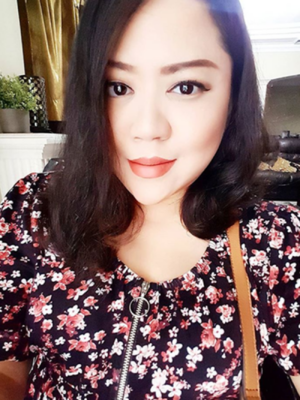
 Nur Fariza, 30, has always felt the need to do well in school. Even though she attended mainstream schools, it was not easy getting in. Born with osteogenesis imperfecta (OI) or brittle bone syndrome, Fariza started primary school a year later than expected, and only after her mother appealed to the school principal.
“The year before, I was sick in hospital. So, I was older than the others. I was only 7 or 8 years old, but I remember vividly how my mother had to beg the principal. Somehow, I understood what was going on. That particular incident forced me to grow up really fast.”
As a result, she put intense pressure on herself to do well academically. The need to prove that she was “just as capable or better,” was the first of a series of strains on her mental health.
The second was the bullying she experienced during the entire four years of secondary school. Although she kept up with and did well in her studies, her social life was “horrible.” She recounts an incident where some classmates threw her books down from their classroom on the fourth storey. They then took her wheelchair away and taunted her, “Eh, you go crawl there!”
“I didn’t know how to socialise. I was in and out of hospital a lot, so I didn’t know how to speak to people. I thought it was maybe partly because of that and partly because people are just assholes. I don’t know.”
Curiously, after that incident Fariza was sent for counselling – not her bullies. “Even at that time, I was questioning the counsellor, ‘Why am I here?’ ‘Why aren’t they here?’”
She stopped going to classes because of depression. Eventually, the school sent her to see a psychiatrist, who said that her depression and anxiety were symptoms of borderline personality disorder. (She could not officially be diagnosed with BPD as she was only 16.) They said that being bullied was one of the reasons.
“I spoke a lot about bullying years later [in my 20s]. I started to do some campaigns, go to schools and talk to bullied people. I talk a lot on social media about this because I think social media is the way to reach out these days.”
While being bullied was a major factor in her BPD diagnosis, Fariza says that the issues she brings up with her therapist – like social isolation and family problems – are often linked back to her disability. “[But] not everything is particularly about that. Don’t make excuses for people’s poor behaviour.”
Fariza recently had a tattoo done on her left wrist of a semi-colon. The punctuation mark was made popular by Project Semicolon, a non-profit based in Wisconsin that was started in 2013 by Amy Bleuel to inspire people struggling with depression, self-harm and other ailments. Fariza got the tattoo after surviving a suicide attempt in 2015.
“That was a relapse. The first time I was suicidal, I was a teenager. Everything was going wrong and that was a time when my relationship with my father became very strained, to the point that I stopped talking to him.”
While she admits that she still shows some of the symptoms of BPD such as the fear of abandonment and mood swings, she feels she is getting better and more stable. “It’s such a complex issue,” she says. “In a way, it’s an invisible disability because when my episodes happen it’s debilitating. I couldn’t hold a job. I couldn’t even get myself out of the bed to shower.”
In addition to medication and therapy, Fariza also has other strategies of self-care.
“I started writing poetry again. Whenever I know an episode is coming, I do some grounding methods. I stop and look at the environment [to be] in touch with what is there at present. Focus on my breathing. Being open about mental illness is helpful too: on social media, to friends, to my partner.”
Currently working at a hotel as a communications and reservations agent, Fariza has developed close relationships with some of her colleagues in the industry. “My friends are more understanding. I’ve had a meltdown at work before. I was in the toilet, sitting on the floor and crying. I got messages and calls from all these friends. That’s when I told myself, these people love me.”
“Family doesn’t have to be blood. It could just be someone giving you a call. ‘Are you OK?’ is all you need sometimes.”
Does this post resonate with you? Share it to help others who might find themselves in a similar situation.
