
Thirty-year-old Mandy Harvey is already quite famous. She’s performed at the Kennedy Center, earned the coveted golden buzzer after her performance on America’s Got Talent, and recently published her first book. This singer-songwriter also happens to be post-lingually deafened due to a connective tissue disorder which damaged her nerves. Sara Novic talked with Mandy about deaf culture, her songwriting process, and her fame after America’s Got Talent.

Mandy spent most of her summer touring and finishing her book, which chronicles her journey after hearing loss. Although she didn’t previously entertain the idea of appearing on a TV show, says Mandy, she saw it as an opportunity to encourage others, and describes her golden buzzer moment as a dream.
“It was more about building confidence, and good or bad, I was encouraging other people and pushing myself.”
Mandy’s golden buzzer came courtesy of Simon Cowell, who according to Mandy, recognized her talent above all else. Mandy appreciates that, “He wasn’t giving me a pity vote, and that makes it really important, because deaf people can do anything.” Mandy wants recognition based solely on her musical abilities.
“I don’t need pity. I want to be looked at like a musician, because I am one. I happen to be deaf.”
Mandy studied music education before losing her hearing, so she understands music theory and layout. After losing her hearing at 18, she abandoned music, never expecting to return to her musical roots. She credits her parents with rekindling her love of music and encouraging her confidence. At that time, Mandy was studying American Sign Language (ASL), which she says motivated her to accept herself and try new things. Now, Mandy wants her music to provide encouragement to others.
“I started to believe I could.”
Mandy’s first song, “Try,” tells her story of struggle and perseverance. She describes the inspiration behind the song: “After I lost my hearing, I gave up, but I want to do more with my life than just give up.” The first time she performed “Try,” she simply picked a note that she was comfortable with, and kept it. She recorded herself and sent it to someone with the sense of hearing, who charted the music so she could see what she wrote.
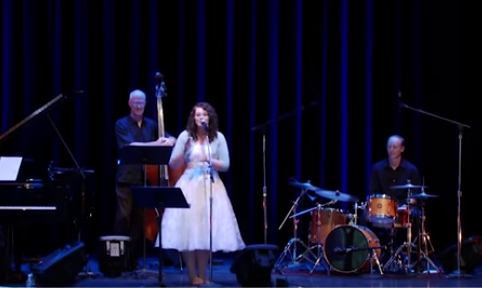
Although Mandy takes advantage of modern technology when making music (she uses visual toner apps which help her see what’s she’s singing), she relies more on her sense of touch. Mandy began by talking into a balloon, which helped her feel herself talk, and moderate her sound and volume. She taught herself how to sing with other musicians and keep time, all by touch. This technique helps her feel the movement in her body as she’s singing.
When asked about her decision to learn ASL, Mandy conveys her desire to communicate with those around her, which led to her decision, but she understands that ASL may not be right for everyone, and that each person must find their way. ASL helps her sing and sign at the same time, providing a connection to the music that she welcomes, but she emphasizes it as a personal choice for individuals, “And that’s their choice. We should respect their decision in how they want to communicate.”
Mandy wants her music to provide encouragement to others facing hurdles.
“I really hope my music and my life can help encourage people not to give up.”
She also hopes her story will motivate others living with hearing loss, who can benefit from music like she has.
“But … maybe I can encourage late-deafened people and people who are losing their hearing and don’t know what to do, and connect that way.”