
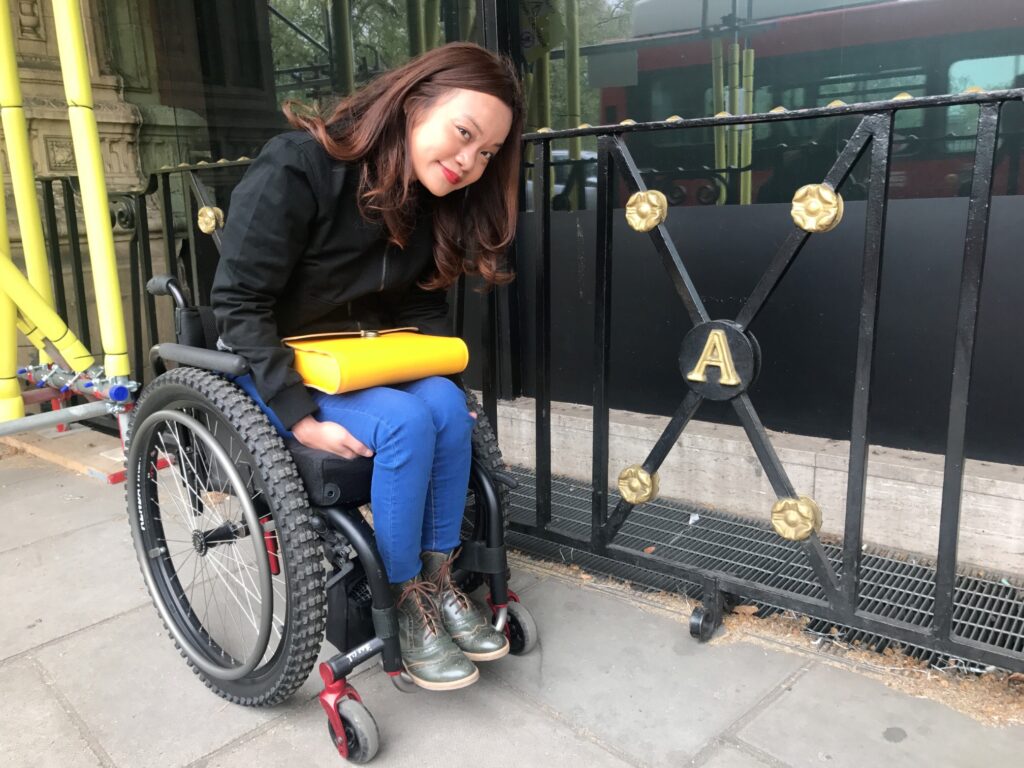
Living with a disability has been a rollercoaster journey for Azlin Binte Amran. One day, Azlin fell into an escalator that was under maintenance and broke her spine. Doctors told her that she was very lucky to have survived the accident, and informed her that she had a slim chance of walking again.

This news heavily affected Azlin, who believed at that moment that she had “lost [her] independence, [her] friends, and [her] identity.” As an outdoorsy individual, she was saddened when she realised that many of her hobbies, such as jumping off the jetty into the sea or climbing waterfalls, required the use of her legs.
“I would never be able to experience these adventures as I once did. It made me feel like an outsider who doesn’t belong because there is a difference between seeing something beautiful from afar and being able to experience it,” shares Azlin.
Re-learning how to perform daily tasks was something that Azlin had to do as well. “Other people have dreams of being famous, rich or successful but what I wanted was something they already have – the ability to walk,” she says.
However, when the going gets tough, the tough gets going, and Azlin discovered that she was much stronger than she thought she was.
“I needed to redefine what recovery meant and move on with my life.”
Azlin decided that she should not let sadness and regret continue defining her. Instead, she chose to “embrace the future and give happiness a shot.”
“It is fair to say you need to be able to see your own beauty before others can.”
That also meant a refocus on what was truly important and what memories are worth holding on to.

For instance, Azlin’s recent trip to Iceland with her husband and friends not only consisted of the opportunity to visit some of the most picturesque locations on Earth, but included nights of cooking together, working together to traverse up and down snowy hills, and even missing their flight back home. And it was these little moments that made for good stories in the years to come.
“I learnt that with most things, it is a matter of perspective. It is the moments we make and share together that allow them to become stories that we remember.”
Her trip to Iceland was also a testament to the things that Azlin could do. “I would have never believed that a girl in a wheelchair could go to Iceland and come back,” she shares. Such adventures might be hard to come by for individuals with disabilities, Azlin admits, but “a little bit of planning, a little bit of help, and a leap of faith helps.”
“When we are being pushed into difficult situations, we have an opportunity to learn that there’s so much we are capable of.”
Yet, Azlin also recognises the stigma attached to people with disabilities, who are often viewed as helpless, dependent, and requiring charity from others. “While I agree that we need advocacy and support from the government and society, the charity perspective overshadows the bigger issue, which is empowerment,” Azlin notes.
Empowerment comes in different forms, such as building more accessible infrastructure or bridging the gap between the able-bodied society and the disabled community. Representation and inclusion are paramount in accepting diversity, and it is then that individuals of all different backgrounds can come together to build a better society.
“When you allow us into your world, you help us expand our possibilities and create new opportunities for us. Talk to us if you want to know our stories. Employ us. Engage us. This way, you can begin to empower us,” says Azlin.