
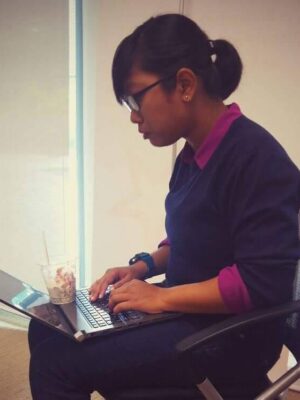
 Corporate strategist Syahidah Alim knows that while getting a job is already difficult in today’s job climate, having a disability compounds the process. Together with her team in Sports Singapore, she works on planning and direction for her organisation.
After graduating from university, Syahidah got a scholarship to pursue a two-year master’s degree in knowledge management at Nanyang Technical University. While some of her peers got a job before even graduating, she continued to send out resumes and go for interviews for months.
“The process was really tough. After my thesis, it took me about 10 months to get a job compared to my classmates. The hardest part was that both me and my classmates started job hunting at the same time before graduation, but it took me a longer time to get a job.”
The most challenging part for Syahidah, however, was not being rejected based on her educational and professional qualifications. For the 31-year-old who was born with cerebral palsy and walks with a limp, it was the seemingly endless rounds of unsuccessful interviews.
“Every day I sent out about 10 CVs to different job posts. Some of them replied saying, ‘Sorry’, either you’re unqualified, overqualified or the position has been taken. That’s alright.”
“Half of the time, I got called up for job interviews. I had to go through rounds and rounds of interviews, but at the end of the rounds they [would say], ‘Oh, we decided to go with the other person.’ That happened to me a lot (…) to the point that I got really unmotivated because [while] the rest of my classmates had gotten jobs, I was still unemployed.”
There are several organisations in Singapore working to change the public perception of hiring practices of people with disabilities (PWDs). For example, according to president of Disabled People’s Association (DPA) Nicholas Aw in an article for HRM Asia, SG Enable can provide assistance in “sourcing for candidates, auditing the workplace, assisting with funding applications” and “provid[ing] support to both employee and employer for at least six months.”
SG Enable provides these services as the administrator of the Open Door Programme, a government -funded initiative by Workforce Singapore (WSG) and Ministry of Social and Family Development (MSF). The programme encourages employers to “hire, train and integrate PWDs” through the provision of grants and employment support services. The programme offers up to 90% subsidies for different workplace accommodations, such as “the purchase of assistive technology, sensitivity training and renovations”.
However, there are still legal obstacles that prevent from entering the workforce in a meaningful way. “Although there are successful professionals with disabilities, they are the exception rather than the norm,” says Nicholas. “[L]egislation is needed to ensure that all companies make the effort to have inclusive hiring practices. No such quota system or any other anti-discriminations legislation exists in Singapore.”
To say that Syahidah’s job-hunting process was tough would be an understatement. In the 10-month long process, she went for 40 to 50 interviews in different industries. “From being a librarian, to consultancy jobs, to even government jobs as well,” she said.
Her big break came when she came across a job opening for a post requiring knowledge management – the very field she was majoring in for her master’s degree.
“I decided to for it, and went through the same interview process. The good thing was that they saw my potential and ability. I started out as an executive for the SEA Games [Southeast Asian Games] organising committee. We were the ones that planned, executed and organised the 2015 Games.”
“Right after the games ended, I got an offer from Sports Singapore to continue my contract full time. It was a different job from knowledge management; more towards strategic planning and relations. I’d always wanted to do a strategy-related job,” said the para-archer, who got into the development archery team just a week after getting the job at Sports Singapore.
“I went through the same interview process, and here I am now.”
This article is a part of our #AbleFamilies campaign in Singapore. Stay tuned for real life stories, advice and experiences from people who believe in and represent the potential of all kids. By now empowering the thousands of kids with disabilities in Singapore and supporting their parents and caregivers, we strengthen the next generation of citizens to promote a more inclusive Singapore.
