
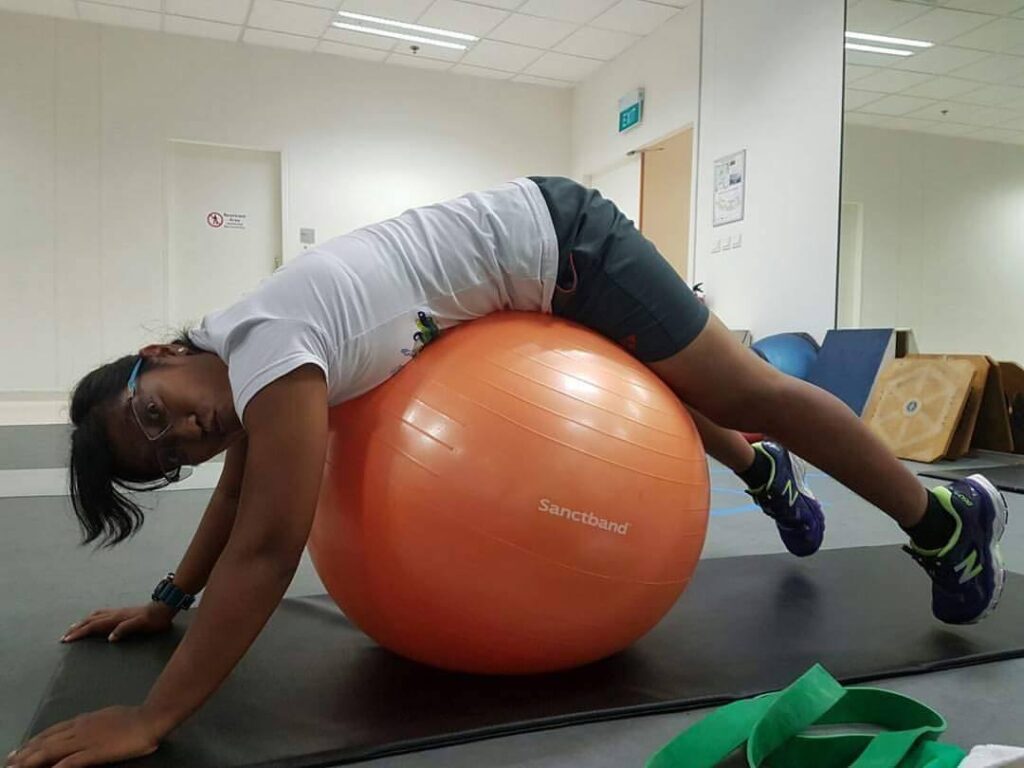
As a teenager, all Syahidah Alim ever wanted was to join in a campfire and enjoy the wild outdoors. Normally an activity where children learn to test their own limits, Syahidah first had to deal with those who placed external limitations on her.
When her mother first decided to enroll her in a mainstream school, she faced resistance from various principals and teachers, who told her to send Syahidah to a special school. Born with cerebral palsy, 31-year-old Syahidah walks with a limp.
“[My mum] was strong-headed about her decision to get me into a mainstream school. She felt that I should learn to be more independent, more strong. I also think she wanted to make a point. She wanted to tell parents who also faced the same expectations as her: dare to be different.”
While Syahidah feels that her mother made the right choice in advocating for her daughter, she admits that it was difficult – although not academically – to live with a disability and attend school at a mainstream level.
“I experienced bullying, which started in Primary 2. There was a period of time [when] I lost my confidence, self-esteem. Other than that, your teachers have assumptions that you cannot do this, cannot do that. There wasn’t much opportunities for me to do sports,” said Singapore’s first para-archer, who made her Paralympic debut in archery at the 2016 Rio Paralympic Games.
When it was time for Physical Education, Syahidah would be “confined” to a classroom. “It was more like my own free time,” she said.
When it came to choosing a co-curricular activity (CCA) in secondary school, Syahidah was summarily rejected on her first try. The reason given? “They said that because of my disability, [uniformed groups] may not be a suitable CCA.”
Uniformed groups incorporate physical elements such as marching, hiking, camping and other outdoor activities. Because of the way that Syahidah walks, they felt that there was a higher risk of her getting injured. “They don’t want to be accountable for any injuries,” she said.
She went home to speak to her mother, who predictably, was “furious”. “The next day, she came to the school and chose one uniformed group – it was Girl Guides – and went to the supervising teacher. She tried to negotiate to get me in. At first the teacher said, ‘That’s not going to happen’. But my mum said, ‘Give her six months and see whether you want her or not.’”
As it turns out, Syahidah ended up staying in Girl Guides for the remainder of her years in secondary school. Most of the times, she attempted to and managed to participate as much as the other students. “If I couldn’t [do something] I would let the teacher know. This was good, because they also learned a lot about me and I learned a lot about them.”
“[The teacher] told me on my last day that she was so wrong. She shouldn’t have made assumptions. That was life-changing for her.”
Another required school activity that was off limits to Syahidah in school was swimming. “At first glance, they told me I couldn’t go because of the usual reason, risk of injury. So because of that I wasn’t able to do swimming with my classmates.”
Determined to not let Syahidah feel left out, her mother persuaded a private swimming instructor at a public swimming pool to take on two private students. Eventually, Syahidah and her younger sister went for regular swimming lessons outside of school hours.
“My mum actually fought a lot for me when I was in primary and secondary school. I really appreciate what she has done. She felt that my disability should not be a reason to not do things. Which is a good thing, because the experiences I had in mainstream school made me stronger as I grew older.”
“She’s quite a badass,” laughs Syahidah.
This article is a part of our #AbleFamilies campaign in Singapore. Stay tuned for real life stories, advice and experiences from people who believe in and represent the potential of all kids. By now empowering the thousands of kids with disabilities in Singapore and supporting their parents and caregivers, we strengthen the next generation of citizens to promote a more inclusive Singapore.
