
“The expectation of disability not being a difference should start from young.”
That is exactly what Singapore’s first inclusive preschool, Kindle Garden, aims to achieve.

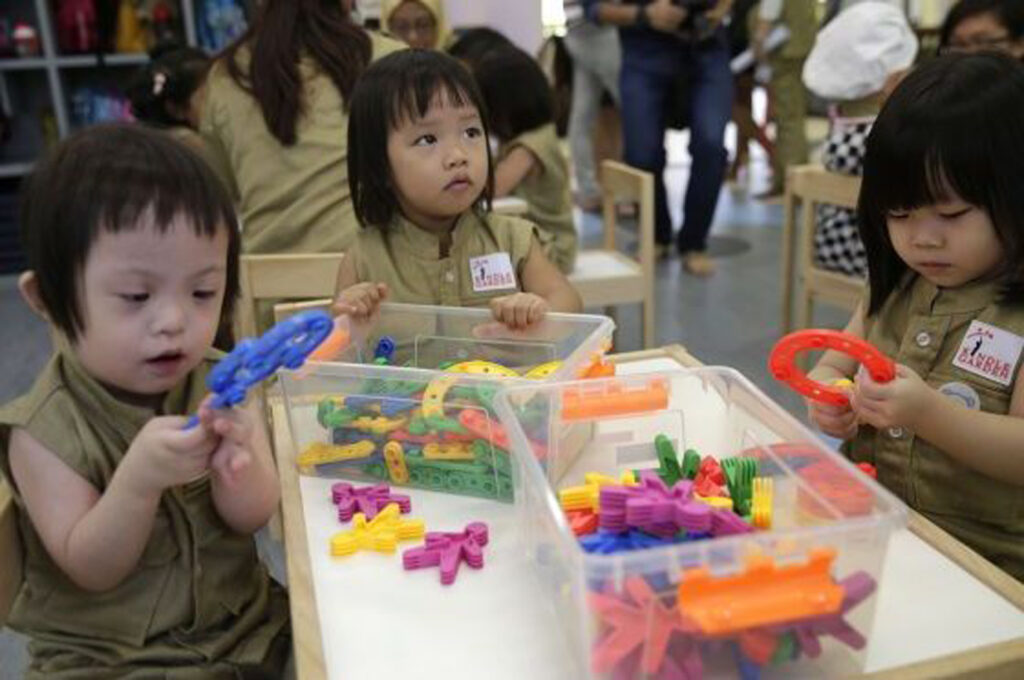
First opened this January, Kindle Garden strives to provide an inclusive learning environment for children with and without special needs, from ages 18 months to 6 years. The preschool reserves around 30% of its places for children with special needs. Children with mild to severe special needs are able to attend. The school has a maximum capacity of 75 children, and the low teacher-to-child ratio ensures that each child receives considerable attention and guidance. The preschool is also equipped with features that enhance the inclusive environment, such as a tactile track to guide visually-impaired children and accessible toilets.
As for the school curriculum, all the children in their respective levels follow the same day-to-day schedule and activities. Additionally, while lessons are tailored to suit the respective needs of each individual child, the children are all ultimately taught the same lesson content. For instance, teachers may use assistive devices, such as a picture communication system, to guide children with special needs through the lessons.
The parents’ reviews
Mr. Tng, whose 2-year-old son is among the first batch of children enrolled into Kindle Garden, had no qualms having his son in the classroom with kids with special needs. He expresses his joy seeing his son making new friends:
“He holds hands, laughs and plays with all his friends… It’s heart-warming that he can […] play with everyone.”
Another parent whose child is also in Kindle Garden, observes how the school community has been extremely supportive and beneficial to her daughter. 3-year-old Khloe Chan, who has Down’s syndrome, used to be more reserved. Since attending school, Ms. Eliza Chan has noticed that Khloe is now more confident and eager to interact with her peers. She is more active at home as well.
“When she sees her classmates up and running about, she’s more motivated to stand up and walk, to follow them to do certain things. She also recognises her classmates, takes a second look and then perhaps points them out.”
Besides that, Ms. Chan has noticed that other children also offer their hands to assist Khloe when she has difficulties walking. Khloe’s classmates, according to Ms. Chan, do not see her as any different from them as well.
Ms. Chan also added that Kindle Garden has given Khloe the opportunity to attend preschool, as no other preschools had accepted her.
Run by voluntary welfare group AWWA, Kindle Garden has been well-received by the community. It has received strong financial backing from the Lien Foundation. Apart from that, there is a strong demand for the preschool, seeing about 100 children with special needs and 25 children without special needs on the wait list. Kindle Garden is also working on eventually catering to all special needs.
Schools like Kindle Garden are pivotal in building an inclusive society, enabling children and parents alike to take the first steps in embracing and accepting people of all abilities. This sentiment is echoed by Mr Izaan Tari Sheiki, whose 3-year-old daughter also attends Kindle Garden, who says:
“We, as adults, may not be sure how to handle those with special needs, but children can know from an early age that it is not a problem.”
“The adaptive environment (that the pre-school provides) helps them build confidence too,” added an IT manager, Mr. Tng. Thus, inclusive schools like Kindle Garden play an essential role in promoting the idea that ultimately, “everyone is the same.”
This article is a part of our #AbleFamilies campaign in Singapore. Stay tuned for real life stories, advice and experiences from people who believe in and represent the potential of all kids. By now empowering the thousands of kids with disabilities in Singapore and supporting their parents and caregivers, we strengthen the next generation of citizens to promote a more inclusive Singapore.