
 Children with disabilities may have all the family support they need, but for them to truly thrive, it often takes support from the family, institutions and children themselves. A balance of love and age-appropriate independence training, topped off with a strong will is what guides them towards their fullest potential.
Muscular Dystrophy Association Singapore (MDAS) organises the aptly-named Bridge programme that nurtures children with disabilities who are either making the transition from a special school into a mainstream one, or needing extra academic support after completing their education.
“A lot of our members are neither here nor there. We’ve got a few who have graduated from special schools, [but they] cannot read, cannot write,” says Judy Wee, accessibility consultant and senior manager at MDAS.
“What we try to do is build confidence, teach them empowerment. We teach them how to talk to people, how to ask for help. We teach them growing up skills and decision making. We have some who have finished education but were at home for so many years, [they] forgot how to read and write. So we teach them how to use a computer. We have a group who finished school but don’t know what to do with their lives. So we introduce them to vocational work.”
Judy once mentored a young woman who had finished her education but could not find a job. She arranged a tuition teacher for her, and after dramatically improving her reading, writing and math skills, managed to find work. But more important than the tutoring was her own willingness to travel for her lessons – it was not the teacher who came to her.
“I told her, you want? Then you learn. You learn how to exercise. You learn to build yourself up. You learn how to be independent. You learn how to transfer yourself. Show your parents that you are old enough, mature enough,” said Judy.
Coaching independence
One of the most important ways that CWDs can practise and gain independence is through mobility training. The first step is obtaining a personal motorised wheelchair, a task that usually falls to the parents of CWDs. Once they have one, the next step is for them to learn how to get around independently on public transport and in public areas.
Judy recalls a young man, Saifudeen, who was not allowed to leave the house on his own. With other staff members from MDAS, she taught him how to use the public transport system. After one guided trip, he quickly got the hang of it and insisted on taking the MRT by himself.
“We said, okay, we’ll follow you part of the way, then you go the rest of the way. It took a while before his parents accepted the fact that he could actually take the MRT on his own. He now smiles non-stop. Because it’s freedom.”
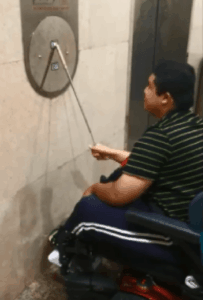
“He has a extendable ‘wand’ that he uses to reach for the lift button – to reach for everything. His father bought it for him and he bought more to share with his friends.” For children, support from their peer group is just as important as support from their family. Positive peer models can encourage and inspire CWDs to push themselves further. “They say things like, I’m pressing the lift button for everybody now. It’s empowering to know that, hey, I can do things to help my friends.”
For parents, seeing other CWDs gain independence can provide that gentle push towards giving their own children more opportunities to do things for themselves.
“This other boy, his mother still follows him around. But she says, I don’t press anything now. He does everything himself. I’m just waiting for a day when he says that he’s ready to go by himself.”
With or without disabilities, children in modern-day Singapore are subjected to much more information than they can process. They are also faced with increasing expectations of academic success, which when compounded with additional positive or negative expectations of having disabilities, can affect their mental health.
Once a week at MDAS, the children who attend classes or therapy enjoy a period of unstructured time in between sessions. “Everyone loves Monday, after lunch, because we’re all sitting at the table, just talking. Asking questions, teasing each other. Our volunteers have never seen something like that. They say, the kids are free. They are treated as people.”
Simply allowing for free time like this can be greatly beneficial, as children learn more about themselves and try to figure out their own capabilities.
“They learn that they are no different from anybody else,” said Judy. “I explained to a boy: it’s okay if you have a disability, you can still make decisions. He asked me yesterday, you mean I can say no? I said, yeah, but you must be happy with the reasons you’re giving yourself.”
Judy strongly believes that CWDs should make their own decisions and do everyday tasks for themselves, even when it is initially difficult for them to do so. When they are able to fully immerse themselves in childhood and age-appropriate decision-making, it becomes easier for them to push for their own independence.
“If parents don’t give their kids the opportunity to try their own, they won’t know how to develop.”
This article is a part of our #AbleFamilies campaign in Singapore. Stay tuned for real life stories, advice and experiences from people who believe in and represent the potential of all kids. By now empowering the thousands of kids with disabilities in Singapore and supporting their parents and caregivers, we strengthen the next generation of citizens to promote a more inclusive Singapore.
