
In late 2013 when Alex first started feeling ill, he thought he just had a case of the flu. But when he noticed blood in his urine and blotchy, bruised areas on his skin, he knew it was something more serious.
A devastating diagnosis
Alex had streptococcal infection (type A), and was septic. The infection had already begun to attack his limbs and parts of his face, turning the skin black. Doctors told Alex and his family that his left arm would need to be amputated in order to save his life. Alex says his doctors were very matter of fact in delivering this news, and because of that, he was not sad or emotional about losing his arm.
“It was a case of ‘this arm is killing me so it has to go.”
A month later, the infection in Alex’s legs was beginning to poison the rest of his body, and both legs were amputated in two back-to-back surgeries. A short time later, doctors tried to save Alex’s last remaining limb – his right arm – in a 17 hour surgery on Christmas Eve. But the limb was too damaged and weakened from the infection, and it too had to be amputated.
A completely different life
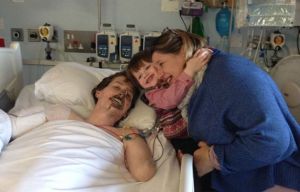
Alex was now facing the rest of his life with no limbs and his face nearly unrecognizably altered with his lips and nose grafted with skin from his shoulder. And yet remarkably, despite so much adversity, Alex’s spirit has not wavered. He says this experience has “made me think differently about being a dad, a partner, a human being.”
Once Alex healed from his multiple surgeries, a new phase in his life began. He had to adjust to having caregivers around him constantly helping with things like bathing and dressing. And he also began to learn to use prosthetic limbs.
Alex proved he was a fast learner when it came to walking on new legs. Just two weeks into a ten-week walking course, he began making strides on devices called “rocker pylons” – prosthetics on short poles with rocker feet. “Going up stairs is difficult because of the shortness of them, and different terrains are hard,” shares Alex. But he continues to push himself.
Alex also uses prosthetic arms with hooks, and he has learned to do things like open a refrigerator and pick up a drink independently.
“I just think it is incredible what the human body is able to overcome.”