
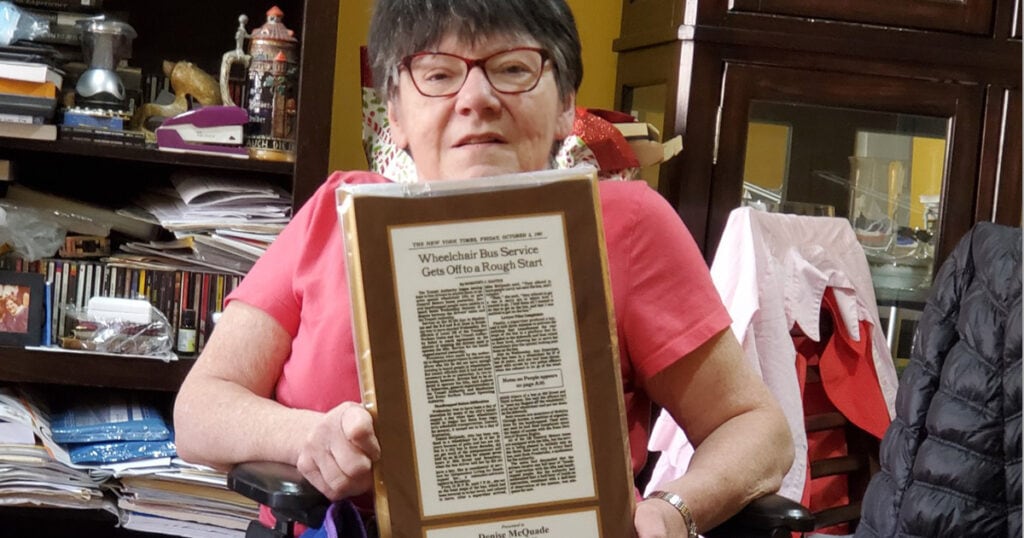
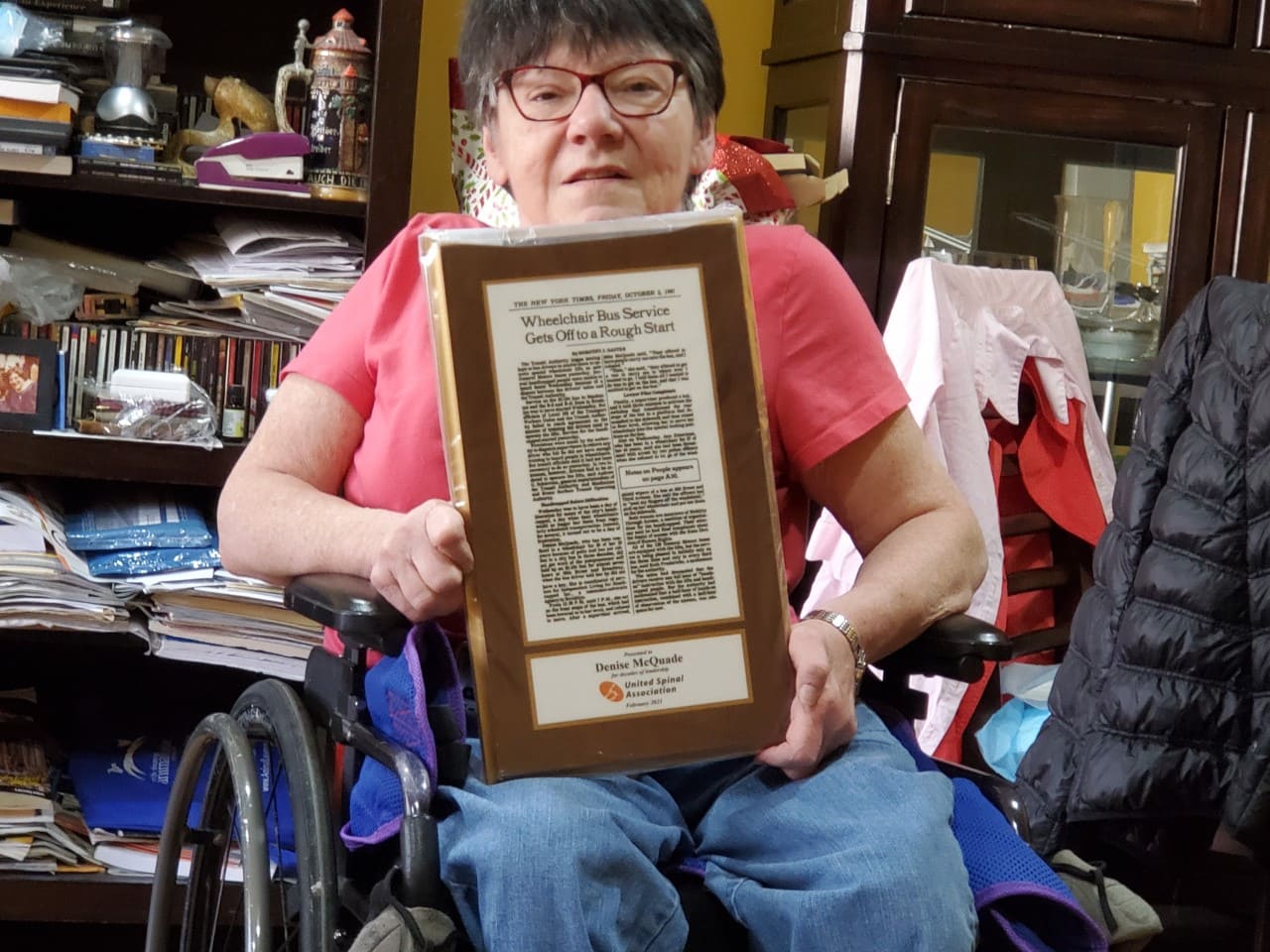
Denise McQuade, one of the first nonveteran women on the board of United Spinal Association, has led a life of leadership and achievement that would put her on the Mount Rushmore of those who have advanced inclusion of people with disabilities.
But you would never know it from talking with her. She’s unassuming, candid, but not one to take sole credit for creating lasting, landmark, positive change.
“I got involved in disability rights in the 1970s – long before the ADA [Americans with Disabilities Act],” said McQuade, a post-polio manual wheelchair user. “When I started out, people could discriminate against you. I was on an interview, but the man looked at my wheelchair and said `it wouldn’t work out.’” I said `maybe if you would show me the work station, but he stopped the interview. You could do that back then.”
McQuade already was active in the Independent Living movement, working as services coordinator at the Brooklyn CIL, when she made headlines in Manhattan. As former United Spinal CEO James Weisman detailed in a recent New York Able Newspaper column, Section 504 of the Rehabilitation Act was requiring accessible buses, but New York’s Metropolitan Transportation Authority (MTA) was resisting access and refusing to train bus drivers or equip them with keys needed to operate lifts.
McQuade was at Broadway and 50th Street when a lift-equipped bus arrived. The driver said he couldn’t operate the lift, but by then she had transferred from her wheelchair to the bottom step of the bus. She refused to move. Police and news media arrived. After a 7.5-hour standoff, McQuade was allowed to board. The positive media coverage of the 1981 high-profile demand for equality led to changes that opened transit access to people with disabilities.
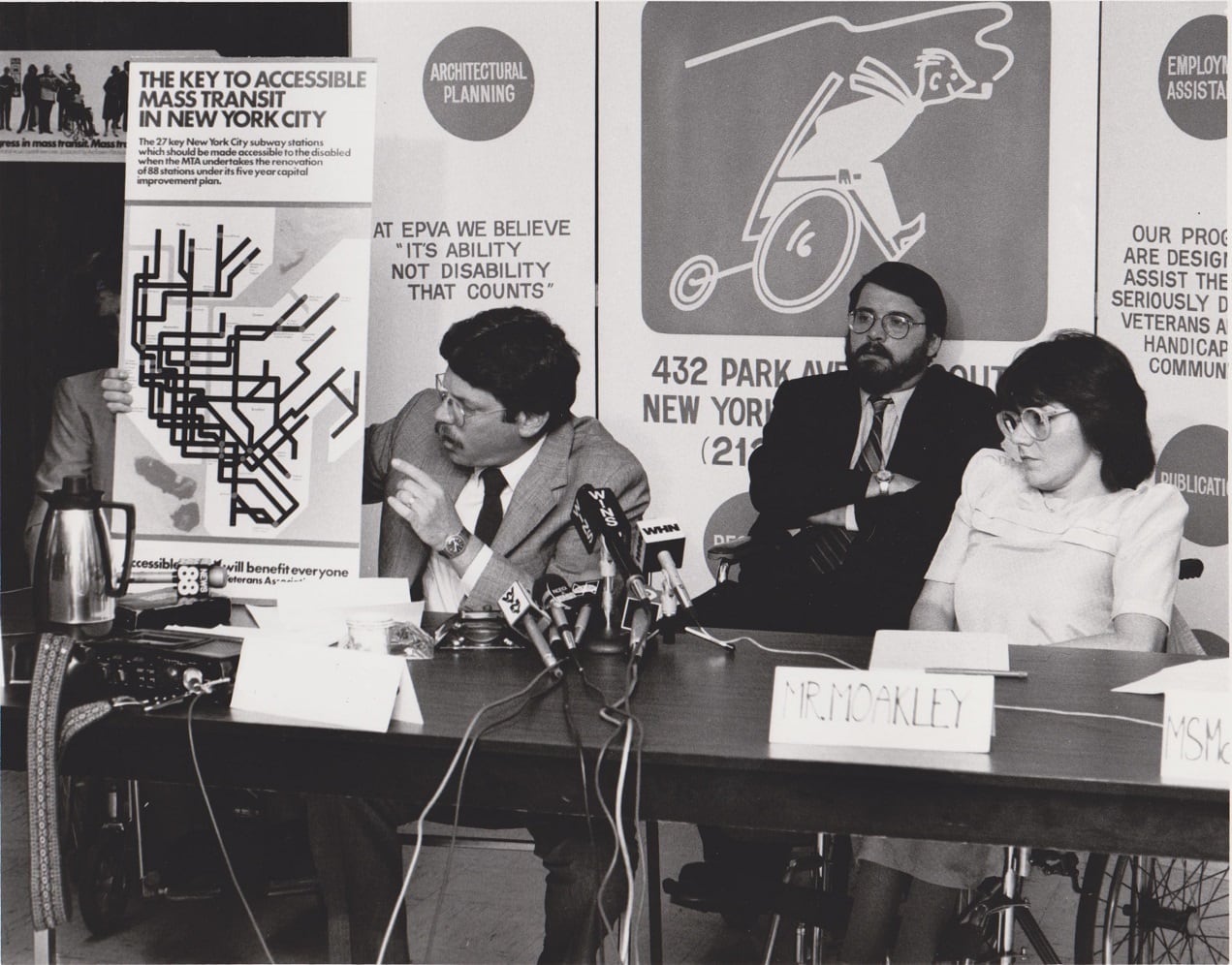
“I have been very active in the movement and still fighting to access mass transit. We’re light years away from where we were, but there are still barriers. In New York, the buses are accessible, but subways and elevated lines will not be accessible until they re-do stations for access,” she said.
McQuade, in a bit of irony, went on to lead the MTA’s ADA Compliance Office about a decade later. She created award ceremonies that recognized bus operators who members of the disabled community nominated for their commitment to delivering accessible bus service. McQuade, as a governor’s appointee, also worked for implementation of an accessible bus and subway system and the creation of a paratransit service.
“Board service was very important to me. United Spinal started as Eastern Paralyzed Veterans Association, so there were not many females. Now, the board is reflective of the diversity of the large community it serves,” she said. “It is gratifying to see United Spinal expanding services for such a vast range of needs.”
McQuade, as staff and then executive director of the Brooklyn Center for Independence of the Disabled, worked on passage of human rights legislation and the NYC accessible building code.
“503 and 504 of the Rehab Act was important, because any program that took federal dollars had to be accessible. But the ADA, that gave us true civil rights – so we can participate in anything everyone else can. It gave us broad protection and now you see more wheelchair users, more blind people, more people with various disabilities out in the work force and participating in the community,’ said McQuade, who worked on passage of the ADA –but adamantly scoffs at taking credit, noting “it was an effort of so many.”
McQuade, retired from the workaday world but still an activist, accompanied United Spinal on several Roll on Capitol Hill advocacy events when she served as its “first civilian” when the association expanded beyond veterans to become a national spinal cord injury/disorder organization.
“In the early days, the idea was people with disability should not be restricted from anything,” she reflected. “Now, we are saying `why do you have stairs when a ramp will do? People can trip on stairs. Why can’t you have curb cuts? It doesn’t cost more. It benefits a family pushing a baby stroller too.’ It’s not rocket science to design for the needs of all – from a level threshold to kitchen access.”
Steve Wright
Contributing Writer