Allaina Humphreys has spent more than 30 years transforming her lived experience as a quadriplegic into meaningful policy and systems change. In a recent interview with Annie Streit, United Spinal’s Grassroots Advocacy Manager, she spoke on her local and state advocacy roles, her mission-driven design studio and the belief that accessibility benefits everyone. Here is an edited version of their conversation.
Annie: Can you start off by giving background about yourself and your disability and how you got involved in advocacy?
Allaina: I broke my neck while training for AAU Junior Olympic Nationals in gymnastics 32 years ago. I became a C5-6 quadriplegic, just three years after the Americans with Disabilities Act went into effect. In fact, the staff came to my room at rehab and they said, “Hey, we want to talk to you about the ADA.”
And I was like, “What does the American Dental Association want to do?” And they just laughed and then they explained it. But at that time, I didn’t know anything about advocacy except that I just had to exist in daily life. And I wasn’t going to let people tell me I couldn’t go places or I couldn’t do things because I was 15, gosh darn it. As a teenager, I was going to do what I was going to do.
My mom had to advocate really strongly to get me to be mainstreamed in school, they wanted to put me in the standalone classroom. And she said, “You know what, my kid is in all these honors classes and you’re not going to deny her an education because she can’t walk.”
And so she was very fierce and it took quite a few months, but it worked out. So advocacy works.
Annie: You’re the owner of Free Wheelin Design. Can you share what you offer at this company and is this something you’ve always wanted to do?
Allaina: Actually, before my injury, I wanted to be a doctor. I had been studying that and then all of a sudden, you know, my fingers didn’t work. So being a surgeon was kind of out of the question. A friend of mine who kept coming to visit me at the hospital was in computer science at University of Illinois Chicago (UIC).
And he said, “Did you know you can do art on the computer?” Because I had been a fine artist; I did pencil portraiture and painting. I was like, I had no idea. He brought me a computer and he got me a program and said, this is what you do. I went, okay, it sounds like fun.
Since my disability is so significant, nobody really wanted to hire me for a real job. So I just slowly made my way into doing this for my work. Then I learned that through this work, I could help people, I could do all kinds of things to magnify information, I could solve people’s problems, I could teach them stuff about marketing, and I just found it incredibly fulfilling.
At Free Wheelin Design, I do graphic design, basic web development and marketing. And I exclusively work with nonprofits, school districts and small businesses where you’re really helping the community, and then a few electoral candidates as well.
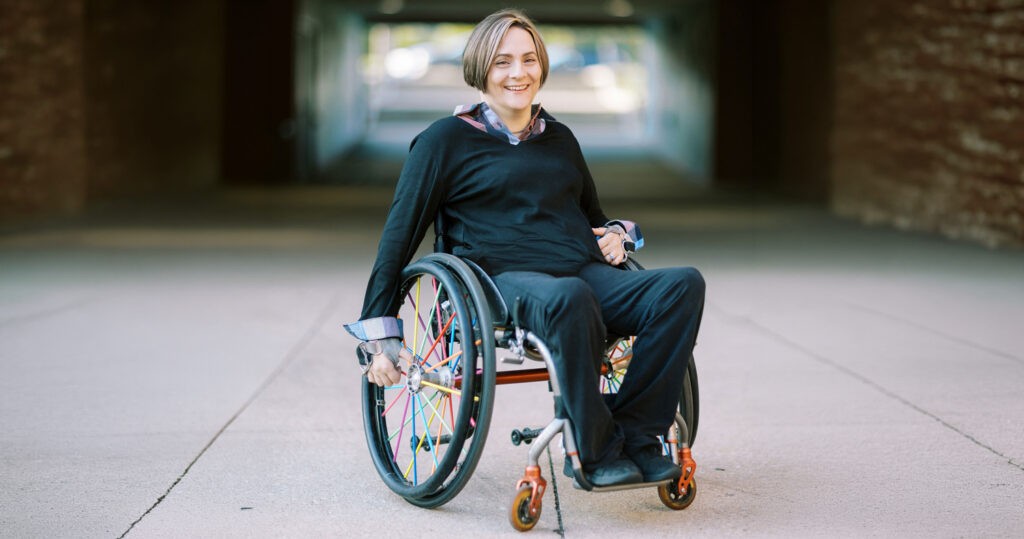
Annie: You are also the founder of Bolingbrook Pride. Can you talk about this a little bit? And by the way, I love that you have rainbow-spoke wheelchairs.
Allaina: Yes, I have rainbows, but my kids decorated them for me. But I founded Bolingbrook Pride because in the suburbs, LGBTQ+Pride looks different than the city of Chicago, right? I think people are afraid of what they don’t know. The number one thing we always heard was don’t throw it in my face.
It was like, oh, absolutely not. That’s not what people are actually interested in doing. So I started this new way of doing suburban Pride celebrations.
We’re the first Chicago-suburban Pride organization to come about, along with Aurora. I started doing what I call the Bolingbrook Pride Picnic and Puppies. We have a dog rescue that comes and offers puppy cuddles to demonstrate that not only do dogs show acceptance better than anyone, but it’s also a way to get exposure for these animals. The first ones we did was a bully breed rescue, these dogs have been maligned for no reason other than perception.
It was like, let’s break that stereotype. I think offering education and experience is the way that we cut to each other’s humanity and that’s how we’re going to get inclusion, accessibility, all of those things.
I know a lot of folks who are LGBTQ+, I myself am pansexual, so I’m married to a man and have children. And I just feel like it shouldn’t matter. And the way to teach people that it doesn’t matter is by showing them who the community really is.
Annie: You’re also on the board for Change Illinois. Can you share what this organization is?
Allaina: They are a nonpartisan, nonprofit organization who works to end gerrymandering because everyone deserves access to elect representation that looks like them, will vote for them, will help them. We work on ending prison gerrymandering, for those who are in prison who can vote, to make sure that their vote counts from where they live and not where they’ve been incarcerated.
And then we are really working on forming a coalition this year to support the production of an Illinois Voting Rights Act. There’s a national voting rights act, but things are uncertain nationally. We want to make sure we have protections at the state level so that everyone has access to the ballot. We also hold our elected officials accountable to ethical standards.
But a lot of what we do is in coalition, which is kind of my favorite thing. I think the more diversity of experience that can be brought to the table, the greater the impact that you can have.
Annie: That’s so important to bring up because like a lot of the things that we do at United Spinal and the resources we share, it can cover so many and help out so many different disabilities. It’s not just spinal cord injury. Work smarter, not harder, come together because as you very well know, advocacy is hard work.
Join our Grassroots Advocacy Network