

United Spinal’s Emergency Preparedness Working Group brings together wheelchair users from around the country to share information, make informed decisions about their safety and advocate for better policies. Members recently discussed practical ways to evaluate and strengthen emergency plans. Below are three recommendations that came out of that discussion.

1. Make and Test Your Evacuation Plan
Everyone should have an evacuation plan regardless of ability, but if you use a wheelchair or mobility device, there are some extra considerations to keep in mind. Make sure you have an accessible place to go — whether it’s a friend’s house, a hotel, a shelter or somewhere else. If you live or work in a building with multiple floors and are not on the ground floor make sure you know your building’s emergency plan.
Plan ahead for accessible transportation that you may need for evacuation or getting around during or after disaster. Check with local transit providers as well as with your emergency management agency to identify appropriate accessible options. Justina Plowden, an advocate and former Ms. Wheelchair Louisiana, suggests contacting your local Home and Community Based Services if you need help with transportation.
Andy Weyant, a working group member from New York, says not to overthink emergency planning. Even little things can pay dividends. “For testing your emergency prep, you can do something as simple as turning your lights off to check and see if you have everything you need if the power goes off, or go spend the night at a hotel to see everything that is needed if you have to evacuate.”
2. Get Your Gear Ready
Part of living with a mobility disability is having lots of essential gear and supplies. Making sure you have everything you need, ready to go and in working condition, in case of an emergency is essential. Keep important equipment and assistive devices in a consistent, convenient and secure place, so you can quickly and easily locate them. Plan for enough disability-related supplies for up to two weeks (medication syringes, colostomy, respiratory, catheter, padding, distilled water, etc.).
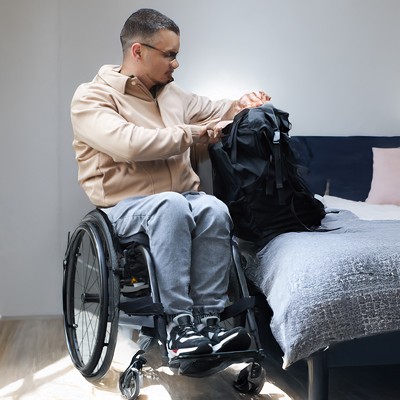 Practice gathering and loading your “go bag” or portable kit to make sure you can carry everything you need. Ranae Beeker, United Spinal’s State Advocacy Coordinator for Washington state, emphasizes the importance of testing your emergency prep. “Testing my plan forced me to evaluate what I thought I would need and what I actually needed,” she says.
If you use a motorized wheelchair, consider keeping a lightweight, manual chair available as backup. It’s also wise to keep a repair kit or tools to fix or adjust your wheelchairs and tires.
“I use a specialized off-loading cushion on my power chair that requires nightly charging and is essential in preventing pressure sores,” says Annie Streit, United Spinal’s grassroots advocacy manager and a C5 wheelchair user from Indiana. “To ensure I’m always protected, I’ve purchased an additional off-loading cushion and keep a backup ROHO cushion on hand for any emergency situations where I may not have access to power and I can easily grab it to evacuate.”
3. Alert Your Support Network
 Whether you rely on caregivers or require assistance evacuating, being on the same page with your support network could be the difference between a smooth evacuation and a stressful nightmare. Start out by contacting your local emergency management offices to see if they have a registry of people with disabilities so they know where you are and what you need. “Make sure that your local fire departments, local police stations, EMT’s and electric company know about any type of life sustaining equipment you have, and know that you are dependent on this equipment,” says Ken Ryno, a working group member and advocate from Pennsylvania.
Make sure your caregivers, and family and friends if appropriate, know your emergency plan and how to stay in communication. Take the time to train all the people you may reach out to. It is best to have more than one person in your support network at every location where you spend significant amounts of time, such as your home and your place of employment. Remember, the key to safety is to practice with intention, simulate potential real-life conditions, and include everyone in the process.
Emergency Preparedness Working Group
If you are interested in participating in United Spinal’s Emergency Preparedness Working Group to collaborate with advocates across the United States on emergency preparedness for the SCI/D and wheelchair user community to deal with natural or manmade disasters, please fill out the online form.
Resources
New Mobility articles:
• In Case of Fire … Take Stairs?
• Surviving California’s Historic Wildfires
Online:
• Emergency Planning for People with Disabilities (SJ Ready)
• Personal Emergency Plan Workbook (NCDP)
United Spinal Association:
• The Wheelchair Emergency Preparedness Compendium You Always Wanted
• Everything you need to know to create a support network and communication plan