
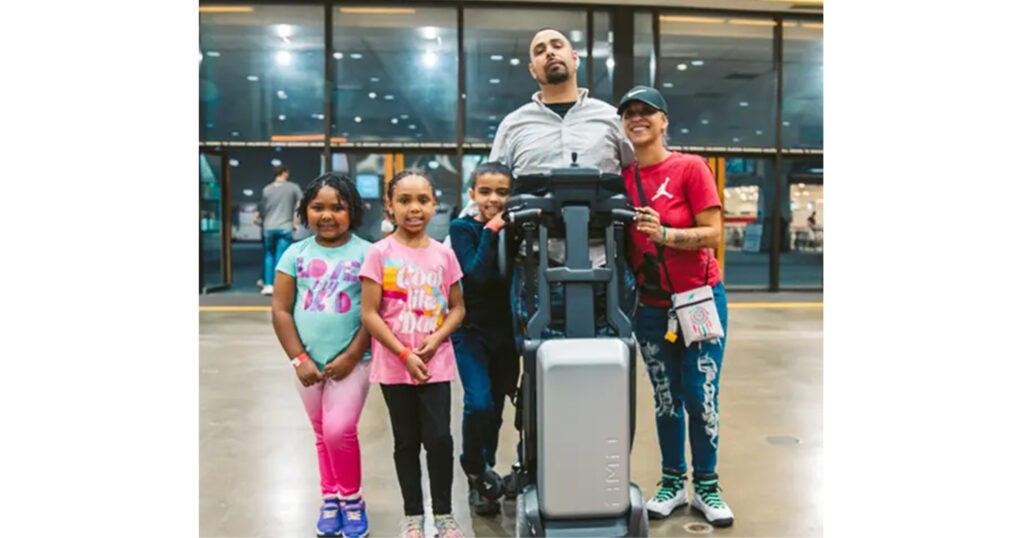
Matia Mobility is one of the companies that the Tech Access Group has had the pleasure of getting to know and working closely with over the past few months. The Tek RMD is notable for its technical innovation and for improving the health and well-being of wheelchair users.
Standing Room Only at Social Events
Most people are thankful for their wheelchairs because they make it possible to be out in the community, living life on their own terms. Still, for many wheelchair users, independence can sometimes come at the cost of navigating environments that were never designed with them in mind.
Take, for example, social events where standing is the norm, which can be alienating to someone who uses a wheelchair. Although crude, the adage, “you meet many butts in a wheelchair,” is apt, since you often find yourself positioned at waist height in crowds at a party, navigating a world that rarely considers your vantage point. A wheelchair user is even more stigmatized for not looking like every other partygoer.
But the challenges go far beyond social exclusion. Wheelchair users often face serious physical consequences from prolonged sitting:
- Pressure sores (decubitus ulcers): This one hit close to home for the spinal cord-injured. When you’re sitting for hours, even with the best cushion in the world, pressure builds—especially over bony spots—and it cuts off circulation. That lack of blood flow breaks down your skin. It’s not just painful, it’s dangerous.
- Spinal alignment and posture problems: Spend any amount of time in a wheelchair, and your body starts compensating. Bad posture becomes survival posture. Over time, this can cause your spine to twist, affect your breathing, and make everything more difficult.
- Discomfort and pain: If the chair or cushion doesn’t fit just right—or even if it did once but your body changes—you’re in for some deep discomfort. It’s not just a sore back; it’s a daily grind.
- Incontinence issues: Limited mobility doesn’t just affect where you go; it affects when. And if your body can’t move fast enough, you’re left dealing with a situation that hits your dignity, your hygiene, and your confidence.
These are serious issues that demand attention, as they can ultimately render a person confined to a bed if not adequately addressed. One tool often used to combat these problems is a standing frame—a stationary assistive device that supports individuals in a standing position. By allowing users to bear weight through their legs and maintain upright posture, standing frames help improve circulation, reduce the risk of pressure sores, promote better digestion and bladder function, and support overall well-being.
While standing frames offer essential health benefits, they can be uncomfortable and are not easily adjustable. In large part, that means a person is stuck in the frame until someone else helps them out. This lack of autonomy can be frustrating and limit when and how standing is incorporated into daily life. The solution to a frustrating problem can be just as frustrating as the problem itself.
Some Medicare plans do offer coverage for powered stand-up wheelchairs, but only when there is a strong medical justification. And even then, there are currently no manual wheelchairs on the market that offer a stand-up function. Adding such a feature to a lightweight manual wheelchair would undermine its primary purpose.
The Tek RMD, Matia’s flagship device, allows users to stand and move in tight indoor spaces, offering a level of eye-to-eye interaction and autonomy that traditional wheelchairs can’t match. One of the first things people notice when they get into a Tek RMD is just how tall it stands. For many, it’s the first time they’ve ever used a stander—or even experienced standing upright in years. That change in perspective can be emotional, empowering, and even a little disorienting at first, but it’s a reminder of how much standing can change not just how you move, but how you’re seen.
A Stand-Out (c-mon, I had to)
Unlike traditional standing frames, the Tek RMD allows you to shift positions vertically, making weight shifting possible and increasing overall comfort during use. Also, unlike standing frames, the Tek RMD can move! That means people can “walk” around their houses, reaching for cupboards and drawers that they could not go.
I experienced this firsthand, as I had the opportunity to try out the Tek RMD in my own home. I just sat in a chair with the pad under me, and the device lifted me off the ground. From there, the agile Tek RMD guided me around my floor.
And here’s another thing worth knowing—Matia has coverage from most of the major payers, and they’ve recently gone in-network with Blue Cross Blue Shield. It’s part of their ongoing effort to make this type of technology more accessible to those who need it. That matters. A lot. Click here to check if your insurance is eligible.
There are a few—not downsides, but limiting features—that are important to note. While the device is supportive, users still need to have decent trunk control to operate it safely. Additionally, the Tek RMD requires a certain level of fine motor control to manipulate the joystick for movement. That means it’s not suitable for everyone, and users with limited upper-body function may find it challenging without assistance
In the end, it’s not just about health metrics or technical innovation—it’s about dignity, inclusion, and the subtle but profound effects of reclaiming a vertical presence in the world. Consider the small miracles: reaching a shelf without asking for help, joining conversations at eye level, or simply navigating a crowded room without feeling invisible or in the way. No butts up here!
View this post on Instagram