
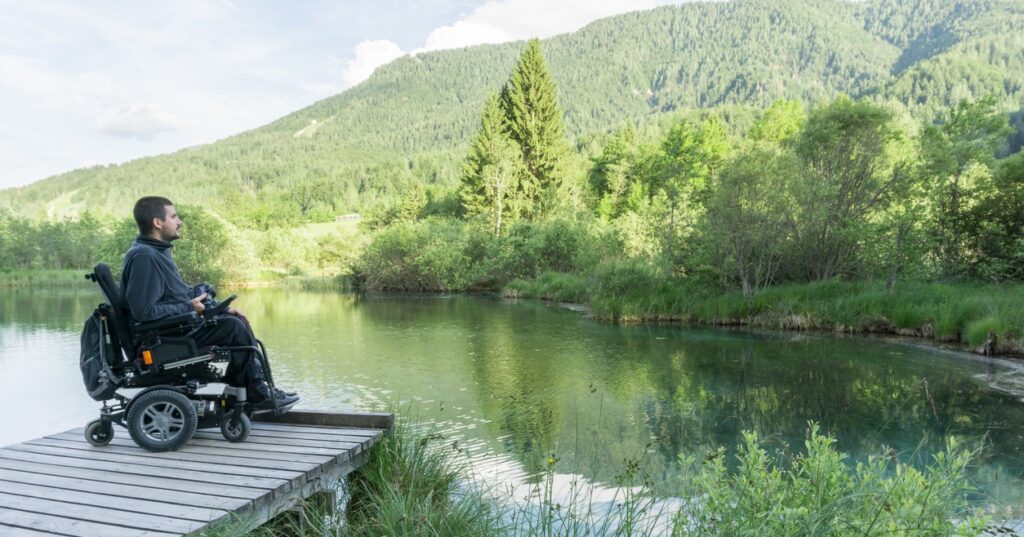
The wonderful wheelchair-user members of the United Spinal Association’s Outdoor Access Working Group want to share their favorite wheelchair-accessible trails with you. They also share how accessible the trails are so you can assess your own adventure level.
California Redwoods, birds and butterflies
Bonnie Lewkowicz is an Outdoor Access Working Group member and the Founder/Director of Access Northern California. One of Bonnie’s goals is to improve access to outdoor recreation for people with disabilities, and she shares some of her favorite trails:
Reinhardt Redwood Regional Park, Oakland: This park was reviewed while using a rear-wheel motorized wheelchair. The easiest and most accessible trail is the Stream Trail accessed at the Redwood Gate, but the East Ridge trail at Skyline Gate, while much less accessible, is worth a visit for a vastly different experience. Bonnie adds that it feels remote along the Redwood Trail through the redwoods. This park also has accessible parking, restrooms, and picnic tables.
Gray Lodge National Wildlife Area, Gridley: Bonnie states that this wildlife area offers “fantastic birdwatching and many miles of flat, accessible trails,” in the 9,200 acres of protected wetlands with over 300 species of birds and mammals. The three-quarter-mile Wetlands Trail is asphalt, but the Flyway Loop Trail is dirt and gravel. Other amenities include accessible parking, restrooms, and picnic tables.
Point Pinole Regional Park, Richmond: This is the largest park on the northeast bay shore. There are 12 miles of trails, and at least 5 miles have some access. Bonnie’s website provides accessibility information for the multiple trails at this park, and she further adds, “There are miles of accessible trails through a variety of different habitats with good birdwatching, and sometimes there are Monarch butterflies over winter.” Other amenities include accessible parking, restrooms, and picnic tables.
Yosemite Valley Floor Trail, Yosemite Valley: There are multiple accessible trails in Yosemite Valley, and the Yosemite Accessibility Guide is a great resource for wheelchair users who need information before visiting the park. Bonnie emphasizes that the Yosemite Valley Floor Trail offers “miles of accessible trails with continuous spectacular views. It’s what I call a destination trail because you need to spend a few days there to take in all of the beauty.”
Some other accessible trails at Yosemite National Park are the Lower Yosemite Falls Trail, Mirror Lake Paved Trail, Sentinel Meadow Cook’s Meadow Loop Trail, Glacier Point Trail, and Grizzly Giant and California Tunnel Tree via Accessible Trailhead.
Explore the Granite State’s mountains and forests
View this post on Instagram
New Hampshire resident and Outdoor Access Working Group member, Melinda Simms, shares information on accessible trails in her area.
Crotched Mountain, Greenfield
Crotched Mountain offers the longest mountainside accessible trails in the United States. The Gregg and Dutton Brook accessible trails combine unique hardpack pathways, boardwalks, moderate grades, switchbacks, and rest stops to create a natural and accessible hiking experience for people of all abilities. Everyone can get out and enjoy nature. You can download the trail map to familiarize yourself with the trails and terrain before your visit.
White Mountain National Forest, Concord
Below are ADA-compliant trails in the White Mountain National Forest. The United States Forest Service provided all descriptions.
Saco Ranger District, Conway
Rail N’ River Trail: Beginning behind the Russell-Colbath Historic House on the Kancamagus Scenic Byway, 12.3 miles west of the Saco Ranger Station in Conway, this fairly flat, shady loop trail takes you out to the Swift River at an opening that may prove to be a good fishing spot.
Rocky Gorge Scenic Area: From the parking area, follow the paved path to the bridge that crosses the Swift River just below the Gorge. Across the bridge, the path narrows and is surfaced with compacted gravel, winding its way along the edge of the Gorge to a viewing area just above the falls. The path continues up a small ridge at 8% grade to the top, where it crosses the Nanamocomuck Trail, then descends in a short section of 14% grade before arriving at Falls Pond, where there is a hardened viewing area near water’s edge. There are benches for resting along the trail from the parking area to the pond. The total distance of the trail into Falls Pond is approximately 1,300 feet.
A second choice is to proceed from the parking lot and, instead of crossing the bridge, continue along the hardened gravel trail that follows the old location of Rt. 112. Just past the bridge is a masonry overlook with a beautiful view upstream of the bridge and a bench for resting. This path follows the river for approximately 1,000 feet before ending at a widened area.
Sabbaday Falls: Located 16 miles west of the Saco Ranger Station on the Kancamagus Scenic Byway, this 0.4 mile trail leads to a picturesque series of cascades in a narrow flume. The gravel trail is wheelchair accessible, but is steep in places (6 to 25% grades) with frequent level spots. At the trail intersection by the falls, follow the signs for the Sabbaday Brook Trail, not the Sabbaday Falls Path. The trailhead parking area has accessible toilets and a picnic area, although not all picnic areas are easily accessed. Accessible toilets are also located here. Access to the dam may be difficult for some people due to the uneven grassy path surface. Two accessible fishing platforms are located between the boat launch and the dam, and this section of trail has been improved and surfaced with gravel.
Pemigewasset Ranger District, Campton
Diana’s Baths: This curious set of circular stone cavities is located on Lucy Brook. An accessible trail leaves the west side of West Side Road in North Conway. The Baths are located 0.8 miles from the trailhead at the parking area. Accessible toilets are also located here.
Forest Discovery Trail: The Discovery Trail is located along the Kancamagus Scenic Byway, approximately 7 miles east of Lincoln and 800 feet from the entrance to Big Rock Campground. Two separate loops comprise a total of 1.3 miles of gravel-surfaced trail, ranging from flat to average 8% grade. The shaded trail passes different prescriptive cutting units that serve as an educational site for timber management. There are breathtaking views and opportunities to see some wildlife. Accessible restrooms are available on-site, with benches for resting and interpretive panels trailside.
Lincoln Woods Trail: Parking for this trail is located at the Lincoln Woods Visitor Center on the Kancamagus Scenic Byway, 5 miles east of Lincoln. The trail crosses a suspension bridge over the East Branch of the Pemigewasset River, then follows an abandoned railroad grade for 2.8 miles along the west side of the river. The trail is shady, wide, and with an easy grade. A visitor information cabin and accessible toilet facilities are located at the parking area.
Livermore Road: Located in Waterville Valley near the Tripoli Road, this former logging road is closed to motorized vehicles but is a great road for horseback riding, mountain biking, and wheelchair hiking. The gravel road is mostly level, shaded by trees, and has an accessible restroom in the parking area.
Lower Ammonoosuc River Trail: This trail offers a view of the lower falls of the Ammonoosuc River. To view the falls, park in the lot at the 1/4-mile mark. Here, the Ammonoosuc River flows down a long channel of granite shelves. The biggest drop in the river is not more than three feet but the overall effect is still quite beautiful.
Accessible Appalachian Mountain trails
Melinda also recommends checking out the Appalachian Mountain Club Region, which lists five wheelchair-accessible trails. The AMC is the oldest outdoor group in the United States. Founded in 1876 to explore and preserve the White Mountains in New Hampshire, it has expanded to twelve chapters located in Connecticut, Maine, Massachusetts, New Hampshire, New York, New Jersey, Pennsylvania, Rhode Island, and Washington, D.C. The largest chapter is Boston’s, with over 20,000 members, followed by New Hampshire’s 12,000.
Another option for researching accessible trails is The New Hampshire State Parks website, which has a comprehensive list of parks with accessibility features.
Accessibly hike Arizona’s Grand Canyon and more
View this post on Instagram
Greg Houck is an Outdoor Access Working Group member from Arizona. He shares various resources for accessible trails in his area, including TrailLink, AllTrails, and VisitArizona.
VisitArizona lists 13 Wheelchair Accessible Trails in Arizona. While not complete, it is a great starting point for finding trails that fit your needs. The Trails include some of Greg’s favorite accessible trails with breathtaking views.
Rim Trail, Grand Canyon Village: This 13-mile paved trail on the South Rim of the Grand Canyon passes park highlights, including Mather Point, Hopi House, and the historic El Tovar hotel.
Crescent Moon Ranch, Sedona: One mile of two paved loops along Sedona’s Oak Creek, where the iconic Cathedral Rock can be seen.
Dead Horse Ranch State Park, Cottonwood: This park offers a mile and a half of accessible trails that circle three lagoons in the Verde Valley. The Canopy Trail offers great opportunities to view birds and fauna.
Montezuma Castle National Monument, Camp Verde: The half-mile paved Rimrock Trail takes you to the Sinagua cliff dwellings. The entrance fee for Montezuma’s Castle also includes admission to the Tavasci Marsh Overlook trail and the Tuzigoot National Monument, which has a fully accessible visitor center.
Woodland Lake Park Trail, Lakeside: This one-mile paved trail in the Pinetop-Lakeside area goes around the Woodland Reservoir and is popular with birdwatchers.
Boyce Thompson Arboretum, Superior: This is the oldest botanical garden in the state, and it has a mix of paved and compressed earth trails.
Tempe Town Lake, Tempe: You can find 7.5 miles of paved trail around this urban lake near Arizona State University.
Papago Park and Papago West Park, Phoenix: Several trails pass through Papago Park, where the Phoenix Zoo and Desert Botanical Garden are located. The Elliott Ramada Loop Trail in Papago West Park offers 2.7 miles of paved and dirt trails with great views of red rock formations and downtown Phoenix.
Brown’s Ranch, Scottsdale: The Jane Rau Interpretive Trail is a nearly half-mile trail that provides access to the flora and fauna of the Sonoran Desert. Sections of this trail have grading higher than the average for an accessible trail because they were built to the 2013 US Forest Service Trail Accessibility Standards.
Riparian Preserve at Water Ranch, Gilbert: Here, you can find a mix of paved and flat dirt trails. Water Ranch Lake has a concrete trail that branches off to dirt trails around the seven ponds on the preserve.
Saguaro National Park, Tucson: This park’s east section offers trails to view thousands of the saguaro cactus, the nation’s largest cactus. The west section has a half-mile of paved trail.
Coronado National Forest, Tucson: Located in southern Arizona, this national forest offers several short accessible trails. Shuttle tours are also available and can accommodate up to two wheelchair users per trip.
Homolovi State Park, Winslow: This half-mile paved Homolovi II Trail takes you to the park’s largest archaeological sites, including Hopi pueblos that date back to the 14th century and contain nearly 2,000 rooms.
Join our Outdoor Access Working Group
Do you have a passion for making the outdoors more wheelchair accessible? Consider joining United Spinal Association’s Outdoor Access Working Group.