
Accessible Parking
Accessible parking is an issue that affects members of the disability community all over the United States. The Accessible Parking Working Group members are advocating to increase awareness and education to improve this issue, and gathering data in order to show the need for updating the minimum standards for accessible parking spots.
The Complete Guide to Accessible Parking
Our Accessible Parking Guide is a valuable resource for anyone seeking to understand and promote accessible parking rights and responsibilities.
This guide provides comprehensive information including key terms, different types of accessible parking spaces, and covers the process of obtaining and using an accessible parking permit.
The guide also delves into important aspects like accessible parking etiquette, public education initiatives for various stakeholders, and strategies for enforcing accessible parking regulations and preventing fraud.
The Complete Guide to Accessible Parking - Information for Law Enforcement
Our Accessible Parking Working Group created Information for Law Enforcement for advocates to share with their local law enforcement. This document highlights the crucial role of enforcing accessible parking laws in an effort to maintain accessibility for the disability community and uphold the legal protections that are in place for them. It also lists what advocates are asking law enforcement to do and what to look for in regard to accessible parking, along with the link to download The Complete Guide to Accessible Parking.
You can help create awareness and change by sharing this with your local law enforcement. Download your copy:
Join the Fight!
We urge the Department of Transportation and the Access Board to implement these policy revisions, ensuring that the ADA’s accessible parking minimum standards are sufficient to accommodate the number of individuals in need. Join our Accessible Parking working group and lets work together to demand change!
Changes Are Needed
Picture this scenario: You are a wheelchair user navigating a parking lot, searching for the elusive accessible space. As you approach, another vehicle swoops in, claiming the last and only accessible space in the 25-space lot. The driver casually walks from their vehicle, assuring they will only be a minute. You are forced to park at the far end of the lot, hoping nobody parks beside you and blocks you from reentering your car. Sadly, this is a common experience for wheelchair users nationwide.
Our members consistently report a shortage of accessible parking spaces caused by non-disabled drivers parking illegally, placard fraud, construction disruptions, and blocked access aisles. The most significant and readily solvable issue, however, is the outdated Americans with Disabilities Act (ADA) standards for the minimum number of accessible parking spaces.
ADA standards fail to meet the growing need for accessible parking. These standards, last updated in 2010, require only 1 in 25 spaces to be accessible for smaller lots, dropping to a mere 2% for larger ones. This doesn’t come close to the actual need: 9.66 disabled placards and plates per 100 vehicles nationwide. Read our Issue Paper for more details.
Our working group members explain the importance and impact of the Accessible Parking Guide
United Spinal Association calls for revision of the ADA accessible parking minimum standards. The current standards do not meet the genuine needs of wheelchair users, the broader disability community, and the aging population. We advocate for the following revisions:
.
- Raising the minimum standard of accessible spaces to 10% of a parking lot across all lot sizes, matching the national average of 9.66 disabled placards and plates for every 100 registered vehicles.
- Raising the minimum standard of van-accessible spaces to 2% of a parking lot across all lot sizes.
Five Cars for Two Spots
Data collected from 20 states, including AL, CA, HI, IL, IN, IA, MA, MI, MN, NH, NM, NC, ND, OH, PA, RI, SD, WV, WI, and WY, reveal a significant disparity between ADA standards and actual need. On average, there are 9.66 disabled placards and plates for every 100 registered vehicles, far exceeding the ADA minimum accessible parking space standards of 4% of a 100-space lot or 2% of a 500-space lot. The median figure is 8.43 plates and placards to 100 vehicles, also far above the ADA minimum standards.
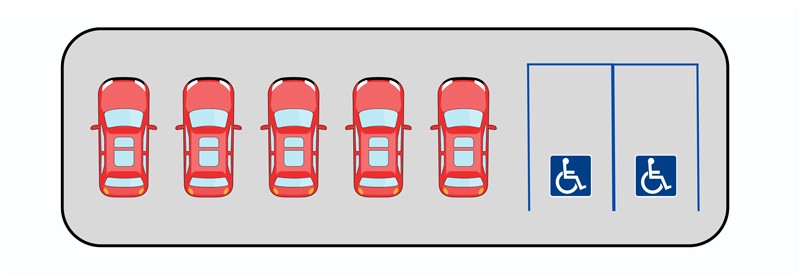
A parking lot of 50 spaces is only required to have 2 accessible spaces, but for every 50 registered vehicles nationally, there are 5 disability plates and placards.
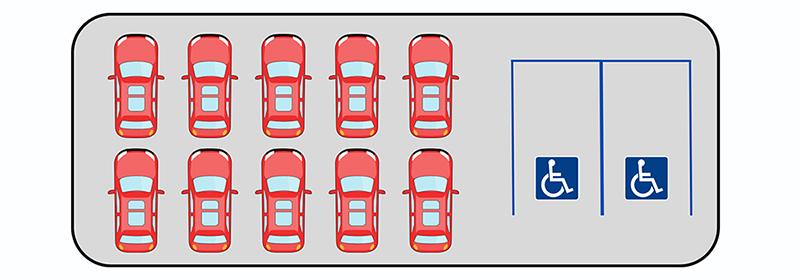
Ten Cars for Two Spots
Indiana: For every 50 registered vehicles, there are 10 disability plates and placards.
Numbers are based on data collected through direct communication with disability placard- and plate-issuing agencies as well as elected officials in 20 states. Across these states, the average proportion of total active disability plates and placards to registered vehicles is 9.66 to 100. In Indiana, the proportion is 19.03 to 100.

Nine Cars for Two Spots
Minnesota: For every 50 registered vehicles, there are 9 disability plates and placards.
Numbers are based on data collected through direct communication with disability placard- and plate-issuing agencies as well as elected officials in 20 states. Across these states, the average proportion of total active disability plates and placards to registered vehicles is 9.66 to 100. In Minnesota, the proportion is 17.17 to 100.

Seven Cars for Two Spots
North Carolina, Ohio, and Wyoming: For every 50 registered vehicles, there are 7 disability plates and placards.
Numbers are based on data collected through direct communication with disability placard- and plate-issuing agencies as well as elected officials in 20 states. Across these states, the average proportion of total active disability plates and placards to registered vehicles is 9.66 to 100. In North Carolina, the proportion is 13.30 to 100. In Ohio, the proportion is 12.96 to 100. In Wyoming, the proportion is 13.92 to 100.
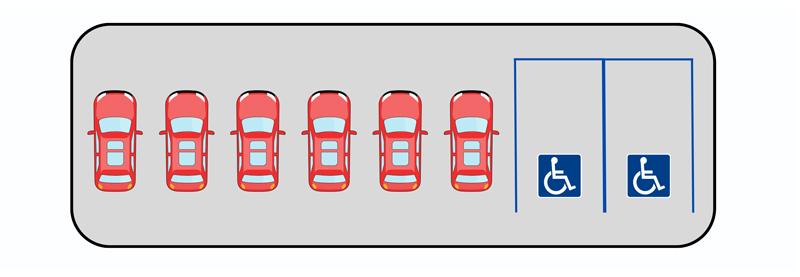
Six Cars for Two Spots
West Virginia: For every 50 registered vehicles, there are 6 disability plates and placards.
Numbers are based on data collected through direct communication with disability placard- and plate-issuing agencies as well as elected officials in 20 states. Across these states, the average proportion of total active disability plates and placards to registered vehicles is 9.66 to 100. In West Virginia, the proportion is 10.53 to 100.
Five Cars for Two Spots
Hawaii, Illinois, New Hampshire, Pennsylvania, Wisconsin: For every 50 registered vehicles,there are 5 disability plates and placards.
Numbers are based on data collected through direct communication with disability placard- and plate-issuing agencies as well as elected officials in 20 states. Across these states, the average proportion of total active disability plates and placards to registered vehicles is 9.66 to 100. In Hawaii, the proportion is 9.01 to 100. In Illinois, the proportion is 8.31 to 100. In New Hampshire, the proportion is 8.71 to 100. In Pennsylvania, the proportion is 8.55 to 100. In Wisconsin, the proportion is 9.34 to 100.
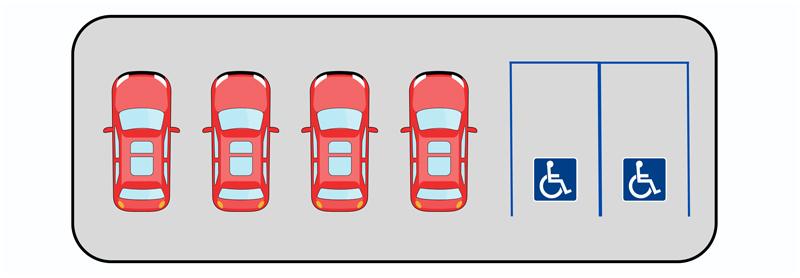
Four Cars for Two Spots
Alabama, California, Illinois, Massachusetts, Michigan, New Mexico, North Dakota, Rhode Island, South Dakota: For every 50 registered vehicles, there are 4 disability plates and placards.
Numbers are based on data collected through direct communication with disability placard- and plate-issuing agencies as well as elected officials in 20 states. Across these states, the average proportion of total active disability plates and placards to registered vehicles is 9.66 to 100. In Alabama, the proportion is 7.71 to 100. In California, the proportion is 7.81 to 100.In Massachusetts, the proportion is 6.79 to 100. In Michigan, the proportion is 6.51 to 100. In New Mexico, the proportion is 6.29 to 100. In North Dakota, the proportion is 7.18 to 100. In Rhode Island, the proportion is 7.47 to 100. In South Dakota, the proportion is 6.73 to 100.

Three Cars for Two Spots
Iowa: For every 50 registered vehicles, there are 3 disability plates and placards.
Numbers are based on data collected through direct communication with disability placard- and plate-issuing agencies as well as elected officials in 20 states. Across these states, the average proportion of total active disability plates and placards to registered vehicles is 9.66 to 100. In Iowa, the proportion is 5.98 to 100.
Join Our Accessible Parking Working Group
This working group advocates for improved accessible parking and increased awareness and education regarding common barriers encountered by the disability community. It also examines accessible parking laws and regulations throughout the United States. Click here for more information. Join us!