Like many of us, my spinal cord injury came into my life with a bang – a car accident, to be exact.
My first encounter with a therapist post-SCI was in the ICU when I was hopped up on a large amount of morphine. I remember her asking me how I dealt with stress in my life. I told her that I saw joy as a cloud, and whenever I felt down, I could just reach out and pull a little piece of joy off that cloud for myself.
Yeah, those drugs were strong.
The next time we saw each other, I was no longer on the morphine drip. I was coming back into my body and into my new normal of being paralyzed, the harsh edges of trauma no longer cushioned by chemistry.
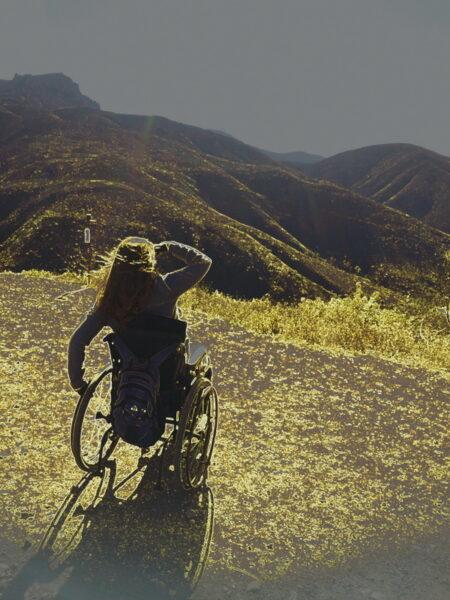
Since we had last met, I could see in the therapist’s face that we were now worlds apart. My internal emotional landscape had experienced a seismic shift while her own had remained relatively stable. I felt my face burn hot with envy. When she saw my distress and cheerily reminded me of my “cloud of joy” that I could pull from, that burning envy became a boiling bitterness, and I felt myself shut down.
I also felt a strange sense of violation, as if in ICU, she had seen me in a vulnerable, intoxicated state and was now expecting me to access that same space. The only clouds I could see at that point were storm clouds gathering on the horizon. A hurricane of grief was coming, and there was no joy in it.
I don’t remember seeing her again after she left my room that day. It’s possible I did and have simply blocked it out. Many of my memories of this time are missing, altered, or out of order. What I do know is that my encounters with her did not make me feel great about rolling out the welcome mat for future therapists.
Trying Out Therapy
Over the past 30 years, I’ve been on a journey to find ways to improve my mental health. I’ve sought to find some combination of professional help, medication, and various self-administered techniques that could alleviate the depression, anxiety and detachment that has followed me to some degree or another ever since I was a child.
When I became spinal cord injured, it was like a double whammy for me. Dealing with SCI/D on its own can be difficult, and the addition of mental health issues made my personal post-SCI life even more challenging.
In 2002, two years post-SCI, I sought out another therapist. My relationships had been suffering since the accident, in part due to my worsening mental symptoms, and I could tell my partner was pulling away. I was also experiencing intense insomnia and anxiety attacks.
Natalie was a therapist several of my family members had seen over the years and had highly recommended. She had a physical disability that caused her to walk with a severe limp since childhood. I assumed that since we both had disabilities, she would be a good fit for me. However, this was not the case, and I left several months into seeing her. Around 2004, I started going to another therapist. Emily was hard of hearing. I didn’t find much help with her, either.
At that point, I thought the problem might lie with my brain chemistry. I went to my doctor, who put me on an anti-depressant with no other professional support.
While I felt a small reduction in anxiety, my interpersonal relationships and overall life experience did not improve by much. In fact, my partner and I ended our relationship.
By then, I had become discouraged. If I couldn’t find help with therapists who, like me, were women who also dealt with impairments and if I couldn’t get my life together with the help of medication nor move on from the traumas of my past, then perhaps the fault was simply my own.
Couldn’t Hold it Together
I spent the next few years white-knuckling my way through life without professional help, stumbling from one day to the next while barely keeping my head above water. I started another unhealthy romantic relationship and began to isolate myself socially.
I didn’t yet know that I was suffering from post-traumatic stress disorder as my symptoms weren’t presenting themselves like they do in the movies. I wasn’t having flashbacks of my car accident or waking up from nightmares about it as a sweaty, screaming mess. I was, however, experiencing many lesser-known symptoms of PTSD that included emotional numbing, being easily startled, outbursts of aggression and feeling constantly on guard. (Please see this link for a fuller list of signs and symptoms of PTSD.)
Even though I did notice a sharp change in my personality post-SCI, I assumed that it was because I wasn’t strong enough to get over what had happened to me in the past. Perhaps I had just become a jumpy jerk, like a drunken chihuahua with a chip on its shoulder.
It wasn’t until 2007 that I started looking into therapy again. I had tried holding my life together on my own, but two things happened in quick succession that broke me down to the point where I knew I couldn’t do it alone anymore. First, the romantic relationship I was in became abusive. Second, two weeks after the abuse began, my father died suddenly.
Giving Therapy One More Chance
This one-two punch, piled on top of my SCI trauma, landed me in the reception office of my local hospital’s mental health unit. I asked if any female therapists were available. I was told no. The receptionist offered me an appointment with one of the male therapists. Sensing my hesitation, she said softly, encouragingly, “He’s very gentle.” That was the beginning of my relationship with the best therapist I’ve ever had.
Yes, John was a man, and I was a woman. Yes, he was nondisabled, and I was disabled. But John repeatedly put my concerns that these differences would constitute too much of a fundamental gap between us to rest over the years.
My therapeutic relationship with John would never have worked for me if he hadn’t been so willing to listen to me from a place of vulnerability and an eagerness to learn. Unlike my previous therapists, he didn’t assume that he knew how I felt or how my life worked as a person with a disability.
Even though John was helping to guide me, he was aware that he had blind spots regarding my life as a wheelchair user. If he ever gave me advice that I felt was off-base or wouldn’t work in my life — we all know how complicated SCI/D can make things — he was willing to listen to the reasons why and not assume that I was trying to make things difficult on purpose.
Working with John brought me an incredible amount of growth. I learned how to regulate my emotions and be more compassionate toward myself. He helped me explore how my family dynamics affect how I conduct my life. Yet there seemed to be certain painful, immovable cores scattered within me, emotional blind spots I couldn’t bring into focus, and strange sensory symptoms I couldn’t explain. It wouldn’t be until many years after starting my work with John, sometime during the first year of the COVID lockdown, that I would find out that PTSD caused a lot of these elusive feelings.
Inside a Flashback
Like many people did when COVID first hit, I used my excess housebound time to get things organized. One day, while rummaging through a deep corner of my closet, I found a box of old writings from just a few years after the car accident that caused my SCI. In these was an account of my time in ICU that detailed certain things I had long forgotten.
As I began to read, my initial curiosity turned to discomfort and fear as my own words started to unlock memories that my brain had deliberately walled off, as a mother’s brain might erase the memories of the intense pain of giving birth. I quickly shoved the papers back into the box and continued tidying up.
I don’t remember what precipitated the next night’s experience. All I knew was that one moment, I was lying in my bedroom listening to a new album, and the next, I felt like I was waking up in ICU from my spinal fusion surgery 20 years prior.
My breathing became shallow; my heartbeat rabbit-quick, eyes darting back and forth. I grimaced and gripped my head in anguish as I stared at the ceiling, feeling the breathing tube taking up my throat and my neck stiff, head held frozen in traction. I was in my bedroom, looking at my ceiling, yet also in the hospital recovery room – as if the hospital was a visual and mental film overlay. As the music kept playing in my bedroom in real-time, the flashback showed my then-fiancé mouthing the words I love you to me as he stood by my bedside and how I blinked back three times, unable to speak due to being intubated.
I began to hear gasping noises and realized that I was hyperventilating. Thankfully, at that point in my life, I had had enough anxiety attacks to know when one was ramping up. My autopilot kicked in, and I began to slow my breathing deliberately. From some dark recess of my mind, I recalled a technique I had read regarding how to pull yourself out of a PTSD flashback: use something to anchor yourself to the present.
Underneath the overlay of the sounds of my flashback – the beeps of the hospital machines, the hive-like murmurs of the medical staff – I could still hear the music playing in my bedroom. I focused on the song (32.22 by Childish Gambino) and said out loud, “You are listening to this song in 2020. It can’t be 2000 because this album came out in 2020.” I repeated this until the sounds of the year 2000 began to fade. Only once my mind was fully back in the present did I finally feel safe enough to start crying.
A Targeted Approach
Although that night was painful, I’m glad it happened because it finally convinced me that I, without a doubt, did indeed have PTSD. I began seeing another therapist, Kristin, who specialized in trauma therapy. While John taught me how to be kinder to myself and live each day in a healthier way, the type of therapy I was doing with him was cognitive behavioral therapy. Often called “talk therapy,” it wasn’t the right tool for sorting out PTSD.
Working with Kristin, I learned that what I experience is actually C-PTSD, or Complex Post Traumatic Stress Disorder. C-PTSD occurs when a person is exposed to long-term trauma, while PTSD involves a single traumatic event. Long-term traumas can include situations such as domestic violence, childhood abuse, war, or even medical trauma. C-PTSD shares several symptoms with PTSD and adds shame, feelings of worthlessness, and difficulty in forming meaningful relationships.
Since it was during the time of strict quarantine, I had to attend my sessions with Kristin fully online. EMDR therapy, or Eye Movement Desensitization and Reprocessing, is a targeted technique used to treat PTSD. EMDR can seem strange when you first learn how it’s performed. To a fly on the wall, it looks like two people sitting across from one another. Person A is told to bring up a memory over and over while watching person B move her hand back and forth. Yet, there is important work being done.
Unsticking the Brain
In essence, EMDR works like this: When we sleep, we enter REM – rapid eye movement – stages, which is when we dream. During these stages, our brain processes memories. However, when we go through trauma, traumatic memories can get “stuck” in a certain part of our brain and are unable to be properly processed by our REM sleep. Those memories crop up as PTSD symptoms in our everyday lives because they are not stored away properly.
EMDR therapy uses back-and-forth eye movements that mimic how our eyes move during REM sleep to help “unstick” those memories so that they can be properly stored and processed. It’s as if the traumatic memory is a fence post sunk deep into hard-packed ground, and the eye movements are the back-and-forth pushing and pulling to uproot that post. (For a more detailed and accurate explanation of how EMDR works, check out this page at EMDR Sydney Therapy.)
I’ll admit I was skeptical at first that EMDR would work. Instead of me watching Kristin’s hand, she had an EMDR program. She would have me watch a circle move back and forth across the screen as she remotely guided me through my memories again and again.
It was sometimes incredibly difficult as if that fencepost memory was wrapped in barbed wire or would never budge. I kept at it because, after a few months, I noticed what I can only describe as space being created in my brain. It was as if parts of my mind were becoming more organized, like that deep corner of my closet where I found those old ICU writings.
Here and Now 
I was only able to see Kristin for a year due to insurance reasons, but those sessions helped take the sharp edge off my C-PTSD symptoms. I stopped ruminating over the early, grief-filled years of my SCI, I became more emotionally vulnerable, and I became less angry overall. I haven’t had another flashback. But I still have work to do. This chihuahua is still jumpy.
I still see John regularly. I’ve come to a place where I’ve accepted that my mental health issues won’t be “cured” but need to be managed, just as my SCI does. And just like SCI, there are ebbs and flows to this care. Sometimes, a heavy hand is needed to keep me from capsizing. Other times, it only takes a light touch to keep me balanced.
I don’t always get it right, and every now and then, a storm rolls in, but that’s OK. Even in the gathering of storm clouds, there is sometimes great beauty.
Find a virtual or in-person support group on United Spinal’s Peer Support Group page. Contact our Community Support team for more information about all United Spinal’s chapters and programs. Join us by signing up for a free membership. Illustration by Mark Weber.