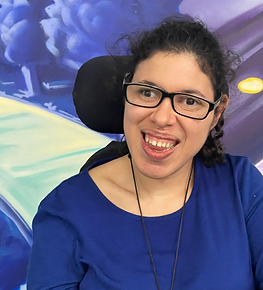
United Spinal Association member Cristina Cortez has taken time from her book tour in Central America to share her journey to becoming a published poet. Her work weaves together all elements of her identities as a bilingual Salvadorian-American with cerebral palsy who uses a power wheelchair and has a deep connection to Indigenous cultures. We hope you enjoy getting to know Cristina and her work as much as we do.
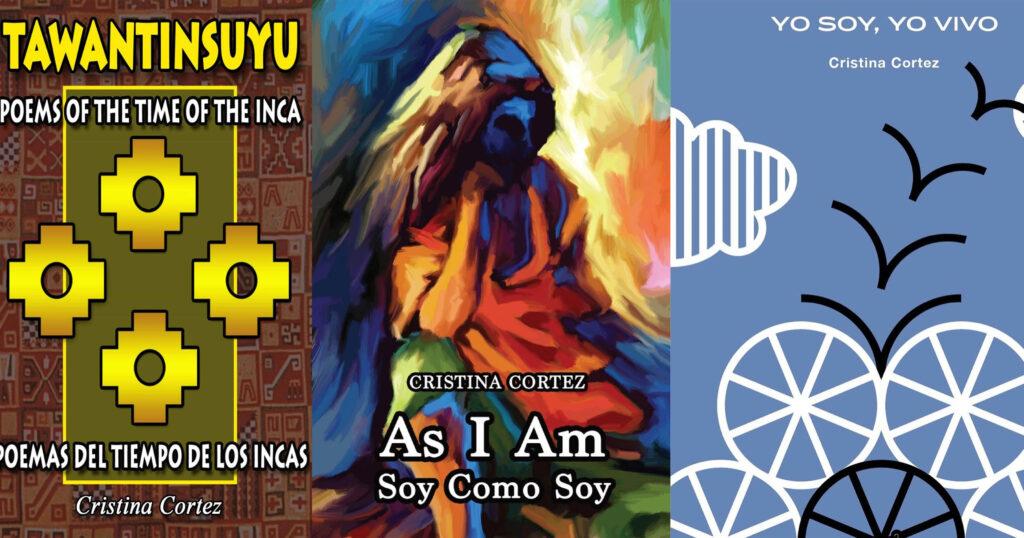
It’s been five years since I launched my author career, and in that time, I have published three books. Each has been key to my development as an advocate for marginalized cultures and disability rights. Take a look.
Giving voice to the permanence of Indigenous culture
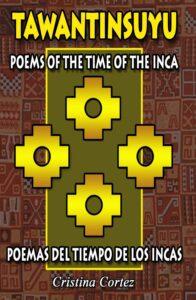
My first venture into publishing was Tawantinsuyu: Poems of the Time of the Inca, a bilingual poetry collection celebrating the history of Perú and its indigenous people. While I could have published a disability-themed project, I chose to start off with a collection of historical poems to assert that I am not a disabled author. Rather, I am an author who happens to have a disability with a diverse set of literary interests.
Tawantinsuyu: Poems of the Time of the Inca begins with the arrival of the first indigenous peoples to the region and ends with the rise and fall of the Incan Empire. In the poems, the historical sites seek to tell the story of the people who built them. By letting the monuments speak, I am giving a voice to the permanence of indigenous culture in the region. I use this technique to create a counter-narrative to the Eurocentric history of the American continent.
The direct and outspoken tone of the counter-narrative is exemplified in the poem “Coricancha” when the ancestral temple of the city of Cuzco declares:
the spaniards built a church to their god to cover up the past.
but i still stand.
an earthquake crumbled their church
but i still stand (35)
The poems recount historical events from the indigenous perspective and are written in a Gothic mode —dispensing with conventional stylistic and grammatical rules whenever possible and appropriate. This stresses the continued relevance of indigeneity and, by extension, the American continent as a whole.
Tawantinsuyu: Poems Poems of the Time of the Inca was released as a bilingual edition. It was important to me that my poems be translated into Spanish so that the material could be accessible to readers in the Latin American community. I am glad my publisher from Books&Smith respected and upheld my vision for the book.
The final product is the result of a team of collaborators, including fellow authors who served as editors of previous drafts, the translator, the cover designer, and the official editor and publisher. Tawantinsuyu: Poems of the Time of the Inca is a book that deals with overarching themes of indigeneity, reconciliation, heritage, identity, and diversity.
Meeting fellow Central American poets and editors
After releasing Tawantinsuyu: Poems of the Time of the Inca, I was ready to publish a second book. But the problem was choosing whether to continue with my historical poetry collection or turn to my disability advocacy work. I was stumped. Which one was best? In what direction or directions should I take my writing and career?
In the midst of dealing with these questions, a fellow poet called me and told me that some Central American poets and editors would be coming to visit him, and he wanted to invite them to my house for dinner so they could meet me and get to know my work. I agreed.
The night of the dinner came, and as the conversation started to flow, each of the editors told me about their small presses and publishing interests. Two of them were from Honduras and were open to publishing anything a writer had to offer. The other was based in El Salvador and interested in publishing work by underrepresented women. During the dinner, I read some of the poems that would appear in my second book. While the reaction to my reading was reserved, the dinner ended on a positive note that we would all be open to the possibility of working together in the future.
After weighing the publishing options, I chose to open a conversation with the editor of Editorial Ojo de Cuervo from El Salvador. In our first conversation, Susana Reyes said she was not interested in hearing project pitches. Instead, she wanted to see the work behind them. Liking her forwardness, I agreed. Reyes then tasked me with prepping all my works in progress and printing them out so she could evaluate them and size up my career possibilities.
Choosing my author path
During the evaluation of my writing, Reyes asked me about the themes of my work as she read poem after poem. I said the themes were identity, past, dreams, disability, history, mythology, nature, travels, etc. As I identified them, she put the poems into distinct piles. There were seven piles.
Now, with these piles, Reyes asked me what I wanted to do with my work: be a stand-alone author with books few and far between or a career author with consistent releases.
I answered: career author.
Satisfied with my answer, Reyes said, “Well then, if that is the case, I would like to work with these poems. There is potential in them, and there is a book in here.” She pushed the two biggest piles to me. They were the identity and disability poems. As I looked through the collection that Reyes chose, they included some of my earliest poems about self-discovery and someone learning to claim her disabled body as part of her assertive identity.
I arranged the pieces, and this resulted in a personal and direct poetry collection about growing up and being a person with a disability with a confident identity. I passed the emerging book over to her. She looked at the collection and said it was one she could get behind, but she said she only worked with books written in Spanish.
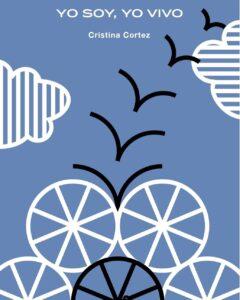
Emboldened by the possibilities of the new book, Reyes and I started to workshop the translations of the poems, and over the next few days, we produced the manuscript for my second book, Yo soy, yo vivo.
With the manuscript in hand, we discussed the potential impact of the book and the release and promotional strategy. Ojo de Cuevo will distribute the book locally in El Salvador and me through Amazon KDP in the U.S.
Months later, Reyes asked me if I would be willing to do a Book Tour in Central America, and I answered yes. The Yo soy, yo vivo Book Tour in Guatemala & El Salvador was slotted for July 13-27, 2023. The book tour was a success, enjoyable and stunning but also demanding.
This career-shifting book tour would hurl me headlong into new spaces. It showed me that my work had the potential and power to open a dialogue about social justice.
The book tour made me confront the brutal reality that for people with disabilities, the right to inclusion and accessibility isn’t always a given. Please see the follow-up post about the book tour for an in-depth retrospective on the pleasures and challenges the experience afforded me.
As I Am / Soy Como Soy
Following the successful book tour for Yo soy, yo vivo, I released its bilingual counterpart As I Am / Soy Como Soy. This book is my most personal and direct poetry collection about growing up and being a person with a disability who developed a confident identity.
The poems are social-justice-focused, diverse, tender, and intently break out of the margins of convention. In this book, I deliberately use different literary and experimental techniques that make the poems flow together in unexpected ways, weaving, ebbing and oscillating from one to the other. The tonal distinctiveness and dexterity of the book are most evident in the poem series titled “In-Capacity,” and this is seen in poem “XIV.”
XIV
When it comes to disability,
people often see the limit
as the definition of it.The limitation is only the beginning of new possibilities
that exist beyond that. The limitation is the point
of origin. The present is the starting point of the future.A person is a powerhouse of energy
waiting to be unleashed
to surpass the limitations of life and live abundantly.A person has to believe in the self as limitless,
and know that the cup of opportunity overflows,
and the honey that comes
from it is endless.The road of life is rocky,
but perseverance makes it smooth.
It may wind and twist and turn
but becomes easier with each step. (59)
In “In-Capacity” and As I Am / Soy Como Soy as a whole, I use quotes from Gabriel García Márquez, Helen Keller, Stephen Hawking, Ludwig van Beethoven, W. B. Yeats, and others to discuss themes of identity and self-growth.
Weaving together disability, bilingual narratives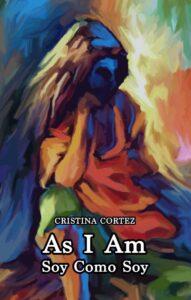
I released As I Am / Soy Como Soy because people with disabilities sometimes don’t have positive or strong role models to show us that a fulfilling life can be achieved. The quotes are combined with my thoughts to illustrate that the disability community is made up of different people.
My poems use the voices of other individuals with or without disabilities to present a collective. An isolated quote represents the life of a person who “suffered” or lives with a disability. But collectively, the poems join together these voices, and the voices, in turn, converge into the voice of a unified speaker who declares: You can put me in the margins, but I will not be marginalized, my life is worth living.
As I Am / Soy Como Soy redefines the meaning of what it is to be someone who lives with a disability despite always being under the lens of discrimination simply for being different.
To underscore its literary and disability-empowered strengths, As I Am / Soy Como Soy was released as a bilingual edition on July 30th, the week of the ADA’s 33rd anniversary. The book features a forward by Rhina P. Espaillat, writer, poet, and translator; a literary analysis by Edgar Smith, poet and editor; cover design and artist statement by Hector Escalante Rivera; and a back cover review by Jason Fogler, Ph.D., Director of Leadership Education in Neurodevelopmental and related Disabilities at Boston Children’s Hospital and assistant Professor of Pediatrics and psychology at Harvard Medical School. These collaborations bolster the book as a critical literary edition.
As I Am / Soy Como Soy, in its multidimensionality, is meant to continue to foster the importance of the independent living movement for people with disabilities. Moreover, the book can serve as an inspiration and motivational text for any and all readers interested in personal growth, and further fuel the fight for disability advocacy and full inclusion.
Tawantinsuyu: Poems of the Time of the Inca, Yo soy, yo vivo, and As I Am / Soy Como Soy have each been vital to my development as an advocate for marginalized cultures and disability rights. The books address themes of heritage, identity, and diversity. To date, I am working on the follow-up to As I Am / Soy Como Soy, a memoir titled Un-bound: Living with a Disability, and a haiku travelogue titled Poems from the Road in an effort to continue my work as an advocate for social justice.
There are plenty ways to become involved with United Spinal. Join us and find your chapter, explore our peer support network, or choose one (or more) of our working groups to make a difference in your community.