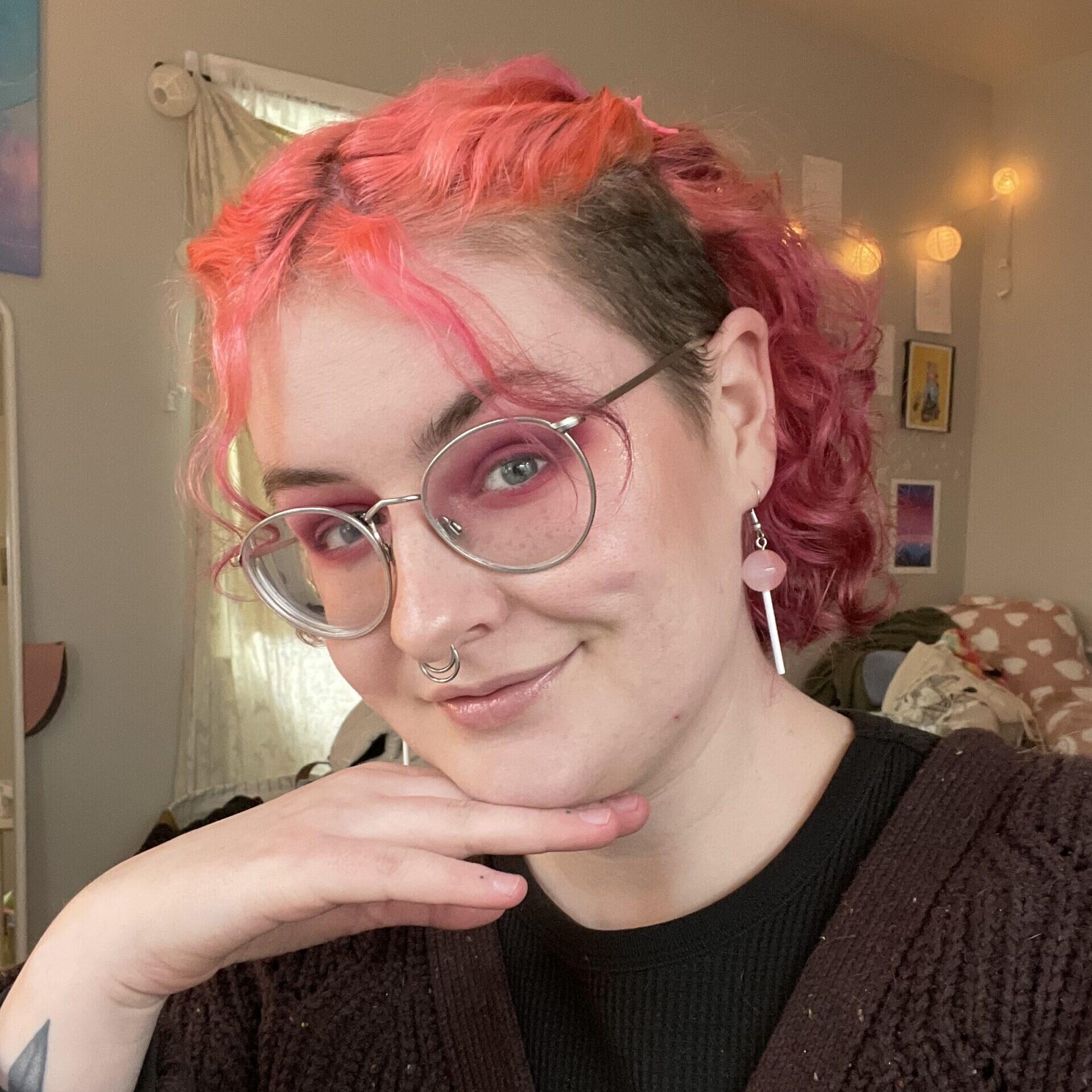
- United Spinal member Em Kase shares how it feels to be a wheelchair user excluded from queer spaces.
- Em demonstrates how spaces and events are not inclusive or intersectional if they are inaccessible to wheelchair users.
- This includes Pride events in businesses with steps — and don’t get us started on grassy slopes and inaccessible sidewalks!
I came out as queer back in 2014, so I had a few years of experience with pride events before I became physically disabled in 2020.
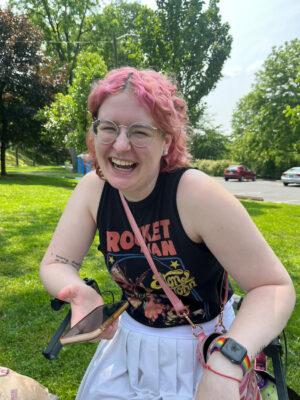
Going to pride as a nondisabled, newly-out queer person was one of the most joyful and impactful moments of my queer journey. I met incredible people with so many different backgrounds and intersectional identities. But the one marginalized group I rarely saw at these pride events was disabled people. Though at the time, I don’t think I was consciously aware of the absence of the queer disabled community. After all, I was still able-bodied and socialized in a society that doesn’t talk about disabled people in any setting, let alone at pride events.
So, with my rainbow paraphernalia in hand, I celebrated with the queer community to the fullest extent.
Fast forward six years to 2020.
We were at the beginning of a global pandemic, fighting a virus that disproportionately kills disabled and chronically ill people. There was no pride event to be had in 2020 for anyone.
My Personal Intersection Between Queer and Disabled Begins
September 2020 arrived, and I started experiencing multiple neurological and musculoskeletal symptoms: dislocations of my joints, chronic pain, high heart rate and pre-syncope symptoms, chronic muscle spasms and brain fog.
I saw at least a dozen different specialists, and no one had any good answers for me.
“It’s just anxiety.”
“You’re so young; it’s probably just growing pains.”
“All your bloodwork is normal, so it must all be in your head.”
I started using forearm crutches to help me walk so I didn’t fall or put too much pressure on the joints in my legs and cause dislocations. Today, I also use a manual wheelchair.
In 2021, I finally had some answers as I was diagnosed with postural orthostatic tachycardia syndrome, mast cell activation syndrome, and later in the year, Ehlers-Danlos syndrome.
Cases of Sars-Covid 2 started to decrease as we emerged from a winter of increased infection, hospitalization, and death. It looked like pride events were finally happening again!
With My Wheelchair Came the Loss of Local Pride
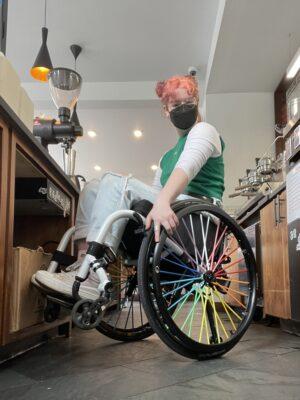
As I looked at all the dates and locations for Pride events from my newly disabled perspective, I realized none of those venues and events were accessible.
Pre-Pride bar crawls were at bars with stairs that I couldn’t safely climb without my heart rate spiking. Drag brunches were in restaurants without accessible entrances, and all the main pride events were on grassy hills or inaccessible streets. There was no access to accessible toilets or disability-informed first aid.
Worst of all, none of these events required masks.
As a newly disabled and high-risk individual, seeing all my nondisabled queer friends walking around those events unmasked, possibly transmitting a virus that disproportionately killed people like me, was simultaneously heartbreaking and infuriating.
For a community that touted slogans of “all are welcome” and “the future is intersectional,” the complete disregard for disabled and chronically ill queer people was, and still is, an act of everyday ableism.
Wheelchair Inaccessible Pride Events are Unsafe Spaces
“If your pride events are inaccessible, they are performative and not about queer liberation. Access is the minimum. If pride is not for all of us, it is merely just a party for those with privilege.”
— Dandelion Hill
I wanted to be able to join my fellow queer friends at Pride. I wanted to have fun and support local queer artists and vendors. I wanted to be able to feel safe in my queer community. And as an able-bodied person, I could have all those things.
Becoming disabled during a global pandemic, in which so many nondisabled people have shown their blatant disregard for disabled life, was, and still is, terrifying. But I was still hopeful that maybe I’d be able to safely connect with my community at Pride.
I have been nothing but disappointed.
Venues are still physically inaccessible, with stairs and steep inclines, no shaded areas for people with heat intolerance, and only one or zero accessible bathrooms. And none of the events require masks.
These things combined show me, and the rest of the disabled queer community, that we are not welcome. We are not safe here. We are an afterthought.
Please contact our Community Support team for more information about United Spinal’s chapters and programs. Join us by signing up for a free membership. To support our mission, donate here.